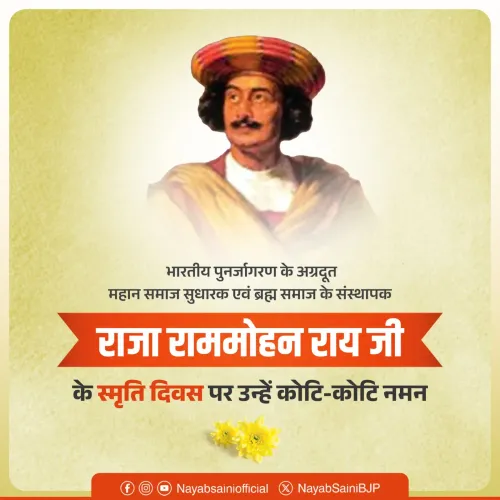
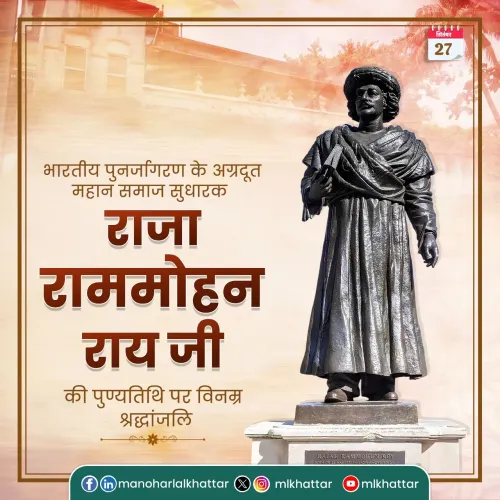
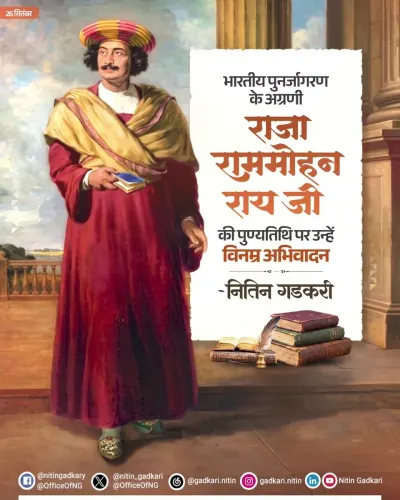
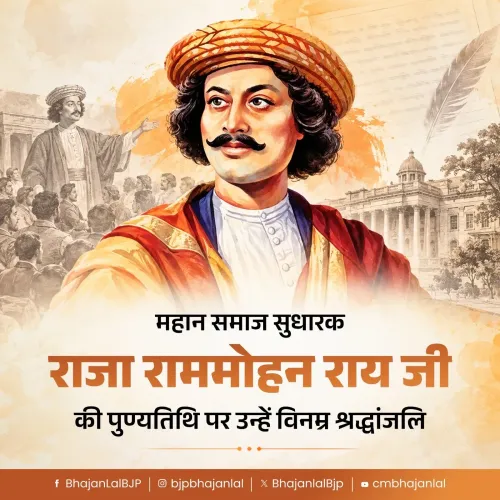
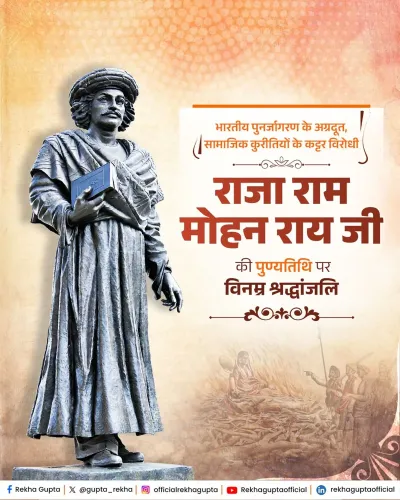
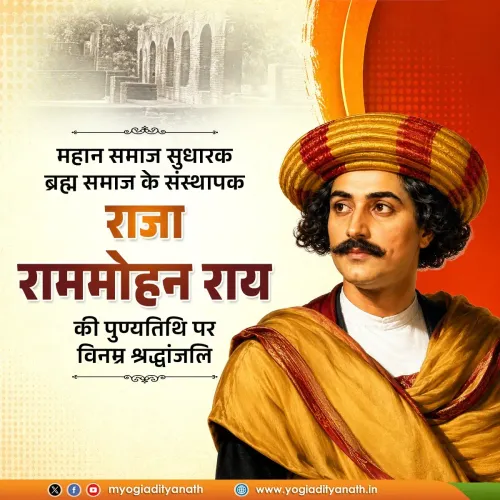
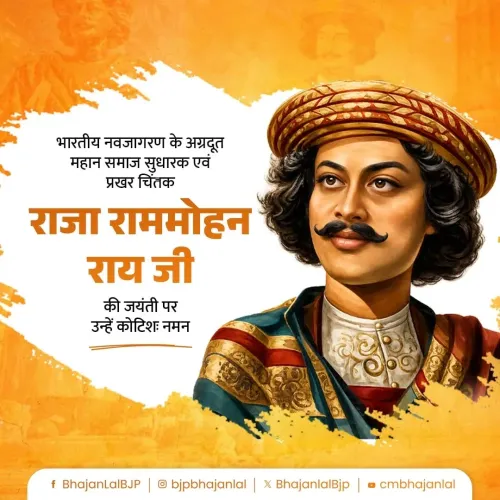
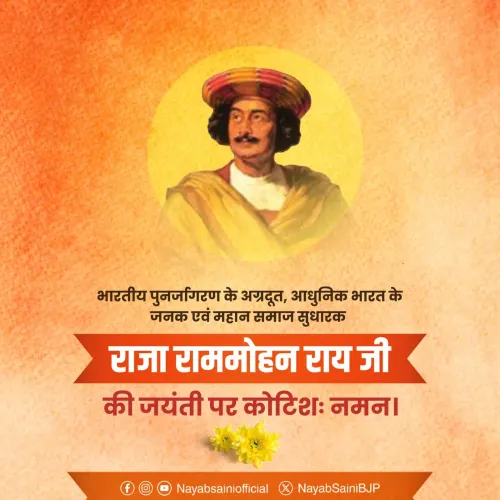
Lalan Singh pays tribute to Raja Ram Mohan Roy on death anniversary

Synopsis
On Raja Ram Mohan Roy's death anniversary, Union Minister Lalan Singh paid homage to the 19th-century reformer, hailing his fight against sati and social evils and calling for a renewed commitment to an equitable, rational and progressive India.
Key Takeaways
Lalan Singh posted a tribute to Raja Ram Mohan Roy on his death anniversary, 27 September 2026 .
Roy is credited with securing the ban on sati through the Bengal Sati Regulation of 1829 .
Roy founded the Brahmo Samaj in 1828 , a landmark monotheistic reform movement.
Singh called Roy the 'father of the Indian Renaissance' and urged a societal commitment to equality and rationalism.
No new government programme or scheme was announced alongside the tribute.
Nearly two centuries after he dismantled one of colonial India's cruellest social institutions, Raja Ram Mohan Roy still commands a place in the morning posts of India's cabinet ministers. On his death anniversary, Sunday, 27 September 2026, Union Minister for Panchayati Raj and Fisheries Rajiv Ranjan Singh — popularly known as Lalan Singh — offered a written tribute on X, calling Roy the 'father of the Indian Renaissance' and urging citizens to renew their commitment to an equal, rational and progressive society.
Singh wrote in Hindi: 'आधुनिक भारत की नींव रखने वाले राजा राममोहन राय को 'भारतीय पुनर्जागरण का जनक' कहा जाता है' — 'Raja Ram Mohan Roy, who laid the foundations of modern India, is called the father of the Indian Renaissance.' He added that the nation would 'always remember his struggle against social evils and his contribution to building a modern, progressive society,' and closed with a call to resolve, on this anniversary, to build 'an equitable, rational and progressive society.'The reformer who rewrote India's social contract
Raja Ram Mohan Roy was born in 1772 in Bengal and spent his life fighting practices that had hardened into custom. His most consequential campaign ended with the Bengal Sati Regulation of 1829, which banned the immolation of widows — a reform secured after relentless petitioning of the British colonial administration. He also opposed polygamy and child marriage, and championed English-medium education at a time when that was a radical proposition. In 1828, Roy founded the Brahmo Samaj, a monotheistic reform movement that rejected idol worship, caste discrimination and priestly monopoly over religious life. The Samaj seeded a generation of reformers — from Debendranath Tagore to Keshub Chunder Sen — who carried his rationalist flame well into the twentieth century. Roy died in Bristol, England, in 1833, still fighting for India's rights at the imperial court.A September ritual: why ministers mark this date
Roy's death anniversary falls every 27 September, and it draws commemorative statements from across India's political spectrum — a pattern consistent since the republic's early decades. These tributes rarely announce new programmes; their function is to place the speaker inside a lineage of progressive thought and to signal continuity with the reform tradition Roy inaugurated. For Lalan Singh, a senior Janata Dal (United) leader whose party has historically positioned itself around social justice and Bihar's developmental politics, invoking Roy's legacy carries its own resonance — the reformer's core concerns, access to education, dignity for women, the dismantling of entrenched hierarchy, remain live political questions in the constituencies JD(U) contests. The thread Roy pulled in 1829 has never fully unravelled. That is precisely why, nearly 200 years on, it still demands a tug.Point of View
But their ideological framing matters. By invoking Roy's rationalism and egalitarianism, Lalan Singh — a senior figure in Nitish Kumar's JD(U) — places his party within a reformist tradition at a time when questions of caste, gender equity and access to education remain politically salient in Bihar and beyond. The tribute makes no new policy commitment, but the vocabulary it uses — 'equitable,' 'rational,' 'progressive' — is a deliberate positioning signal. Roy's legacy also sits comfortably across communal lines, making him a safe but genuinely resonant anchor for secular-progressive messaging.
NationPress
27 Sept 2026
Frequently Asked Questions
When is Raja Ram Mohan Roy's death anniversary?
Raja Ram Mohan Roy's death anniversary falls on 27 September each year. He died in Bristol, England, in 1833 .
Why is Raja Ram Mohan Roy called the father of the Indian Renaissance?
Roy is given this title for his pioneering campaigns against sati, polygamy and child marriage, his founding of the rationalist Brahmo Samaj in 1828 , and his advocacy for modern education and women's rights — all of which triggered a broader cultural and intellectual awakening in 19th-century India.
What did Lalan Singh say about Raja Ram Mohan Roy?
Lalan Singh described Roy as 'the father of the Indian Renaissance' and said India would always remember his struggle against social evils. He called on citizens to resolve to build 'an equitable, rational and progressive society' in Roy's memory.
What was the Brahmo Samaj and who founded it?
The Brahmo Samaj was a monotheistic Hindu reform movement founded by Raja Ram Mohan Roy in 1828 . It rejected idol worship, caste discrimination and priestly authority, and became a seedbed for subsequent generations of Indian social reformers.
Who is Lalan Singh in Indian politics?
Rajiv Ranjan Singh , known as Lalan Singh, is a senior leader of the Janata Dal (United) and serves as Union Minister for Panchayati Raj, Fisheries, Animal Husbandry and Dairying in the central government.