WII study: Lightning strikes create nursery habitats in Andaman mangroves
Synopsis
A new WII study from the Andaman Islands flips the script on lightning — far from being purely destructive, strikes are creating nursery-like openings in dense mangroves that double seedling density and temporarily boost species richness. The finding has direct implications for how India plans mangrove restoration across its coastline.
Key Takeaways
The Wildlife Institute of India (WII) studied six sites across the Andaman Islands , assessing 20 canopy gaps in each of two age categories.
Lightning-caused gaps range from 270 m² to 2,463 m² and kill trees in a characteristic circular pattern .
Seedling and sapling densities were two-fold higher in new canopy gaps ( 1–6 years old ) than in intact forest.
Plant species richness peaks in newly formed gaps and declines over time due to competitive exclusion by dominant species, chiefly Rhizophora apiculata Blume .
WII recommends long-term monitoring of canopy gaps and species-specific selection for mangrove restoration projects.
The Wildlife Institute of India (WII) has found that lightning strikes in dense mangrove forests of the Andaman Islands are not merely destructive events — they actively create small canopy gaps that function as nursery habitats, boosting plant species richness and structural diversity in the ecosystem. The findings, drawn from a field study across six sites in the Andamans, provide new insights into how natural disturbances shape mangrove regeneration.
How Lightning Shapes the Mangrove Canopy
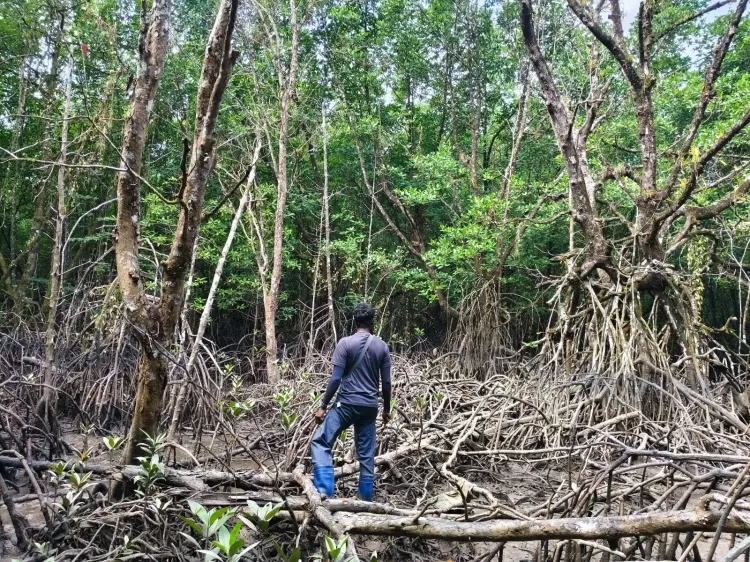
Lightning strikes in mangrove forests typically kill trees in a circular pattern, opening up the dense canopy and exposing the forest floor to increased sunlight. These gaps alter local microclimatic conditions — including light availability, temperature, soil moisture, and nutrient dynamics — compared to surrounding intact forest. The WII study assessed 20 canopy gaps in each of two age categories: New Canopy Gaps (1–6 years old) and Recovering Canopy Gaps (7–15 years old), with each gap paired against a control plot in undisturbed forest. Canopy gap area ranged between 270 m² and 2,463 m².
Key Findings on Species Richness and Recovery
The study found that plant species richness was highest in newly formed canopy gaps and declined as gap age increased — a pattern consistent with competitive exclusion by dominant species. Both seedling and sapling densities were two-fold higher in new canopy gaps than in intact forest. Rhizophora apiculata Blume, a tall stilt mangrove, was the dominant species across all sampling categories. Water temperature increased with canopy openness, while water pH and salinity were not significantly influenced by gap formation.
'Our study shows that the canopy gaps likely caused by lightning disturbance in mangrove forests are acting as a nursery habitat for plant regeneration and enhancing structural heterogeneity in the vegetation. It allows a greater number of plant species to establish in the early gap regeneration stage, but the species richness declines in the later gap successional stage, indicating competitive exclusion by dominant species, which are better suited to the specific microhabitats,' the WII researchers noted.
What This Means for Mangrove Restoration
The researchers emphasise that this understanding of post-disturbance vegetation recovery is critical for ecological restoration planning. Not all species that colonise early-stage gaps survive into maturity, which has direct implications for which species planners should introduce during restoration efforts. 'Our results suggest that only a few species found in early successional stages persist into the mature stage. This highlights the need to select appropriate species for mangrove restoration that suit the specific microenvironment,' the team said.
Notably, the study also establishes baseline data on vegetation structural changes and species diversity across regenerating and intact forest zones — information that was previously lacking for Andaman mangroves specifically.
What the WII Recommends Next
The institute has called for long-term canopy gap monitoring at varying size classes and at fixed year intervals, which it says would provide crucial insight into mangrove succession dynamics. 'Further, long-term canopy gap monitoring at varying size classes and fixed year intervals would provide crucial insight into mangrove canopy gap succession that helps in understanding mangrove recovery, following a disturbance event,' the WII stated. This comes amid growing global concern about mangrove degradation, with the Andaman Islands holding some of India's most intact mangrove ecosystems.
Point of View
Uniform replanting efforts may actually suppress the biodiversity window that disturbance events naturally create. If restoration planners ignore succession dynamics and competitive exclusion, they risk producing monoculture stands that look green on satellite imagery but underperform ecologically. The call for long-term monitoring is correct, but India has a poor track record of funding ecological baseline studies beyond the initial publication cycle.
NationPress
5 Nov 2026
Frequently Asked Questions
What did the WII mangrove study in the Andaman Islands find?
The Wildlife Institute of India found that lightning strikes create canopy gaps in Andaman mangrove forests that act as nursery habitats, with seedling and sapling densities two-fold higher than in intact forest. Species richness peaks in newly formed gaps but declines over time as dominant species outcompete others.
How do lightning strikes affect mangrove forests?
Lightning kills trees in a circular pattern, opening the forest canopy and altering local conditions such as light, temperature, soil moisture, and nutrient levels. These changes temporarily create favourable conditions for a wider range of plant species to establish themselves.
Which mangrove species dominated the study sites in the Andamans?
Rhizophora apiculata Blume, a tall stilt mangrove, was the dominant species across all sampling categories — new gaps, recovering gaps, and intact forest control plots.
Why does this study matter for mangrove restoration in India?
The study shows that only a few species from early successional stages persist into maturity, meaning restoration planners need to select species suited to specific microenvironments rather than replanting uniformly. The WII has recommended long-term canopy gap monitoring to better guide future restoration efforts.
What methodology did the WII use for this study?
The WII assessed 20 canopy gaps each in two age categories — New Canopy Gaps (1–6 years old) and Recovering Canopy Gaps (7–15 years old) — across six sites in the Andaman Islands. Each gap was paired with a control plot in adjacent intact forest, with gap areas ranging from 270 m² to 2,463 m².