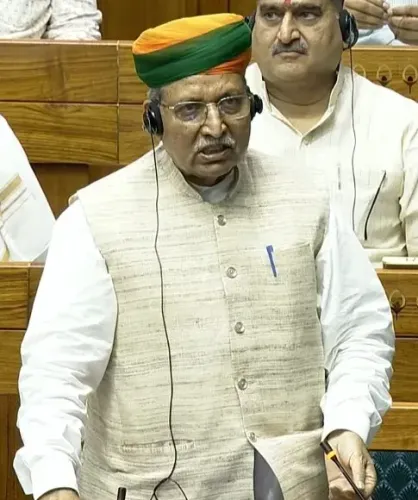
Lok Sabha Passes Bill to Expand SC Judge Strength to 37

Synopsis
The Lok Sabha passed the Supreme Court (Number of Judges) Amendment Bill, 2026 on August 3, raising the apex court's sanctioned judge strength from 33 to 37. Delhi CM Rekha Gupta welcomed the move as a step toward faster, more accessible justice for Indian citizens.
Key Takeaways
The Lok Sabha passed the Supreme Court (Number of Judges) Amendment Bill, 2026 on August 3, 2026 .
The bill raises the Supreme Court's sanctioned judge strength from 33 to 37 (including the Chief Justice).
The 2019 amendment had previously raised the strength to 34; this is the next legislative step in expanding judicial capacity.
Delhi CM Rekha Gupta hailed the bill as foundational to a strong democracy and faster resolution of constitutional matters.
The bill must still clear the Rajya Sabha and receive presidential assent before taking effect.
The Collegium will then need to recommend candidates to fill the four new judicial posts.
India's apex court is about to get bigger — and Delhi Chief Minister Rekha Gupta says that matters for every citizen waiting on justice. The Lok Sabha passed the Supreme Court (Number of Judges) Amendment Bill, 2026 on Monday, August 3, 2026, raising the sanctioned strength of the Supreme Court of India from 33 judges to 37 — a move framed as a direct assault on the country's stubborn backlog crisis.
Posting in Hindi, CM Gupta wrote: 'सशक्त न्याय व्यवस्था, सशक्त लोकतंत्र की आधारशिला है' — ('A strong justice system is the cornerstone of a strong democracy') — calling the bill a step toward 'swift and accessible justice for citizens' and faster resolution of constitutional matters.From 34 to 37: The Numbers Behind the Reform
This is not the first time Parliament has turned to judge-count expansion as a pressure valve. The Supreme Court (Number of Judges) Amendment Act, 2019 raised the sanctioned strength to 34 — the Chief Justice plus 33 judges — to address a rising caseload that had been building for years. The 2026 bill adds four more posts, bringing the total to 37 judges including the Chief Justice.
India's Supreme Court has long operated under the weight of high pendency — constitutional benches, civil appeals, criminal matters, and Article 32 petitions pile up faster than they are disposed. More judges, the logic goes, means more benches, more hearings, and faster outcomes for litigants who can wait years, sometimes decades, for a final word.
A Pattern of Incremental Judicial Expansion
Successive governments — across party lines — have used legislative amendments to expand judicial capacity rather than restructure the appointment pipeline. Alongside judge-strength increases, complementary reforms have included fast-track courts for specific offence categories and e-filing systems to reduce procedural friction. The 2026 amendment follows that same institutional playbook: more seats at the bench, without touching the Collegium's role in filling them.
The real test now shifts to the Rajya Sabha, where the bill must pass before receiving presidential assent. After that, the Collegium will need to recommend candidates for the four new posts — a process that carries its own timelines and political texture. Until those seats are filled, the expanded strength exists on paper.
Four new judges won't dissolve decades of pendency overnight. But each additional bench is one more forum where a citizen's case can finally be called.
Point of View
Broadly popular, and genuinely responsive to a real problem. By framing judicial expansion as a democracy-strengthening measure, the BJP government positions itself as a steward of rule-of-law without wading into the more contentious territory of judicial appointments or the Collegium system. The four additional posts are modest relative to the scale of pendency, but the political signal is clear: the executive is willing to legislate capacity even when structural reform remains off the table. The harder question — whether the Collegium will fill these seats swiftly — will determine whether the bill becomes a meaningful reform or a well-intentioned number on paper.
NationPress
17 Sept 2026
Frequently Asked Questions
What is the Supreme Court (Number of Judges) Amendment Bill, 2026?
It is a parliamentary bill passed by the Lok Sabha on August 3, 2026, that raises the sanctioned strength of Supreme Court judges from 33 to 37, aimed at reducing case pendency and improving access to justice.
How many judges will the Supreme Court have after this bill?
Once enacted, the Supreme Court will have a sanctioned strength of 37 judges, including the Chief Justice of India — up from the previous 34 (Chief Justice plus 33 judges).
Why is India increasing the number of Supreme Court judges?
India's Supreme Court faces a large backlog of pending cases. Adding more judges allows more benches to sit simultaneously, speeding up hearings on constitutional, civil, and criminal matters.
What happens next after the Lok Sabha passed the bill?
The bill must be passed by the Rajya Sabha and then receive presidential assent to become law. After that, the Supreme Court Collegium will recommend candidates to fill the four new judicial posts.
What did Delhi CM Rekha Gupta say about the Supreme Court judges bill?
CM Rekha Gupta welcomed the bill's passage, stating that 'a strong justice system is the cornerstone of a strong democracy' and that increasing judge strength will accelerate disposal of pending cases and make constitutional hearings more effective.