Maharashtra to launch govt recruitment drive via competitive exams amid paper leak protests
Synopsis
Amid paper leak protests, Maharashtra CM Devendra Fadnavis has announced a major government recruitment push via competitive exams, with a return to OMR sheets and an encrypted e-question bank that keeps even question writers in the dark. The V. Radha Committee's final report will determine whether the state can finally build a credible, leak-proof hiring system.
Key Takeaways
CM Devendra Fadnavis announced a large-scale government recruitment drive through competitive exams on 22 September , amid paper leak protests.
Competitive exams will revert to the OMR sheet pattern and will not be held online next year.
An encrypted 'e-question bank' is being evaluated so that question writers do not know which exam their items will appear in.
The government aims to fill record vacancies in Group 'C' and other cadres; a decision on local body recruitments via MPSC is also pending.
Radha Committee is touring the state and studying models from Tamil Nadu , Gujarat , and UPSC to frame standardised operating guidelines.
Students have demanded an annual exam calendar, pre-declared minimum vacancies, and a unified online portal for grievance redressal.
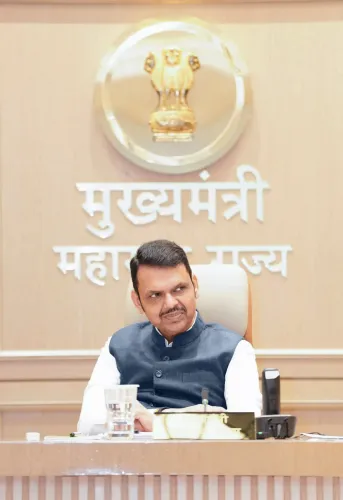
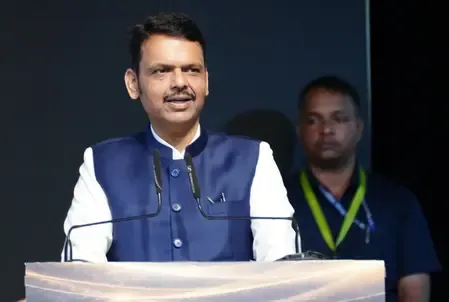
Chief Minister Devendra Fadnavis on Tuesday, 22 September announced that Maharashtra will soon roll out a large-scale government recruitment drive conducted through competitive examinations, even as protests over paper leaks continue to roil the state's public hiring ecosystem. The announcement came after the weekly cabinet meeting in Mumbai.
Committee on the Ground
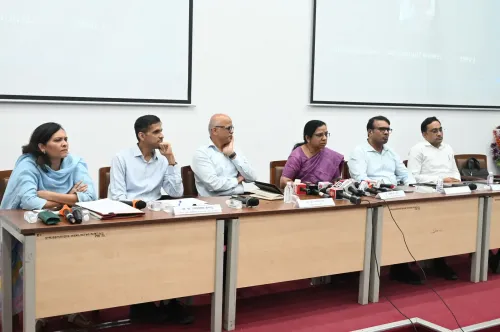
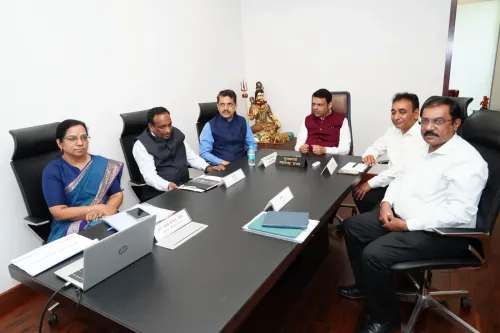
A task force headed by Additional Chief Secretary V. Radha is currently touring Maharashtra, engaging students and stakeholders to gather firsthand feedback on examination processes. Fadnavis expressed confidence that the committee's forthcoming recommendations will lay the groundwork for a more transparent and student-friendly system.
A key demand emerging from student interactions is a return to the objective (multiple-choice) pattern from the descriptive format that was introduced earlier on the recommendation of the Dalvi Committee. The government has indicated it remains open to this change, pending the V. Radha Committee's final report.
Record Vacancies and MPSC's Role
Acknowledging widespread complaints over low vacancy counts in Group 'C' posts, Fadnavis assured that the administration intends to recruit record numbers across Group 'C' and other cadres. The government will also decide soon whether to create an independent recruitment framework for local bodies or route those recruitments directly through the Maharashtra Public Service Commission (MPSC).
Zero-Leak Framework and OMR Pattern
Task Force Chairperson V. Radha confirmed that competitive examinations will not be held online in the coming year. Instead, they will revert to the Optical Mark Recognition (OMR) sheet format, with standardised operating guidelines being framed to ensure uniformity. To achieve a zero-leak environment, the committee plans to deploy advanced technology across question creation, printing, transport, and distribution.
A key innovation under evaluation is an encrypted 'e-question bank' system under which even the individuals who write examination questions would not know which exam their questions will feature in — a structural safeguard designed to close loopholes exploited in past leak incidents.
What Students Are Demanding
MPSC aspirants have urged the task force to publish and strictly adhere to an annual examination calendar, stressing the need for procedural stability without frequent policy reversals. Pre-declaration of minimum vacancy counts across cadres was also strongly recommended by student groups.
Other demands include rigorous quality checks on question papers and answer keys, standardised evaluation metrics and reviewer audits, a unified online portal for candidate queries and objections, and a single-window system for one-time registration and fee payment across all state examinations. Participants also called for clean restrooms, drinking water, and proper seating at test centres — underscoring long-standing infrastructure concerns at examination venues.
Learning from Other States
The task force is studying operational models of public service commissions in Tamil Nadu, Gujarat, and the Union Public Service Commission (UPSC), according to Radha. The aim is to adapt proven best practices to Maharashtra's scale and administrative context — a sign that the state is looking beyond incremental fixes toward a systemic overhaul of its public recruitment architecture.
The committee's final report, expected in the near term, will shape the contours of Maharashtra's most ambitious government hiring push in recent years.
Point of View
Triggered street protests, and embarrassed successive governments. Fadnavis's announcement addresses the symptoms with the right vocabulary: OMR reversion, encrypted question banks, calendar certainty. But the credibility deficit runs deeper than format or technology. The state's examination machinery has historically struggled with accountability at the administrative level, not just at the printing press. Until independent audits, verifiable vacancy pre-declaration, and swift legal consequences for leak culprits become standard practice, even the best-designed system risks being gamed. The V. Radha Committee has a narrow window to move from consultation theatre to structural reform.
NationPress
22 Sept 2026
Frequently Asked Questions
What did CM Devendra Fadnavis announce about Maharashtra government recruitment?
CM Devendra Fadnavis announced on 22 September that Maharashtra will soon launch a large-scale government recruitment drive through competitive examinations. The announcement follows sustained protests over paper leaks in the state's public hiring process.
Will Maharashtra's MPSC exams return to the OMR pattern?
Yes. Task Force Chairperson V. Radha confirmed that competitive examinations will not be conducted online next year and will instead use the Optical Mark Recognition (OMR) sheet format. Standardised operating guidelines are being framed to accompany the shift.
What is the encrypted e-question bank being proposed for Maharashtra exams?
The V. Radha Committee is evaluating an encrypted digital question bank system where even the individuals who write examination questions would not know which exam their questions will ultimately appear in. This is designed as a structural safeguard against paper leaks.
What are MPSC aspirants demanding from the Maharashtra government?
Students have demanded a published annual examination calendar, pre-declared minimum vacancy counts, rigorous quality checks on question papers and answer keys, and a unified online portal for queries and objections. They have also called for a single-window registration and fee payment system across all state exams.
Which states is Maharashtra studying to reform its exam system?
The task force is studying the operational models of public service commissions in Tamil Nadu, Gujarat, and the Union Public Service Commission (UPSC). The aim is to adapt proven best practices to Maharashtra's specific administrative context.