Maharashtra Assembly Passes Landmark Land Bills Empowering Local Authorities
Synopsis
The Maharashtra Assembly has passed the Maharashtra Land Revenue Code (Second Amendment) Bill 2026, empowering local authorities to resolve 90% of minor land breach cases. Additionally, it aims to streamline industrial investments by amending tenancy laws, abolishing burdensome fees and providing extensions for delayed projects.
Key Takeaways
Major reforms in land governance through the Maharashtra Land Revenue Code.
Decentralization of powers to local authorities for efficiency.
Removal of the burdensome '40-times Nazrana' fee.
Extensions for industrial projects affected by global issues.
Mandatory notification for changes in land use to prevent penalties.
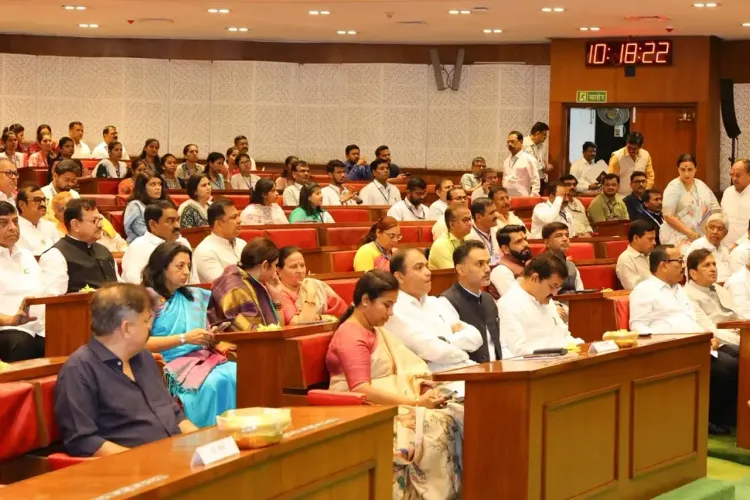
Mumbai, March 24 (NationPress) The Maharashtra Assembly recently reached a unanimous agreement on the Maharashtra Land Revenue Code (Second Amendment) Bill 2026. This legislation empowers district collectors and divisional commissioners to address minor breaches of conditions, ensuring that a significant 90% of cases are resolved at the local level.
Revenue Minister Chandrashekhar Bawankule, who introduced the bill, stated that the process for regularizing breaches of conditions (shartabhang) in government land transactions will now be more efficient and expedited.
Previously, the Maharashtra Land Revenue Code (MLRC) did not contain specific legal provisions to regularize breaches in lands allocated by the government for occupancy or leasehold purposes. The procedure was conducted via government circulars, but the lack of statutory support resulted in litigation and delays.
To remedy this, amendments have been made under Sections 37 ‘A’ and 328 ‘A’ of the Code.
Bawankule noted, “Before this, files concerning even minor infractions had to be forwarded to Mantralaya. This created an enormous workload, and residents needed to travel to Mumbai for minor issues. We are decentralizing these authorities. Approximately 90% of cases with values up to Rs 1 crore will now be resolved at the District Collector or Divisional Commissioner level, leaving only ultra-high-value matters for Mantralaya.”
The bill garnered unanimous backing from MLAs of various parties.
Additionally, the Assembly passed the Maharashtra Tenancy and Agricultural Lands Laws (Amendment) Bill 2026, designed to promote industrial investment and eliminate obstacles within the Tenancy Act.
A significant change includes the removal of the burdensome “40-times Nazrana” requirement on land sales, along with extensions granted to industrial projects under special conditions.
Bawankule elaborated, “Previously, tenants were required to pay a premium equivalent to 40 times the land revenue when selling land 10 years post-acquisition of ownership rights. Although nominal, the recovery process was lengthy and caused considerable inconvenience. This requirement has now been removed.”
He further explained that industrial projects delayed due to global crises, such as COVID-19, NCLT cases, or civil disputes, will now qualify for a three-year extension approved by the State Government to maintain consistency.
Moreover, only ‘Class-1’ lands will be eligible for acquisition for industrial clusters. If the land falls under ‘Class-2’, it must undergo conversion prior to purchase. It is required to notify the District Collector within 30 days of any change in land use, or a conversion premium five times the original amount will be imposed.
Point of View
The passage of these bills represents a pivotal shift in land governance in Maharashtra. Granting district collectors and divisional commissioners the authority to handle minor breaches locally not only reduces bureaucratic burden but also enhances the accessibility of land administration for citizens. This proactive approach to land management could serve as a model for other states, fostering efficiency and supporting industrial growth.
NationPress
23 Sept 2026
Frequently Asked Questions
What does the Maharashtra Land Revenue Code (Second Amendment) Bill 2026 entail?
The bill empowers district collectors and divisional commissioners to regularize minor breaches of conditions in land transactions, allowing about 90% of cases to be resolved locally.
How will this bill affect land transactions in Maharashtra?
It simplifies the regularization process for minor breaches, aiming to reduce litigation and make land management more accessible for citizens.
What changes are included in the Maharashtra Tenancy and Agricultural Lands Laws (Amendment) Bill 2026?
The bill removes the '40-times Nazrana' requirement for land sales, facilitating smoother transactions and providing extensions for industrial projects affected by global crises.
What are the implications for industrial projects under the new amendments?
Industrial projects delayed due to crises will be eligible for a three-year extension, promoting investment stability and growth.
What types of land can be acquired for industrial purposes?
Only 'Class-1' lands can be acquired for industrial clusters, while 'Class-2' lands must be converted before purchase.