Mahua Moitra Slams IIT Roorkee Over Email Curbing Student Protest
Synopsis
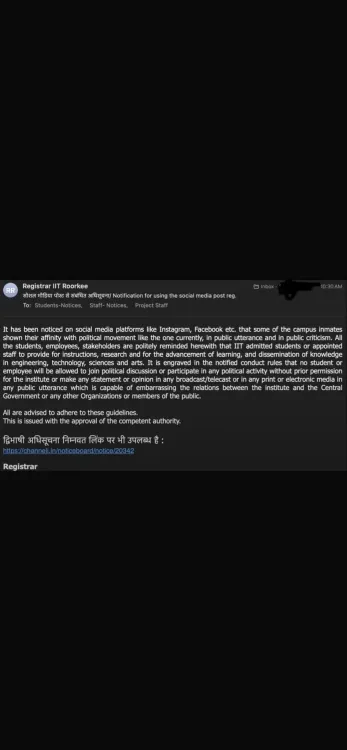
TMC MP Mahua Moitra publicly challenged IIT Roorkee on 21 July 2026, demanding it retract an internal email she said asked students to surrender their constitutional right to free speech and protest, and urged students to disregard the advisory.
Key Takeaways
TMC MP Mahua Moitra posted on X on 21 July 2026 demanding IIT Roorkee retract an email restricting student protest.
Moitra invoked taxpayer funding of the institute as grounds for public accountability, calling it 'our money.' IIT Roorkee was established in 1847 and is governed under the Institutes of Technology Act, 1961 as a centrally funded institution.
The specific email's contents and date have not been independently verified.
Similar conduct advisories restricting campus political expression have previously been issued by other central universities and IITs.
The matter could be raised in Parliament, potentially prompting a response from the Ministry of Education on campus speech guidelines.
TMC MP Mahua Moitra on Tuesday, 21 July 2026 publicly challenged IIT Roorkee, demanding the premier institute retract an internal email she said directed students to forgo their constitutional right to free speech and protest. The Krishnanagar MP, posting on X, also called on students to disregard the advisory and urged the administration to apologise.
Context
Moitra's post directly addressed IIT Roorkee, stating: 'Our money funds you. Don't you DARE tell our kids to forego their constitutional right to free speech and protest. Retract this email and apologise. Students ignore these bootlickers.' The reference to 'our money' points to the institute's central government funding, which flows primarily through the Ministry of Education.
The specific email cited in the post has not been independently verified. The post was accompanied by an image, which appears to show the communication in question, though its full contents and date remain unconfirmed.
Policy Backdrop
IIT Roorkee, established in 1847 and designated an IIT in 2001, is one of India's oldest technical institutions and is governed under the Institutes of Technology Act, 1961, which classifies IITs as centrally funded institutions of national importance subject to government oversight. As a publicly funded body, it draws scrutiny when internal directives are seen to restrict civic rights.
Conduct advisories restricting political expression or campus protests are not new to centrally funded higher-education institutions. Similar episodes have recurred across central universities and IITs when students have organised around issues of national policy, each time reigniting debate over the limits of administrative authority versus constitutionally guaranteed freedoms.
Stakeholders and Impact
IIT Roorkee students are the most immediate stakeholders, with the advisory — if confirmed — potentially chilling political expression on campus. Student bodies at other central universities and IITs are also likely to watch how the administration responds, given the precedent it could set.
Moitra's intervention, coming from a sitting Lok Sabha MP, elevates the episode from an internal administrative matter to one of parliamentary and public interest. Her framing — that taxpayer money entitles the public to hold the institute accountable — is consistent with her broader record of raising institutional accountability questions in Parliament.
What's Next
Attention will now turn to whether IIT Roorkee's administration issues any clarification, retraction, or apology in response to the public pressure. The Ministry of Education may also face questions about whether centrally funded institutions have the authority to issue such advisories and whether national guidelines on campus speech exist or are being considered.
If the matter is raised in Parliament — where Moitra has a track record of tabling pointed questions — it could prompt a formal response from the government on the boundaries of administrative conduct in publicly funded universities.
Point of View
She frames the issue not as a student grievance but as a civic one — a framing that is harder for the administration to dismiss. The episode fits a recurring pattern in which elected representatives use social media to apply rapid pressure on institutions, bypassing slower parliamentary channels. If the Ministry of Education does not weigh in, the silence itself may be read as tacit endorsement of administrative overreach on campus speech.
NationPress
21 Jul 2026
Frequently Asked Questions
What did Mahua Moitra say about IIT Roorkee?
Mahua Moitra demanded that IIT Roorkee retract an internal email she said instructed students to give up their constitutional right to free speech and protest, and called on students to ignore the advisory.
Why is IIT Roorkee funded by taxpayers?
IIT Roorkee is a centrally funded institution governed under the Institutes of Technology Act, 1961, receiving its primary funding through the Ministry of Education, which makes it publicly accountable.
Do IIT students have the right to protest in India?
Yes. Article 19 of the Indian Constitution guarantees citizens the right to freedom of speech and expression and the right to assemble peaceably, rights that apply to students at publicly funded institutions.
Has IIT Roorkee responded to Mahua Moitra's post?
As of the time of publication, no official response or retraction from IIT Roorkee's administration has been confirmed.
Is restricting campus protests common at Indian IITs?
Conduct advisories restricting political expression or protests have periodically been issued at central universities and IITs, typically when students organise around issues of national policy, and have previously drawn criticism from civil society and lawmakers.