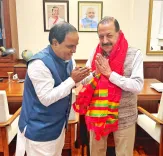
Mandaviya Champions Atmanirbhar Bharat's Rise from Dependency
Synopsis
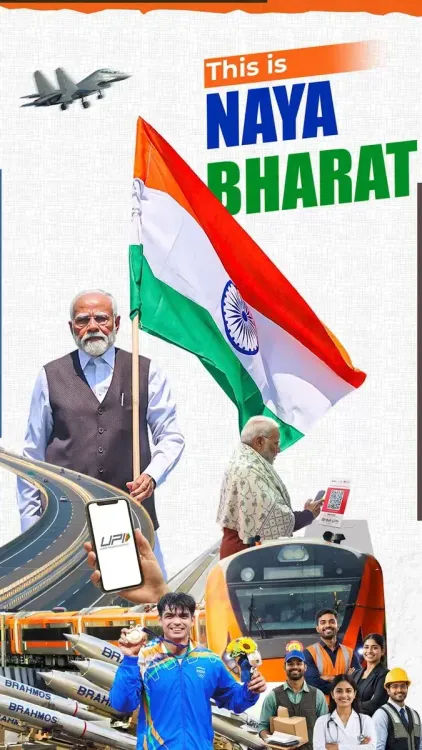
Union Minister Mansukh Mandaviya invoked the Atmanirbhar Bharat vision on 11 August 2026, framing India's economic trajectory as a shift from import dependency to manufacturing dominance — a narrative built on PM Modi's 2020 Rs 20 lakh crore package and reinforced by PLI schemes across key sectors.
Key Takeaways
Union Minister Mansukh Mandaviya posted on 11 August 2026 championing India's self-reliance journey under the Atmanirbhar Bharat framework.
The Atmanirbhar Bharat Abhiyan was launched by PM Narendra Modi in May 2020 with a Rs 20 lakh crore economic package.
Production Linked Incentive (PLI) schemes across more than a dozen sectors form the fiscal backbone of the self-reliance push.
The Make in India initiative, launched in 2014 , provided the ideological groundwork that Atmanirbhar Bharat built upon.
Mandaviya's Labour and Employment portfolio links self-reliance directly to job creation in the MSME sector and formal employment growth.
PLI disbursements and India's share in global value chains are the key metrics to watch in upcoming Economic Survey and Budget presentations.
Six years after Prime Minister Narendra Modi launched the most ambitious self-reliance drive in independent India's history, Union Labour and Sports Minister Mansukh Mandaviya is keeping the drumbeat loud — framing the nation's economic journey in the starkest possible terms: from dependency to dominance.
Posting on Tuesday, 11 August 2026, Mandaviya shared a video with a message that cut straight to the ideological core of the Bharatiya Janata Party's economic vision: 'From dependency to dominance: The unstoppable rise of a self-reliant Bharat.' The phrasing is deliberate — 'unstoppable' signals momentum, not aspiration.
The Atmanirbhar Bharat arc, six years on
The phrase traces directly back to May 2020, when Prime Minister Modi announced the Atmanirbhar Bharat Abhiyan — a Rs 20 lakh crore economic package designed to rewire India's relationship with global supply chains. The pitch was simple: stop importing what India can make, and start making what the world will import. It landed during a pandemic that had just exposed how badly fractured those supply chains could become. The policy architecture that followed was substantial. Production Linked Incentive (PLI) schemes were rolled out across more than a dozen sectors — from semiconductors and smartphones to pharmaceuticals and solar panels — designed to pull manufacturing investment onshore and push Indian goods into global value chains. Before that, the Make in India initiative, launched in 2014, had laid the ideological groundwork, but PLI gave it fiscal teeth.Why a Labour Minister is amplifying an economic message
Mandaviya's portfolio — Labour, Employment, and Youth Affairs — sits at the precise intersection where the Atmanirbhar story either proves itself or falls short. Domestic manufacturing growth only translates into political capital if it creates jobs, absorbs the MSME sector's capacity, and gives young Indians a reason to stay in the formal economy. His amplification of this narrative is not incidental; it is a signal that the government is tying employment outcomes to the self-reliance story ahead of key policy presentations. The metrics that will test this claim — PLI scheme disbursements, India's rising share in global value chains, and formal employment numbers — are expected to feature prominently in upcoming Economic Survey and Union Budget presentations. Those numbers will either vindicate the 'dominance' framing or complicate it. The direction of travel is clear. Whether the pace matches the proclamation is the question every budget season will answer.Point of View
Self-reliance is not merely an economic policy but a civilisational claim, and ministers across portfolios are expected to carry that message. The Labour Minister's specific amplification signals an intent to tie manufacturing growth to employment outcomes — a linkage the government needs to demonstrate, not just assert. The 'dependency to dominance' phrasing raises the stakes: it invites the opposition to measure the gap between the slogan and the data.
NationPress
11 Aug 2026
Frequently Asked Questions
What is Atmanirbhar Bharat and who launched it?
Atmanirbhar Bharat Abhiyan is a central government initiative promoting economic self-reliance through domestic production and reduced import dependence. It was launched by Prime Minister Narendra Modi in May 2020 with a Rs 20 lakh crore economic package.
What did Mansukh Mandaviya post about Atmanirbhar Bharat?
On 11 August 2026 , Mandaviya shared a video on X with the message 'From dependency to dominance: The unstoppable rise of a self-reliant Bharat,' reaffirming the government's self-reliance narrative.
What are PLI schemes and how do they support Atmanirbhar Bharat?
Production Linked Incentive (PLI) schemes offer financial incentives to domestic manufacturers across sectors such as semiconductors, pharmaceuticals, and solar panels, designed to boost local production and integrate India into global value chains.
How does Make in India relate to Atmanirbhar Bharat?
Make in India , launched in 2014 , established the ideological foundation of domestic manufacturing promotion. Atmanirbhar Bharat built on this with a larger fiscal package and sector-specific PLI schemes introduced from 2020 onwards.
Why is a Labour Minister talking about economic self-reliance?
Mandaviya's portfolio covering Labour, Employment, and Youth Affairs directly connects manufacturing growth to job creation. Self-reliance only delivers political and economic results if it generates formal employment, particularly in the MSME sector.