Mandaviya Shares Modi's Somnath Quote on India's Identity
Synopsis
Union Minister Mansukh Mandaviya shared a quote attributed to PM Narendra Modi asserting that those who destroyed the Somnath Temple to erase India's identity no longer exist, invoking the ancient temple's history as a symbol of civilisational resilience.
Key Takeaways
Union Labour and Sports Minister Mansukh Mandaviya shared the post on Sunday, September 27, 2026 .
The quote is attributed to PM Narendra Modi : 'Those who came to destroy Somnath and erase India's identity have no existence today.' The Somnath Temple in Gujarat was destroyed multiple times, most notably by Mahmud of Ghazni in 1026 AD .
The post-independence reconstruction was championed by Sardar Patel and inaugurated by President Rajendra Prasad in May 1951 .
The post is part of a consistent BJP pattern of invoking heritage temples to frame India's civilisational continuity.
A quote about civilizational resilience — and the impermanence of those who tried to erase it — is making the rounds on Sunday, shared by Union Labour and Sports Minister Mansukh Mandaviya.
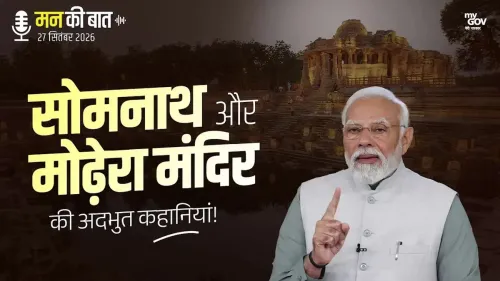
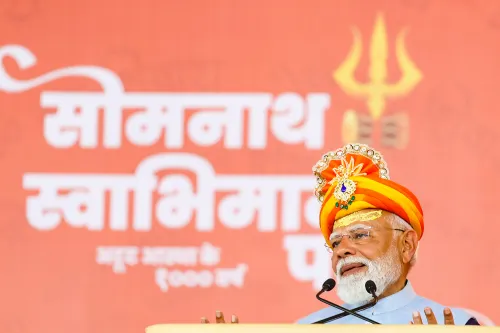
Minister Mandaviya posted a line attributed to Prime Minister Narendra Modi on Sunday, September 27, 2026: 'Jo log Somnath ko todkar Bharat ki pehchaan mitane aaye the, aaj unka koi wajood nahin hai.' — 'Those who came to destroy Somnath and erase India's identity have no existence today.'
Somnath: The Temple That Would Not Stay Broken
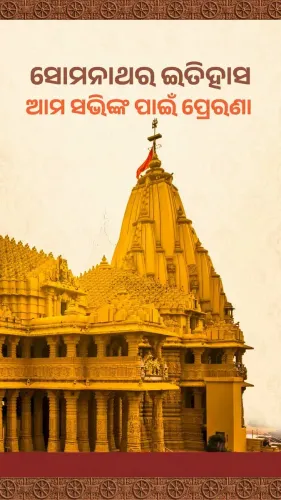
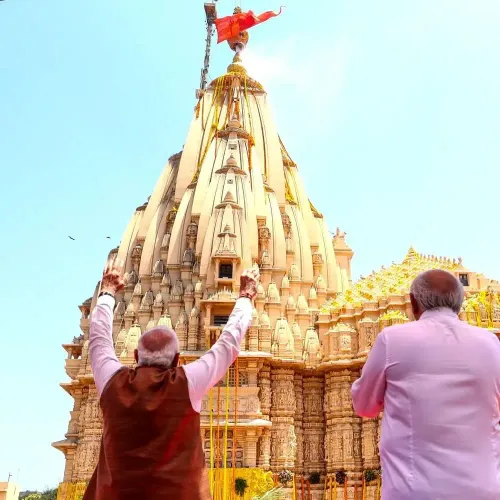
The Somnath Temple in Gujarat carries one of the most layered stories in the subcontinent's history. The ancient Shiva temple was razed multiple times over the centuries, most famously by Mahmud of Ghazni in 1026 AD — a raid that became a recurring reference point in debates about Indian civilisational continuity and historical memory. Its most recent chapter began after independence, when Sardar Vallabhbhai Patel championed its reconstruction. The rebuilt temple was inaugurated by President Rajendra Prasad in May 1951, a gesture that carried enormous symbolic weight at the dawn of the Indian republic: a nation, barely four years old, reaching back thousands of years to reassert its identity.A Recurring Thread in BJP's Cultural Messaging
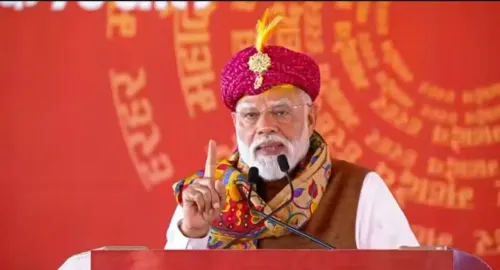
Prime Minister Modi, who represents Varanasi in Parliament and hails from Gujarat, has consistently invoked select heritage sites — Somnath chief among them — as emblems of what he frames as India's unbroken cultural thread. References to temple restorations and civilizational continuity recur in his public addresses, and senior BJP leaders routinely amplify these moments on social media. Manday's post fits squarely within that pattern: a one-line distillation of a longer argument — that India's cultural landmarks outlasted every attempt to obliterate them, while the aggressors themselves have faded from history. The sentiment resonates strongly with Hindu devotees and heritage pilgrims who regard Somnath as more than a religious site — it is, for many, a living monument to survival.Point of View
Shareable one-liner, the minister extends the message to a social-media audience far beyond any single speech. The framing sidesteps overt political partisanship while embedding a deeply ideological assertion about who India's history vindicates.
NationPress
27 Sept 2026
Frequently Asked Questions
What did PM Modi say about Somnath Temple?
PM Modi was quoted as saying that those who came to destroy the Somnath Temple and erase India's identity have no existence today — a statement underscoring the temple's symbolic survival through centuries of destruction and reconstruction.
Why is the Somnath Temple historically significant?
The Somnath Temple in Gujarat is one of India's most ancient Shiva shrines and was destroyed multiple times, most famously by Mahmud of Ghazni in 1026 AD. Its repeated reconstruction, including a post-independence rebuild inaugurated in 1951, makes it a powerful symbol of cultural continuity.
Who rebuilt the Somnath Temple after Indian independence?
Sardar Vallabhbhai Patel championed the reconstruction of the Somnath Temple after independence. It was inaugurated by President Rajendra Prasad in May 1951.
Why did Mansukh Mandaviya post the Somnath quote?
Minister Mandaviya shared a quote attributed to PM Modi about Somnath to amplify a message on India's civilisational resilience — consistent with the BJP's broader communication strategy around heritage temples and Indian identity.
What is the BJP's position on heritage temples like Somnath?
The BJP has consistently framed sites like the Somnath Temple as emblems of India's unbroken cultural identity, referencing their destruction and reconstruction to argue that India's civilisation outlasted every attempt to erase it.