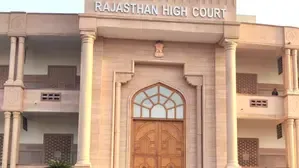
Rajasthan HC: Maternity leave a constitutional right, orders full 180-day leave

Synopsis
The Rajasthan High Court has ruled that maternity leave is a constitutional right rooted in Article 21, ordering the state to grant a government teacher the full 180-day entitlement with full pay and service continuity. The bench's framing — linking maternity leave to the right to motherhood and a child's right to develop — goes beyond routine service-law disputes and carries significant implications for female public sector employees across the state.
Key Takeaways
The Rajasthan High Court ruled that maternity leave is a constitutional right under Article 21 , encompassing the right to motherhood and a child's right to full development.
Justice Anoop Kumar Dhand directed authorities to grant petitioner Pooja Yadav the full 180-day maternity leave with complete salary and service benefits.
The Court held that the maternity leave period will not be treated as a break in service.
Yadav, a Grade-III, Level-I teacher in Siwana, Barmer , had been granted only 34 days of leave despite giving birth on 27 September 2023 .
In a separate ruling, Justice Ganesh Ram Meena quashed the 27 May 2015 cancellation of appointments for six 2013 Information Assistant recruits, citing violation of natural justice principles.
The Rajasthan High Court has ruled that maternity leave is not merely a sanctioned absence from work but a fundamental right that enables a mother to develop deep emotional attachment and affection toward her newborn. The bench, in its 15 October 2026 ruling, directed state authorities to grant a female government teacher the full 180 days of maternity leave along with complete salary and all service-related benefits.
What the Court ruled
Justice Anoop Kumar Dhand held that the right to life guaranteed under Article 21 of the Constitution encompasses both the right to motherhood and the right of every child to grow and develop fully. The Court explicitly stated that maternity leave serves a broader social purpose — enabling women to provide essential care during a critical phase of early childhood — and directed that the leave period must not be treated as a break in service.
Background: The petitioner's case
The petitioner, Pooja Yadav, was serving as a Grade-III, Level-I teacher at Mahatma Gandhi Government School (English Medium) in Siwana, Barmer. During her pregnancy, authorities granted her just 34 days of maternity leave, from 1 September to 4 October 2023. She gave birth to her child on 27 September 2023.
Yadav was subsequently selected for a post at Mahatma Gandhi Government English Medium School in Pur, Kotputli-Behror block, and joined the new posting on 6 October 2023. When she formally requested the full 180-day entitlement with effect from 1 September 2023, the authorities declined, forcing her to apply for childcare leave instead — a workaround that did not adequately protect her statutory rights.
Legal basis and reasoning
The Court referred to Rule 103 of the Rajasthan Service Rules, which provides for maternity leave for eligible female government employees with fewer than two living children. It observed that withholding the full entitlement undermined the social justice objectives embedded in service law, and that both the mother's welfare and the child's developmental needs demanded the protection of this right without administrative interruption.
Second ruling: Natural justice in service terminations
In a separate but notable order issued alongside, Justice Ganesh Ram Meena quashed a government order dated 27 May 2015 that had cancelled the appointments of Rajaram Meena and five other candidates recruited through the 2013 Information Assistant recruitment process. The Court found that the inquiry report underlying the termination decision had never been shared with the affected employees, a clear violation of the principles of natural justice.
The bench noted that abruptly ending the careers of employees who have served the government for several years — particularly when they have crossed the prescribed age limit for other government jobs — inflicts serious and potentially irreversible harm. It directed that the petitioners be treated as having remained in continuous service from the dates of their original appointments. This comes amid a broader pattern of Indian courts reinforcing procedural safeguards in disciplinary proceedings involving public servants.
What happens next
State authorities are now bound to extend Pooja Yadav's maternity leave to the full 180-day entitlement with corresponding pay and service continuity. The ruling is expected to set a persuasive precedent for similar disputes involving female government employees in Rajasthan, where administrative denials of full maternity benefits have periodically been challenged in court.
Point of View
And one that could complicate future administrative denials across Rajasthan. What the ruling exposes, however, is how routine the denial still is: a teacher had to litigate through the High Court to claim a statutory benefit that existed on paper all along. The parallel ruling on the 2013 Information Assistant appointments reinforces a recurring theme in Indian public service law — that procedural shortcuts in disciplinary action routinely come undone in court, years after the damage to individual careers has been done. The real question is whether these rulings prompt systemic change or remain case-by-case remedies.
NationPress
15 Oct 2026
Frequently Asked Questions
What did the Rajasthan High Court rule on maternity leave?
The Rajasthan High Court ruled that maternity leave is a constitutional right under Article 21 of the Constitution, not merely an administrative concession. Justice Anoop Kumar Dhand directed the state to grant petitioner Pooja Yadav the full 180-day maternity leave entitlement with complete salary and service continuity, and clarified that the period cannot be treated as a break in service.
Who is Pooja Yadav and what was her case?
Pooja Yadav is a Grade-III, Level-I government teacher who was posted at Mahatma Gandhi Government School (English Medium) in Siwana, Barmer. She was granted only 34 days of maternity leave after giving birth on 27 September 2023, and when her request for the full 180-day entitlement was denied, she was compelled to seek childcare leave as an alternative before approaching the High Court.
What is Rule 103 of the Rajasthan Service Rules?
Rule 103 of the Rajasthan Service Rules provides for maternity leave for eligible female government employees who have fewer than two living children. The High Court cited this provision to support its direction granting Pooja Yadav the full 180-day entitlement.
What was the second ruling by the Rajasthan High Court in this matter?
In a separate order, Justice Ganesh Ram Meena quashed the government's 27 May 2015 cancellation of appointments for Rajaram Meena and five other 2013 Information Assistant recruits. The Court found their terminations violated natural justice because the inquiry report used to cancel their appointments was never shared with them, and directed that they be treated as having served continuously from their original appointment dates.
Why does the Rajasthan HC maternity leave ruling matter beyond this case?
By anchoring maternity leave in Article 21's right to life — extending it to the right to motherhood and a child's right to develop — the ruling sets a persuasive precedent for female government employees across Rajasthan who face administrative denials of their full statutory entitlement. It reinforces that such denials are not merely procedural failures but potential constitutional violations.