Modi at 25 years in power: What defines his governance record
Synopsis
Twenty-five years of uninterrupted executive power — from a modest Ahmedabad background to three terms as Prime Minister — makes Modi's political durability almost without modern parallel in Indian democracy. The combination of delivery-driven governance framing, digital infrastructure, and a direct-to-voter communication style has redefined what national leadership looks like in India.
Key Takeaways
Narendra Modi marks 25 uninterrupted years in executive office as of 6 October 2026 , spanning Chief Minister of Gujarat (2001–2014) and Prime Minister since May 2014 .
He rose through the RSS and BJP ranks, serving as National General Secretary (Organisation) from 1998 before being appointed Gujarat CM in October 2001 .
The World Bank recorded India's extreme poverty falling from 16.2% in 2011–12 to 2.3% in 2022–23 during his tenure.
Landmark reforms including the GST , IBC , and expansion of Direct Benefit Transfer mechanisms were executed under his leadership.
The IMF projects India to remain the world's fastest-growing major economy , highlighting resilience amid global uncertainty.
Critics raise concerns over centralised decision-making; supporters credit decisive governance for pushing through long-pending structural reforms.
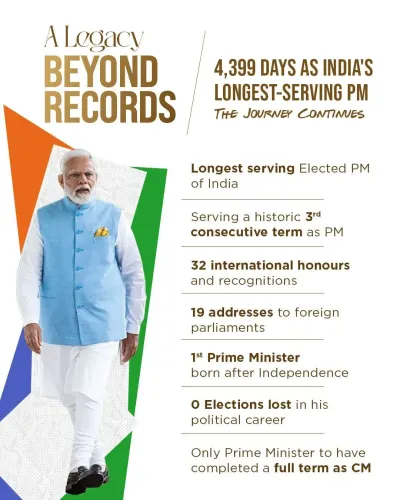
Prime Minister Narendra Modi marks 25 uninterrupted years in executive office on 6 October 2026 — a span that stretches from the Chief Minister's office in Gandhinagar to three consecutive terms as Prime Minister in New Delhi. In a democracy as vast and competitive as India, sustaining executive authority and public support across a quarter-century is, by any measure, historically uncommon.
From Tea Stall to the Top: The Formative Years
Modi's early life was shaped by modest circumstances — he reportedly helped at his family's tea stall while pursuing his schooling. At 17, he left home and spent nearly two years travelling across India before joining the Rashtriya Swayamsevak Sangh (RSS) in Ahmedabad, committing himself to full-time organisational work.
His rise through the RSS ranks brought increasing responsibilities in Gujarat, where he developed what observers describe as a blend of organisational discipline and grassroots political instinct. A formative episode, according to Bharatiya Janata Party (BJP) Gujarat accounts, was the Emergency period imposed by then Prime Minister Indira Gandhi, during which he reportedly worked underground, building resistance networks while evading government crackdowns.
The Gujarat Years: Building the 'Modi Model'
From 1987 onwards, Modi emerged as one of the BJP's key strategists in the state. After the BJP's 1995 victory in Gujarat, he was moved to New Delhi as the party's National Secretary, taking charge of several northern states. By 1998, he had been elevated to National General Secretary (Organisation) — one of the party's most consequential internal posts.
In October 2001, party leadership appointed him to replace Keshubhai Patel as Chief Minister of Gujarat at a difficult juncture: the state was recovering from the devastating Bhuj earthquake and facing concurrent administrative challenges. He served as Chief Minister from 2001 to 2014, a tenure supporters associate with infrastructure expansion, industrial investment, irrigation projects, and administrative reform — collectively described as the 'Gujarat model'.
National Governance: Delivery, Digital India and Economic Reforms
Since taking office as Prime Minister in May 2014, Modi has sought to scale elements of the Gujarat template nationally. His administration has pursued large-scale infrastructure spending, manufacturing initiatives, and landmark structural reforms including the Goods and Services Tax (GST) and the Insolvency and Bankruptcy Code (IBC).
A defining feature of his governance approach, analysts note, has been the framing of policy around measurable delivery rather than announcement alone. The expansion of Direct Benefit Transfer (DBT) mechanisms and digital identity systems has, according to government data, transformed India's public payment ecosystem — reducing leakage and improving service delivery efficiency. Even critics broadly acknowledge that digital governance became central to public administration during this period.
On poverty reduction, the World Bank has noted that extreme poverty in India fell from 16.2 per cent in 2011–12 to 2.3 per cent in 2022–23, alongside substantial progress in infrastructure and access to basic services. The International Monetary Fund (IMF) has projected India to remain the world's fastest-growing major economy, citing resilience and strong domestic demand amid global uncertainty.
Communication, Foreign Policy and Political Durability
Modi's communication strategy has set him apart from many predecessors. Through mass rallies, social media, and the long-running radio programme 'Mann Ki Baat', he has cultivated a direct line to voters across demographics — often bypassing conventional political intermediaries.
In foreign policy, India under Modi has pursued a more assertive international profile, expanded diplomatic engagement, and positioned itself as a leading voice of the Global South while simultaneously deepening ties with major world powers. Analysts frequently cite this posture as one of the defining characteristics of the Modi era.
Critics have raised concerns about the centralisation of decision-making and the space for institutional dissent, while supporters argue that decisive leadership was necessary to push through long-pending reforms. The debate itself reflects the scale of his impact: few leaders since Independence have so thoroughly shaped India's political and governance landscape over a single sustained tenure. How that legacy is ultimately judged will depend, in part, on which reforms take lasting root and which milestones prove durable beyond his time in office.
Point of View
Multi-party democracy is not a story that writes itself — it requires consistent electoral renewal and narrative control, both of which Modi has demonstrated with unusual consistency. Yet the 25-year milestone also invites scrutiny: the centralisation of decision-making that supporters credit for reform velocity is the same feature critics argue has weakened institutional checks. The poverty and growth data are broadly encouraging, but the question mainstream coverage underweights is attribution — how much of the World Bank's poverty decline and IMF's growth projection reflects structural policy choices versus demographic tailwinds and global commodity cycles. India's governance story under Modi is genuinely significant; the honest assessment requires separating durable institutional change from political messaging around it.
NationPress
7 Oct 2026
Frequently Asked Questions
How many years has Narendra Modi been in executive office?
Narendra Modi has completed 25 uninterrupted years in executive office as of 6 October 2026, having served as Chief Minister of Gujarat from October 2001 to May 2014 and as Prime Minister since May 2014. This makes his tenure one of the longest unbroken runs in executive power in post-Independence India.
What is the 'Gujarat model' associated with Modi?
The 'Gujarat model' refers to the governance approach Modi developed during his tenure as Chief Minister of Gujarat (2001–2014), characterised by infrastructure expansion, industrial investment, irrigation projects, and administrative reform. Supporters credit it with spurring economic growth in the state; critics have debated how broadly its outcomes translated to national policy.
What major economic reforms did Modi implement as Prime Minister?
Key reforms under Modi's premiership include the Goods and Services Tax (GST), the Insolvency and Bankruptcy Code (IBC), and a major expansion of Direct Benefit Transfer (DBT) mechanisms linked to digital identity systems. The government has argued these reduced leakage and improved public service delivery efficiency.
What does the World Bank data say about poverty under Modi's tenure?
The World Bank noted that India's extreme poverty rate fell from 16.2 per cent in 2011–12 to 2.3 per cent in 2022–23, alongside substantial progress in infrastructure and access to basic services. The data covers a period that spans both the final UPA years and the entirety of Modi's time as Prime Minister.
How has India's international profile changed under Modi?
Under Modi, India has pursued a more assertive foreign policy posture, expanded diplomatic engagement globally, and positioned itself as a leading voice of the Global South while strengthening ties with major world powers. Analysts describe this more visible international profile as one of the defining characteristics of the Modi era.