PM Modi Invokes Mahabharata Verse to Hail Citizens' Unity
Synopsis
Prime Minister Narendra Modi invoked a Mahabharata shloka on Wednesday to argue that India's rise is powered by citizens' collective resolve. The Hindi post, paired with a Sanskrit verse on unity, extends his long-running pattern of weaving classical references into contemporary nation-building messaging aimed at a broad civic audience.
Key Takeaways
PM Modi posted in Hindi on Wednesday linking civic unity with national strength.
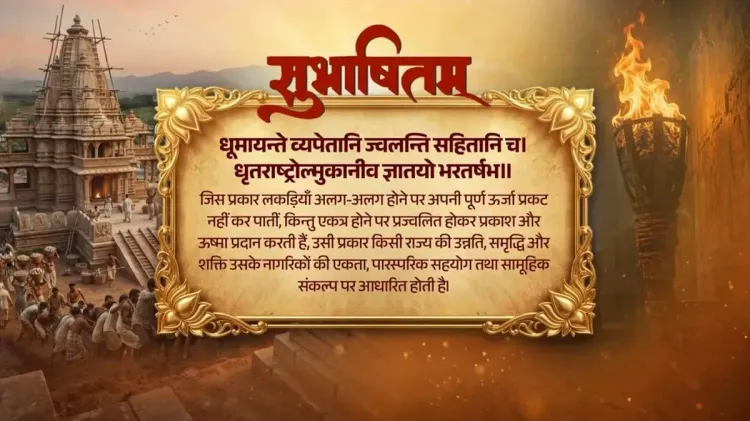
He quoted a Sanskrit shloka from the Mahabharata likening kinsmen to firebrands that blaze when held together.
The message echoes initiatives like Ek Bharat Shreshtha Bharat, launched in 2015.
The post was accompanied by a video and made no reference to a specific event.
It continues Modi's pattern of pairing classical texts with development themes since 2014.
Prime Minister Narendra Modi on Wednesday invoked a Sanskrit verse from the Mahabharata to underscore that India's progress is being powered by the collective resolve of its citizens. In a post on X, the Prime Minister linked civic unity with national strength, reinforcing a recurring theme in his public communications.
'When citizens are bound together in solidarity and mutual cooperation, the strength of the nation multiplies manifold. It is this collective resolve of Indians that is propelling the country to new heights of progress today,' the Prime Minister wrote in Hindi. He followed the statement with a Sanskrit shloka — 'Dhumayante vyapetani jvalanti sahitani cha. Dhritarashtrolmukaniva jnatayo bharatarshabha' — drawn from the epic, which likens kinsmen to firebrands that smoulder when scattered but blaze brightly when held together.
Context
The post, accompanied by a video, frames the message as a meditation on civic togetherness rather than a response to a specific event. The Prime Minister's choice of a Mahabharata verse extends a long-running rhetorical signature in which classical Indian texts are deployed to anchor contemporary calls for unity and development.
The shloka itself is a celebrated articulation of the value of cohesion within a community. By pairing it with a modern message on national progress, the Prime Minister situates everyday civic cooperation within a millennia-old cultural frame.
Policy backdrop
The message echoes themes that have shaped several government initiatives over the last decade. Ek Bharat Shreshtha Bharat, launched in 2015, was designed to strengthen national integration through structured cultural and educational exchanges between states, pairing each state with a partner for sustained engagement.
Related campaigns built around shared civic effort — from cleanliness drives to digital adoption and self-reliance programmes — have repeatedly drawn on the language of jan bhagidari (people's participation). Wednesday's post fits into this lineage, treating citizens not as recipients of policy but as co-authors of national outcomes.
Stakeholders and impact
The primary audience is the wider body of Indian citizens, with the message implicitly addressing youth, civil society networks and community groups that have been mobilised in successive government campaigns. Bilingual framing — a Hindi exposition followed by a Sanskrit verse — broadens reach across linguistic and generational lines.
For the ruling Bharatiya Janata Party, such posts also serve as cultural touchstones that consolidate the party's positioning on civilisational continuity. The absence of any partisan reference, however, keeps the message squarely within the register of national, rather than political, communication.
What's next
Cultural messaging of this kind tends to recur around national commemorations, parliamentary milestones and major policy launches. Observers will watch whether the unity theme is picked up in subsequent government communications or amplified through ministry-level campaigns in the coming weeks.
The forward-looking implication is clear: the Prime Minister is signalling that the next phase of India's growth story will continue to be framed as a citizen-led endeavour, with classical heritage offered as both anchor and aspiration.
Point of View
He reframes routine civic cooperation as part of a civilisational continuum. The absence of partisan markers keeps the message in the national-unity register, even as it reinforces the BJP's broader cultural positioning. Expect this idiom to recur around commemorative dates and major policy rollouts.
NationPress
17 Oct 2026
Frequently Asked Questions
What did PM Modi post on X about citizens' unity?
PM Modi said that when citizens are bound by solidarity and mutual cooperation, the nation's strength multiplies, and credited this collective resolve for India's progress. He paired the Hindi message with a Sanskrit shloka from the Mahabharata.
Which Sanskrit shloka did PM Modi quote?
He quoted 'Dhumayante vyapetani jvalanti sahitani cha. Dhritarashtrolmukaniva jnatayo bharatarshabha', a Mahabharata verse comparing kinsmen to firebrands that smoulder when separated but blaze when united.
What is the meaning of the Mahabharata verse cited by PM Modi?
The verse means that scattered firebrands merely smoke, but when brought together they blaze brightly — and so it is with kinsmen, who are powerful only when united.
Is the post linked to a specific government scheme?
The post does not name a specific scheme. However, its themes align with initiatives like Ek Bharat Shreshtha Bharat, launched in 2015 to promote national integration.
Why does PM Modi often quote Sanskrit texts in his posts?
Quoting classical texts is a long-standing feature of PM Modi's communications, used to anchor contemporary messages on unity and development within India's cultural heritage.