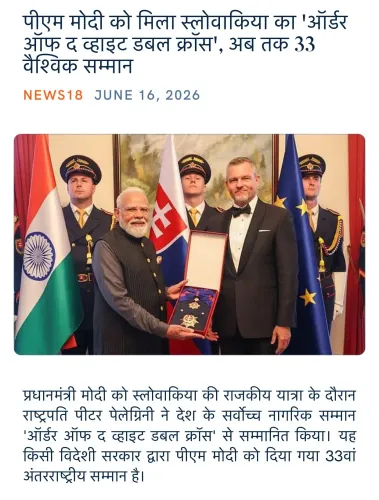
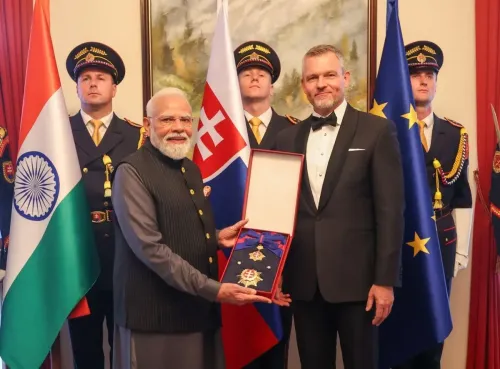
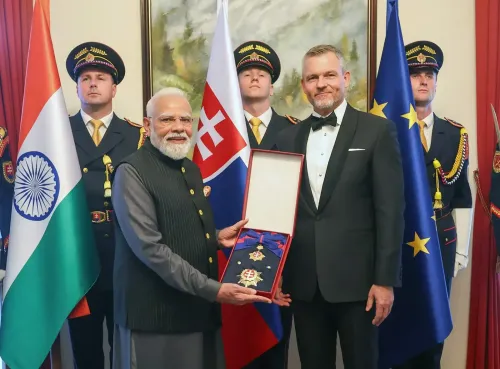
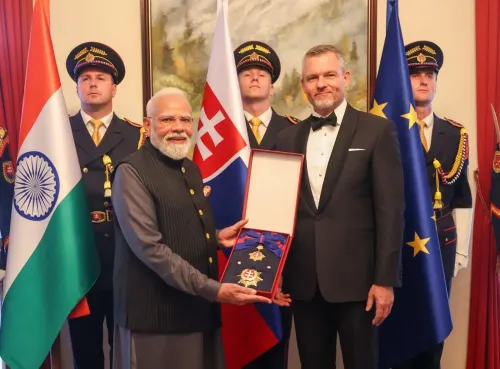
Bhupender Yadav: PM Modi receives Slovakia's top civilian honour
Synopsis
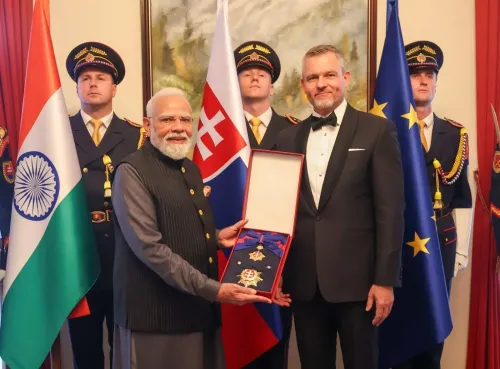
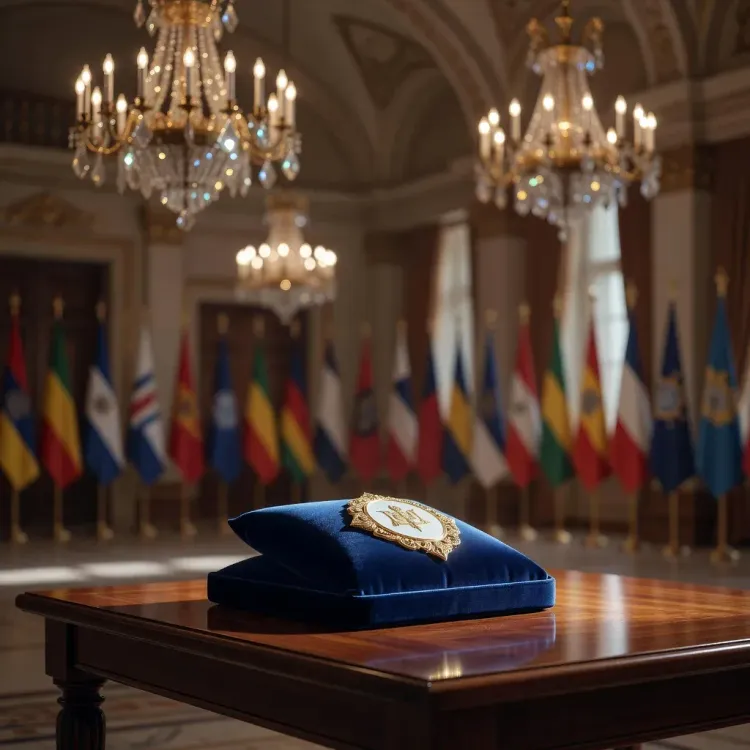
Union Environment Minister Bhupender Yadav announced that PM Narendra Modi has been conferred Slovakia's highest civilian honour, the Order of the White Double Cross (1st Class), raising his total count of international honours to 33 — a milestone Yadav called a reflection of India's growing global stature.
Key Takeaways
PM Narendra Modi has been awarded Slovakia's highest civilian decoration, the Order of the White Double Cross (1st Class) .
The award recognises his contributions to strengthening international cooperation and bilateral ties.
Union Environment Minister Bhupender Yadav announced the honour on 16 June 2026 , calling it 'a moment of immense pride for India.' With this award, PM Modi 's total international honours reportedly stand at 33 from nations across the world.
India and Slovakia have maintained diplomatic relations since 1993 , with growing cooperation in trade, IT, and defence.
The honour follows earlier European decorations including France's Legion of Honour (2018) and Russia's Order of St Andrew (2019) .
Union Environment Minister Bhupender Yadav on Tuesday, 16 June 2026 hailed the conferral of Slovakia's highest civilian decoration — the Order of the White Double Cross (1st Class) — on Prime Minister Narendra Modi, calling it 'a moment of immense pride for India.'
Context
The Order of the White Double Cross, instituted by Slovakia in 1994, is the country's premier state decoration, awarded for exceptional service to the Slovak state or for outstanding contributions to advancing bilateral and multilateral ties. The award to PM Modi was cited as recognition of his contributions to 'strengthening international cooperation and fostering deeper bilateral ties,' as stated in the minister's post.
According to Yadav, this latest recognition brings PM Modi's tally of international honours to 33 from nations across the world — a figure the minister presented as a reflection of 'India's growing global stature and its commitment to peace, development, and meaningful partnerships.'
Policy Backdrop
India and Slovakia established diplomatic relations in 1993, shortly after Slovakia's independence from Czechoslovakia. The bilateral relationship has since grown across trade, information technology, and defence cooperation, with both nations sharing membership in multilateral forums. Slovakia is a member of both the European Union and NATO.
The Slovak honour follows a pattern of European states recognising PM Modi with their highest civilian awards. France conferred its Legion of Honour on him in 2018, and Russia awarded him the Order of St Andrew in 2019. These decorations have accompanied India's post-2014 foreign policy push to deepen bilateral profiles with both major powers and smaller European states.
Stakeholders and Impact
The award carries significance for India-EU relations at a moment when both sides are engaged in ongoing negotiations on trade and connectivity. Central European EU members, including Slovakia, have emerged as active interlocutors with New Delhi on defence technology and digital cooperation, sectors where bilateral momentum has been building.
For the diplomatic corps on both sides, the honour serves as a high-visibility signal of political goodwill. It reinforces India's strategy of multi-alignment — maintaining substantive ties with Western alliance members while simultaneously engaging non-Western partners — a posture that has earned New Delhi recognition across ideologically diverse capitals.
What's Next
Attention will now turn to whether the Slovak honour accelerates a formal bilateral programme between New Delhi and Bratislava on defence procurement or digital infrastructure. The next India-EU summit will be a key marker: outcomes on trade and connectivity agreements could determine how quickly symbolic goodwill translates into structured cooperation. With PM Modi's international recognition count now cited at 33, the Indian government is likely to use this milestone in its broader diplomatic messaging on India's rising multilateral weight.
Point of View
The accumulation of state honours from across the ideological spectrum — Western alliance members, Gulf monarchies, and Eurasian powers — has served as visible currency in India's multi-alignment strategy. Each award reinforces New Delhi's self-presentation as a globally respected, non-partisan partner. The Slovak honour is particularly notable given the EU context: it arrives as India-EU trade negotiations remain in a sensitive phase, and Bratislava's gesture could be read as Central European states signalling independent enthusiasm for deeper India ties beyond Brussels-level frameworks.
NationPress
21 Sept 2026
Frequently Asked Questions
What honour did PM Modi receive from Slovakia?
PM Modi received the Order of the White Double Cross (1st Class) , Slovakia's highest civilian decoration, awarded in recognition of his contributions to strengthening international cooperation and bilateral ties.
How many international awards has PM Modi received in total?
According to Union Environment Minister Bhupender Yadav 's post on 16 June 2026 , PM Modi has now received 33 international honours from nations across the world.
What is the Order of the White Double Cross?
The Order of the White Double Cross is Slovakia's highest state civilian decoration, instituted in 1994 . It is awarded for exceptional service to the Slovak state or for outstanding contributions to bilateral and multilateral relations.
When did India and Slovakia establish diplomatic relations?
India and Slovakia established diplomatic relations in 1993 , shortly after Slovakia became an independent state following its separation from Czechoslovakia.
Which other European countries have given PM Modi their top civilian honour?
France awarded PM Modi its Legion of Honour in 2018 , and Russia conferred the Order of St Andrew in 2019 , among other international recognitions he has received.