RSS chief Mohan Bhagwat: Regime change attempts will fail in India
Synopsis
At his most-watched annual address in Nagpur, RSS chief Mohan Bhagwat invoked unrest in France, Bangladesh, and Nepal to warn that engineered regime-change attempts will not work in India — a pointed signal delivered amid live anti-Election Commission protests and sustained opposition pressure on democratic institutions.
Key Takeaways
RSS Sarsanghchalak Mohan Bhagwat declared at his Vijayadashami address on 20 October in Nagpur that 'regime change will not happen in India.' He cited political upheaval in France , Bangladesh , and Nepal as cautionary examples of instability caused by engineered agitations.
Bhagwat urged protest movements to stay within 'boundaries of propriety' (mariyada) and focus on constructive solutions, not electoral gains.
He invoked the Preamble of the Indian Constitution to stress emotional integration as the foundation of national unity.
The RSS chief warned against ecologically destructive development, referencing natural calamities in the Himalayan belt , and called for regulated information channels.
He placed responsibility for India's rise as a Vishwaguru on the younger generation, calling the Sanatan tradition's flexibility its core strength.
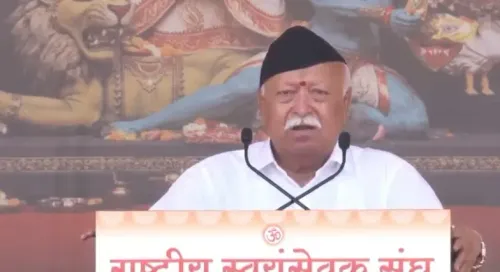
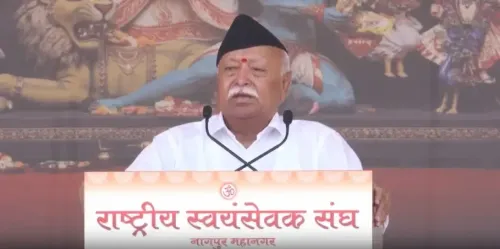
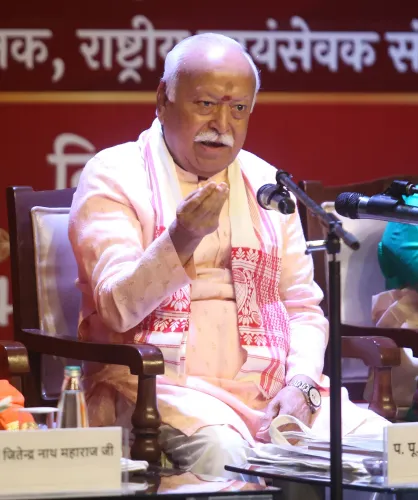
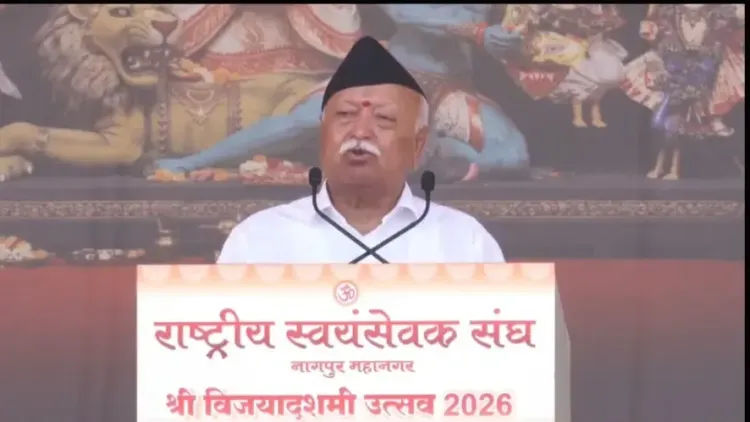
Rashtriya Swayamsevak Sangh (RSS) chief Mohan Bhagwat on Tuesday, 20 October declared that efforts to engineer a 'regime change' in India will not succeed, delivering a pointed warning to domestic and foreign actors during his annual Vijayadashami address in Nagpur. The speech, one of the most closely watched in the RSS calendar, came against the backdrop of anti-Election Commission protests and sustained opposition demands for systemic political overhaul.
The Regime Change Warning
Citing political turmoil observed abroad, Bhagwat drew explicit comparisons with events in France, Bangladesh, and Nepal. 'A storm has blown in the West. Look at what transpired in France, Bangladesh, and Nepal,' he said, cautioning against attempts to replicate such instability inside India.
'Regime change will not happen in India. Such attempts continue in India as well. India has moved forward with steadfast resolve, and the collective vitality (purushartha) of its society has grown,' Bhagwat stated. He argued that even when regimes are dislodged through engineered agitations, the underlying societal problems remain unresolved.
On Protests and Democratic Propriety
While acknowledging public demonstrations as a legitimate feature of democracy, the RSS Sarsanghchalak urged that movements must operate within the 'boundaries of propriety' (mariyada). 'Movements must be directed exclusively towards finding constructive solutions rather than causing friction. Public demonstrations must not sow hatred or hostility among different sections of society. Agitations guided purely by the pursuit of votes or cheap popularity harm long-term stability,' he said.
Bhagwat further cautioned that 'lasting solutions do not emerge from continuous protest alone, but through mutual discourse and constructive dialogue within society.' His remarks are widely seen as an indirect rebuke of opposition-led street movements ahead of upcoming state elections.
National Integration and India as Vishwaguru
Beyond the political commentary, Bhagwat articulated a broader civilisational vision. Invoking the Preamble of the Indian Constitution — 'We, the People of India' — he described emotional integration as the bedrock of the nation. He warned that losing sight of foundational values had historically led to foreign subjugation.
Placing the responsibility of making India a Vishwaguru (world teacher) on the younger generation, he stressed that 'the principle of unity is eternal and unshakeable, whereas our diversity is dynamic. Flexibility in diversity is the hallmark of Sanatan philosophy.'
Ecology, Technology, and Geopolitics
Bhagwat also addressed environmental concerns, warning against development models that disregard ecological balance — particularly in the wake of recent natural calamities in Nepal and the broader Himalayan belt. He called for sustainable and inclusive progress.
On technology, he welcomed the benefits of information accessibility but stressed the need for critical thinking, moral discretion, and regulatory oversight to ensure accurate and safe information flow. Highlighting growing global conflicts, he asserted that India holds the ideological answers to world peace.
Significance and What Comes Next
The Vijayadashami address is the RSS's most consequential annual statement, setting the ideological tone for the organisation's vast network nationwide. This year's speech is notable for its unusually explicit engagement with electoral politics and foreign policy parallels. Political parties and opposition groups are expected to respond in the coming days, and the remarks are likely to shape political discourse ahead of several state assembly elections on the horizon.
Point of View
Naming foreign nations by name and framing domestic protests as potentially destabilising. The Bangladesh and Nepal references carry weight precisely because both involved rapidly collapsed governments; invoking them alongside anti-Election Commission agitations is a deliberate rhetorical move. Critics will argue the speech conflates legitimate constitutional dissent with foreign-funded subversion, a distinction Bhagwat left deliberately blurred. What mainstream coverage may underplay is that the 'regime change' framing mirrors language increasingly used by ruling-coalition figures — suggesting a coordinated ideological counter-offensive rather than an independent organisational assessment.
NationPress
20 Oct 2026
Frequently Asked Questions
What did Mohan Bhagwat say about regime change in India?
RSS chief Mohan Bhagwat declared at his Vijayadashami address on 20 October 2026 that attempts to force a regime change in India will not succeed. He cited India's collective resolve and societal strength as the reasons such attempts are destined to fail.
Why did Bhagwat reference France, Bangladesh, and Nepal?
Bhagwat drew comparisons with recent political upheavals in France, Bangladesh, and Nepal to warn against similar destabilisation tactics being used inside India. He described these as examples of engineered unrest that did not solve underlying societal problems even after governments changed.
What did Bhagwat say about public protests and democracy?
Bhagwat acknowledged protests as a natural part of democracy but said movements must stay within the 'boundaries of propriety' and aim for constructive solutions. He warned that agitations driven by electoral or popularity motives harm long-term stability and social harmony.
What is the Vijayadashami address and why does it matter?
The Vijayadashami address is the RSS's most important annual speech, delivered by the Sarsanghchalak each year to outline the organisation's ideological positions and national priorities. It is closely watched by policymakers, political parties, and the media as a signal of the RSS's direction.
What broader themes did Bhagwat cover beyond politics?
Beyond the political warning, Bhagwat spoke about sustainable development, cautioning against ecologically destructive growth in the Himalayan belt. He also addressed technology regulation, the need for critical thinking in the information age, and India's civilisational responsibility to serve as a Vishwaguru or world teacher.