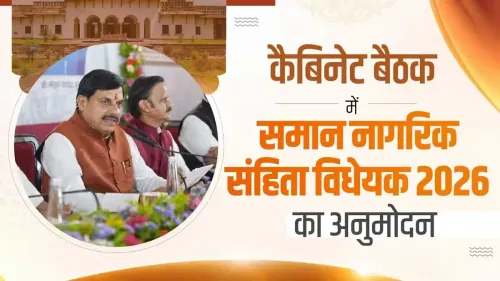
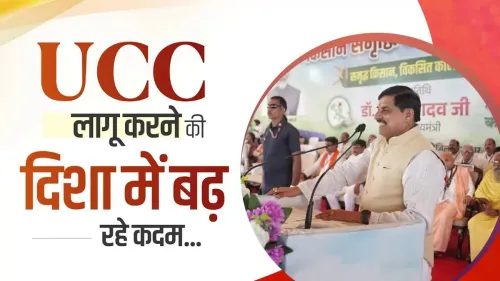
MP CM Mohan Yadav hails UCC bill passed by state assembly
Synopsis
The Madhya Pradesh Legislative Assembly passed the 'Madhya Pradesh Samaan Nagrik Sanhita, 2026' by voice vote on 21 July 2026. CM Dr. Mohan Yadav hailed it as a historic milestone for equality, women's empowerment and constitutional values, making MP the second BJP state after Uttarakhand to enact a UCC law.
Key Takeaways
The Madhya Pradesh Legislative Assembly passed the Madhya Pradesh Samaan Nagrik Sanhita, 2026 (UCC bill) by voice vote on 21 July 2026 .
Mohan Yadav called the passage a 'golden chapter' in the state's history and congratulated all residents of Madhya Pradesh .
Madhya Pradesh becomes the second Indian state, after Uttarakhand (February 2024), to enact fresh Uniform Civil Code legislation.
The UCC is grounded in Article 44 of the Indian Constitution and replaces religion-based personal laws on marriage, inheritance and adoption.
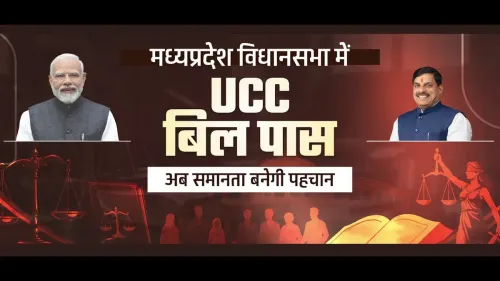
CM Yadav credited PM Narendra Modi , Home Minister Amit Shah , and BJP national president Nitin Nabin for the party's legislative direction.
The law's practical effect depends on rules framing and an implementation timeline; court challenges remain a possibility.
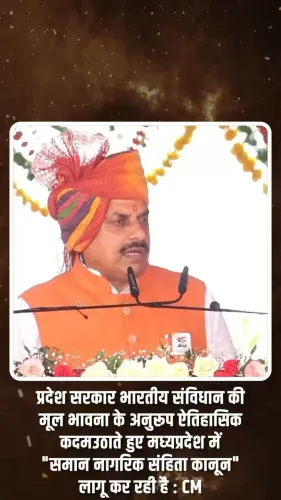
Madhya Pradesh Chief Minister Dr. Mohan Yadav announced on Tuesday, 21 July 2026 that the Madhya Pradesh Legislative Assembly had passed the 'Madhya Pradesh Samaan Nagrik Sanhita, 2026' — the state's Uniform Civil Code (UCC) bill — by voice vote, calling it a golden chapter in the state's history.
Context
Posting on X, Dr. Yadav described the passage of the bill as historic, declaring: 'Madhya Pradesh ke itihas mein aaj ek swarnim adhyay juda hai' ('Today a golden chapter has been added to the history of Madhya Pradesh'). He credited the leadership of Prime Minister Narendra Modi, Union Home Minister Amit Shah, and BJP national president Nitin Nabin for guiding the party toward this legislative milestone. The CM also extended congratulations to all residents of the state.
In a pointed historical reference, Dr. Yadav noted that the decision to implement the UCC was announced from the soil of Jagadishpur, which he said had historically been renamed Islamnagar by foreign powers who imposed Sharia law there — framing the legislation as a symbolic reclamation of constitutional equality on that ground.
Policy Backdrop
The Uniform Civil Code is rooted in Article 44 of the Indian Constitution, a Directive Principle that instructs the State to endeavour to secure a uniform civil code for citizens across marriage, inheritance, adoption and succession. Goa has long maintained a common civil code inherited from Portuguese colonial law, standing as the only longstanding state-level precedent.
Uttarakhand became the first state to enact a fresh UCC law in February 2024, setting a legislative template that BJP-governed states have since looked to replicate. The BJP's 2019 national manifesto had explicitly reiterated the party's commitment to a Uniform Civil Code, making the Madhya Pradesh bill a direct fulfilment of that platform promise at the state level.
Stakeholders and Impact
Dr. Yadav framed the law primarily as an instrument of women's empowerment, stating it would 'set a new example of women's empowerment along with equal justice, equal rights and our commitment to constitutional values.' Women's groups have broadly supported UCC proposals as a check on personal-law provisions that critics say disadvantage women in divorce, inheritance and maintenance across certain religious communities.
The legislation affects all residents of Madhya Pradesh — including members of all religious communities — by replacing religion-specific personal laws with a single civil framework. Religious bodies and minority community organisations have historically raised concerns about the UCC's impact on faith-based customs, and similar debates are expected to accompany the rollout of the Madhya Pradesh law.
What's Next
The passage of the bill by voice vote marks the legislative stage; the law will now require the state government to frame rules and set an implementation timeline before it takes practical effect. Legal challenges before the courts remain a possibility, as has been the pattern with other major personal-law reforms in India.
With Madhya Pradesh now joining Uttarakhand in enacting state-level UCC legislation, attention will turn to whether other BJP-governed states accelerate parallel efforts — and whether the central government moves toward a national framework, a debate that continues to animate Indian constitutional discourse.
Point of View
And signals that the BJP is systematically building a state-by-state legislative record on a plank it has carried since 1989. For CM Dr. Mohan Yadav, the bill is also a political consolidation move — anchoring his government's identity around constitutional nationalism ahead of any future electoral cycle. The historical framing around Jagadishpur/Islamnagar indicates the party intends to deploy cultural memory as a mobilising narrative alongside the legal reform. Whether the law withstands judicial scrutiny will determine whether it becomes a durable policy landmark or a prolonged constitutional contest.
NationPress
20 Oct 2026
Frequently Asked Questions
What is the Madhya Pradesh Uniform Civil Code 2026?
The 'Madhya Pradesh Samaan Nagrik Sanhita, 2026' is a state law passed by the Madhya Pradesh Legislative Assembly by voice vote on 21 July 2026. It replaces religion-specific personal laws with a single civil framework covering marriage, inheritance, adoption and succession for all residents of the state.
Which Indian states have passed a Uniform Civil Code law?
As of July 2026, Uttarakhand (February 2024) and Madhya Pradesh (July 2026) are the two Indian states to have enacted fresh Uniform Civil Code legislation. Goa has maintained a common civil code inherited from Portuguese colonial law for decades.
What is Article 44 of the Indian Constitution?
Article 44 is a Directive Principle of State Policy that directs the State to endeavour to secure a Uniform Civil Code for all citizens of India. It is non-justiciable but has guided legislative debate on replacing religion-based personal laws.
How does the UCC affect women in Madhya Pradesh?
CM Dr. Mohan Yadav stated the law will 'set a new example of women's empowerment' by ensuring equal rights in areas such as marriage, divorce, inheritance and maintenance — replacing personal-law provisions that critics argue disadvantage women in certain religious communities.
What happens after the MP UCC bill is passed in the assembly?
After assembly passage, the state government must frame rules and notify an implementation timeline before the law takes practical effect. The legislation may also face legal challenges in courts, as has been the pattern with major personal-law reforms in India.