MP CM Mohan Yadav Signals Push for Uniform Civil Code
Synopsis
The Chief Minister's Office of Madhya Pradesh, tagging CM Dr. Mohan Yadav, publicly signalled a push to enact the Uniform Civil Code in the state on 20 August 2026, framing it as a new foundation for equality and justice — a move that could follow Uttarakhand's landmark 2024 UCC legislation.
Key Takeaways
The Chief Minister's Office of Madhya Pradesh publicly signalled a push for the Uniform Civil Code (UCC) on 20 August 2026 , tagging CM Dr.
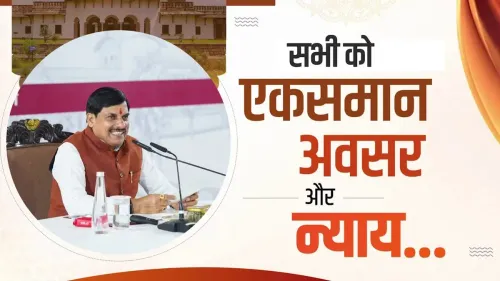
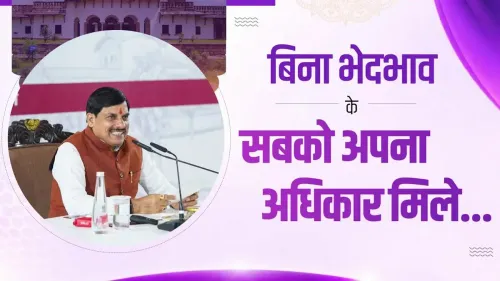
The post framed UCC as giving 'a new foundation to the resolve for equality and justice' in the state.
The UCC would replace religion-specific personal laws on marriage, divorce, inheritance and adoption with a single civil framework.
Article 44 of the Constitution has directed the state to pursue a UCC since 1950 ; the BJP's 2019 manifesto explicitly committed to enacting it.
Uttarakhand became the first state to pass a UCC law in 2024 , providing a legislative template Madhya Pradesh could follow.
Concrete next steps — an expert committee, a draft bill, or Assembly introduction — have not yet been officially announced.
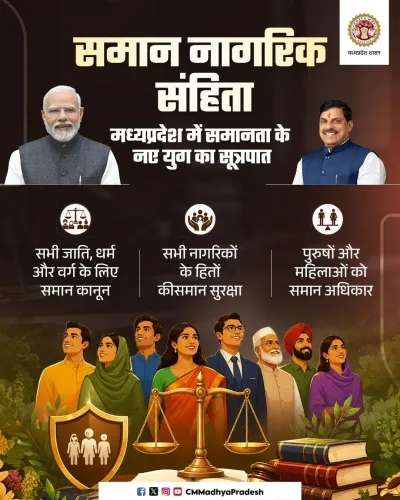
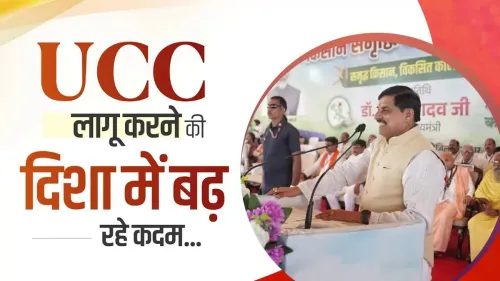
A new front in India's long-running debate over personal law opened on Thursday, 20 August 2026, as the Chief Minister's Office of Madhya Pradesh signalled a renewed commitment to enacting the Uniform Civil Code (UCC) in the state — framing it as the foundation of equality and justice for every resident of Madhya Pradesh.
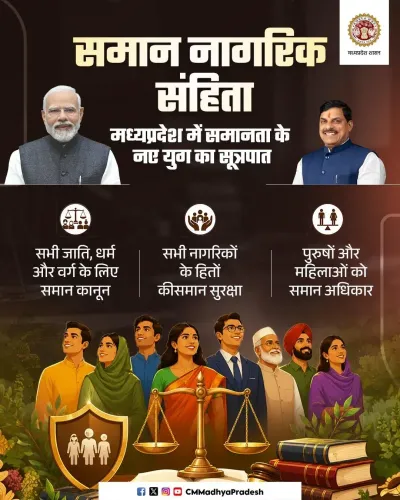
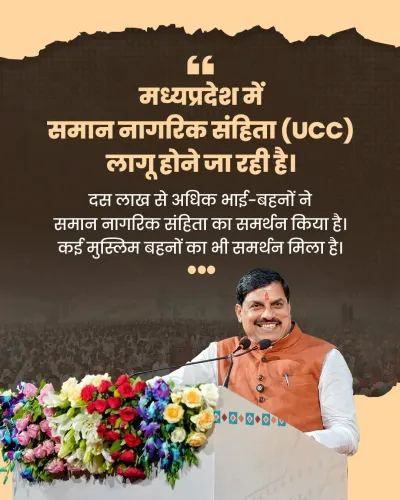
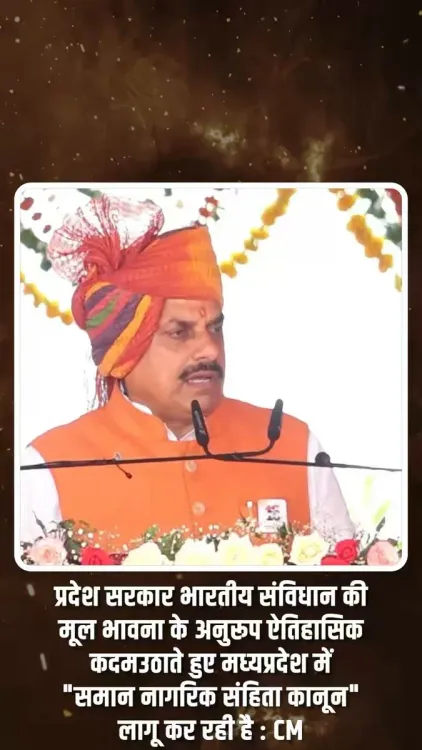
The post, tagging Chief Minister Dr. Mohan Yadav, declared in Hindi: 'Samaan Nagrik Sanhita Kanoon' — 'the Uniform Civil Code law' — would give 'a new foundation to the resolve for equality and justice in Madhya Pradesh.' Brief, but pointed. This is not background noise; it is a deliberate public signal from the state's top office.
What the UCC would actually change
The Uniform Civil Code proposes a single set of civil laws — governing marriage, divorce, inheritance, and adoption — to replace the patchwork of religion-specific personal laws currently in force across India. Article 44 of the Constitution has directed the state to pursue this goal since 1950, but it has remained a directive principle, not a mandate. The gap between aspiration and legislation has persisted for over seven decades.
Uttarakhand broke that deadlock in 2024, becoming the first Indian state to pass a UCC law. That move reframed the debate: the question shifted from 'if' to 'who's next.' Madhya Pradesh, governed by the BJP continuously since 2003 (barring a brief interlude), is a natural candidate to follow.
Dr. Mohan Yadav's BJP and the UCC's political DNA
Dr. Mohan Yadav took charge as Chief Minister in December 2023, succeeding the long-serving Shivraj Singh Chouhan. His government inherits a state apparatus that has consistently aligned with the BJP's national platform — which has carried an explicit UCC commitment since at least the 2019 general election manifesto. Signalling UCC now is, for this government, both ideologically consistent and politically strategic.
Proponents argue the code would advance gender justice — particularly for Muslim and tribal women whose inheritance and divorce rights differ sharply under current personal laws. Critics, including several religious communities and opposition parties, warn that a uniform code risks overriding constitutionally protected religious freedoms. That tension is precisely what makes this signal consequential.
What comes next in Madhya Pradesh
A social-media post, however charged, is not a bill. The concrete milestones to watch: formation of a state expert committee, release of a draft bill, and eventual introduction of legislation in the Madhya Pradesh Legislative Assembly. None of those steps has been publicly confirmed yet. But in Indian politics, a Chief Minister's Office post with this language is rarely idle — it is typically the first public beat of a legislative drum.
If Madhya Pradesh tables a UCC bill, it would add significant momentum to a national conversation that is already moving. The state's size — over 85 million residents — means its legislative choices carry weight far beyond its borders.
Point of View
Still consolidating his identity as CM, championing UCC offers both ideological credibility within the party and a high-visibility governance narrative. The real test will be whether this translates into a draft bill or expert committee within months, or remains ambient positioning ahead of the next electoral cycle. Either way, it keeps the national UCC debate alive and pressures the Centre to accelerate its own timeline.
NationPress
20 Aug 2026
Frequently Asked Questions
What is the Uniform Civil Code and why does it matter in India?
The Uniform Civil Code (UCC) is a proposed single set of civil laws covering marriage, divorce, inheritance and adoption for all citizens, replacing religion-specific personal laws. It has been a directive principle under Article 44 of the Constitution since 1950 and is central to debates on gender justice and national integration in India.
Has any Indian state already implemented the Uniform Civil Code?
Yes. Uttarakhand became the first Indian state to pass a UCC law in 2024, setting a legislative precedent that other BJP-governed states, including Madhya Pradesh, are now expected to follow.
Who is Dr. Mohan Yadav and when did he become Chief Minister of Madhya Pradesh?
Dr. Mohan Yadav is the Chief Minister of Madhya Pradesh, having assumed office in December 2023 after succeeding the long-serving Shivraj Singh Chouhan following the BJP's state election victory.
What would the UCC change for residents of Madhya Pradesh?
If enacted, the UCC would replace existing religion-specific personal laws with a uniform framework governing marriage, divorce, inheritance and adoption — most significantly affecting rights currently governed by Muslim personal law and various tribal customary laws in the state.
What are the next steps to watch for UCC in Madhya Pradesh?
The key milestones are: formation of a state expert committee to draft the code, release of a draft bill for public consultation, and formal introduction of legislation in the Madhya Pradesh Legislative Assembly. None of these steps has been officially confirmed as of the post date.