MP CM Office Backs 'Viksit Bharat-Jee Ram Jee Act' for Rural Jobs
Synopsis
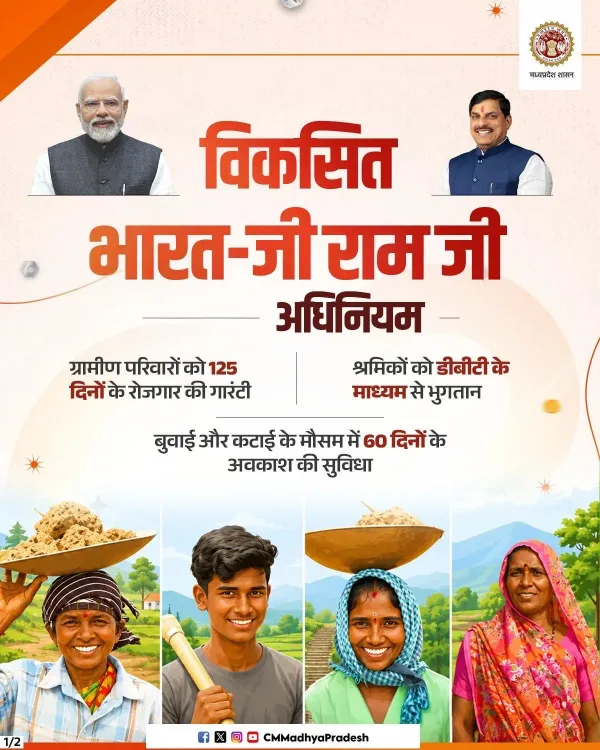
The Chief Minister's Office of Madhya Pradesh has championed the 'Viksit Bharat-Jee Ram Jee Act,' promising 125 days of employment and direct bank transfers for rural workers — extending beyond MGNREGA's 100-day central guarantee and aligning with the Viksit Bharat 2047 vision.
Key Takeaways
The Chief Minister's Office of Madhya Pradesh promoted the 'Viksit Bharat-Jee Ram Jee Adhiniyam' on 15 July 2026 , describing it as a pillar of rural progress and labour empowerment.
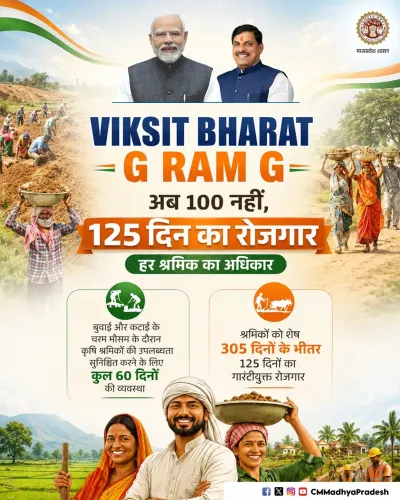
The initiative promises 125 days of employment — 25 days more than the 100-day guarantee under the central MGNREGA, 2005 .
Wages under the scheme are to be disbursed through Direct Benefit Transfer (DBT) , depositing payments directly into workers' bank accounts.
Mohan Yadav was tagged in the post, indicating his office's direct association with the announcement.
The scheme is framed within the national Viksit Bharat 2047 vision, linking state rural welfare policy to India's long-term development roadmap.
Gram panchayats and rural labourers across Madhya Pradesh are the key stakeholders in implementation and benefit delivery.
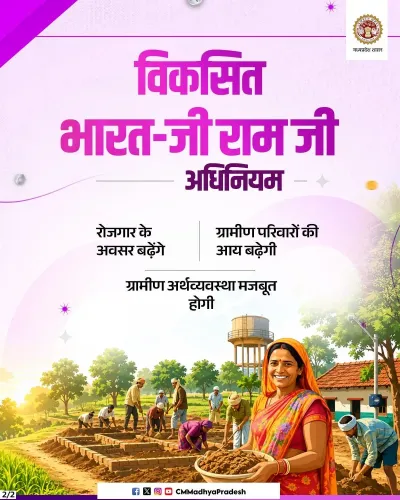
The Chief Minister's Office of Madhya Pradesh on Wednesday, 15 July 2026, highlighted a welfare initiative described as the 'Viksit Bharat-Jee Ram Jee Adhiniyam' ('Viksit Bharat-Jee Ram Jee Act'), calling it a strong foundation for rural progress and the empowerment of labourers in the state.
Context
The official post from @CMMadhyaPradesh, tagging Chief Minister Dr. Mohan Yadav and the state's rural development ministry, outlined two key features of the initiative: a guarantee of 125 days of employment and wage payments to workers through the Direct Benefit Transfer (DBT) mechanism. The post described the scheme as a 'strong foundation for the progress of rural India and the empowerment of labourers.'
The announcement positions the measure as a state-level effort to advance rural welfare, framed within the broader national Viksit Bharat 2047 vision — the Government of India's long-term development roadmap targeting a developed India by the centenary of Independence.
Policy Backdrop
India's foundational rural employment guarantee framework is the Mahatma Gandhi National Rural Employment Guarantee Act (MGNREGA), 2005, which provides a statutory entitlement of 100 days of wage employment per year to rural households. The initiative cited in the post, if enacted as a supplementary state measure, would extend that guarantee by 25 additional days for eligible workers in Madhya Pradesh.
Indian states have periodically built upon the MGNREGA framework after 2020 to counter seasonal unemployment, particularly in agrarian economies. The integration of DBT for wage disbursement is consistent with a nationwide push to eliminate intermediaries, reduce leakages, and ensure timely payment directly into beneficiaries' bank accounts.
Dr. Mohan Yadav has served as Chief Minister of Madhya Pradesh since December 2023 and has overseen the state's rural development and welfare agenda during this period. Madhya Pradesh has a large rural workforce, making employment guarantee schemes a significant policy lever for the state government.
Stakeholders and Impact
The primary beneficiaries of this initiative are rural labourers and households across Madhya Pradesh, particularly those dependent on wage employment during agricultural off-seasons. Gram panchayats are central to the delivery mechanism, as they typically plan, approve, and oversee works under employment guarantee frameworks at the local level.
The DBT payment channel is intended to reduce delays and ensure that wages reach workers without deductions. For rural households in a state where agriculture remains the dominant livelihood, an extended employment guarantee can provide a critical income buffer during lean months.
What's Next
Attention will now turn to district-level rollout details, including how works will be identified, how the additional 25 days beyond MGNREGA's central entitlement will be funded, and what targets have been set for beneficiary coverage. Fund utilisation reports and provisions in the next Madhya Pradesh state budget or panchayat-level planning cycles will offer clearer signals about the initiative's scale and implementation pace.
If the state follows through with robust implementation, the initiative could serve as a model for other large agrarian states looking to supplement central employment guarantees with locally-funded extensions and technology-enabled payments.
Point of View
Giving the state scheme a national ideological anchor. Extending employment days beyond MGNREGA's 100-day floor and pairing it with DBT signals an attempt to address two persistent rural welfare criticisms: inadequate work availability and wage leakages. For CM Dr. Mohan Yadav, the announcement reinforces his administration's rural-first positioning ahead of future electoral cycles in a state where agrarian distress has historically shaped political outcomes. Whether the scheme translates into on-ground impact will depend on the pace of district-level rollout and the state's fiscal headroom to fund the additional days.
NationPress
15 Jul 2026
Frequently Asked Questions
What is the Viksit Bharat-Jee Ram Jee Adhiniyam in Madhya Pradesh?
It is a rural employment initiative announced by the Madhya Pradesh government, described as guaranteeing 125 days of employment to rural workers and paying wages through the Direct Benefit Transfer (DBT) mechanism.
How does the MP scheme differ from MGNREGA?
MGNREGA, the central government's flagship scheme, guarantees 100 days of wage employment per year to rural households. The Madhya Pradesh initiative claims to extend this to 125 days, effectively adding 25 days through a state-level measure.
What is DBT and why is it used for wage payments?
DBT stands for Direct Benefit Transfer, a system that transfers government payments directly into beneficiaries' bank accounts, reducing intermediaries, minimising leakages, and ensuring timely disbursement of wages.
Who are the beneficiaries of this Madhya Pradesh rural employment scheme?
The primary beneficiaries are rural labourers and households in Madhya Pradesh, particularly those who depend on wage employment during agricultural off-seasons. Gram panchayats are involved in planning and implementing the works.
What is the Viksit Bharat 2047 vision that this scheme is linked to?
Viksit Bharat 2047 is the Government of India's long-term development goal of making India a developed nation by 2047, the centenary of Independence. State governments have been aligning welfare and infrastructure schemes with this national vision.