MP CM Office Cuts Cotton Mandi Fee from 1% to 0.5%
Synopsis
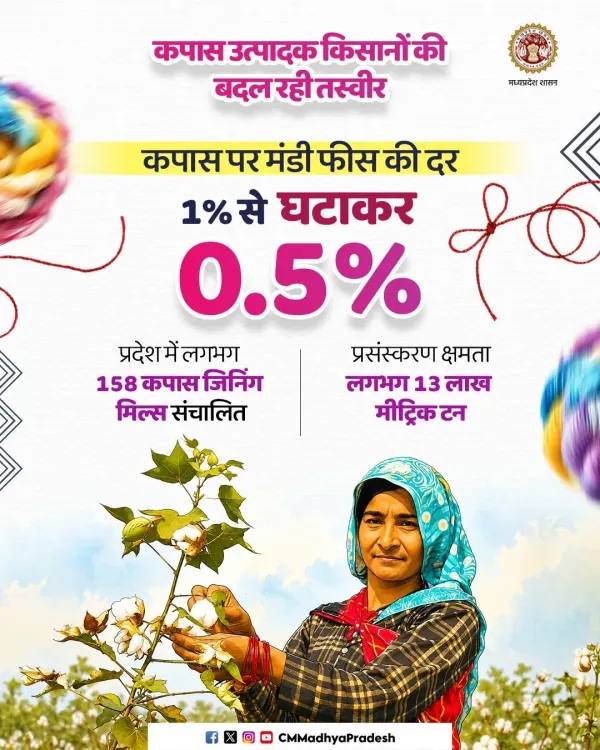
The Chief Minister's Office of Madhya Pradesh has halved the mandi fee on cotton transactions from 1 per cent to 0.5 per cent, offering direct cost relief to cotton growers and traders operating through state APMC markets.
Key Takeaways
The Chief Minister's Office of Madhya Pradesh announced a cut in cotton mandi fee on 17 July 2026 .
The mandi fee rate on cotton has been reduced from 1 per cent to 0.5 per cent — a 50 per cent reduction in the levy.
The fee applies to transactions at APMC mandis , the state-regulated agricultural markets.
Cotton growers in Madhya Pradesh are the primary beneficiaries, retaining more of their sale proceeds.
The move is part of a broader pattern of Indian states adjusting mandi fee structures to lower transaction costs for farmers.
Implementation across mandi yards and its impact on seasonal cotton arrivals will be the next key milestone to watch.
The Chief Minister's Office of Madhya Pradesh announced on Friday, 17 July 2026 a reduction in the mandi fee rate on cotton from 1 per cent to 0.5 per cent, signalling a direct relief measure for cotton growers and traders transacting through state-regulated agricultural markets.
Context
The post, shared from the official @CMMadhyaPradesh handle, states in Hindi: 'कपास पर मंडी फीस की दर 1% से घटाकर की गई 0.5%' — meaning 'The mandi fee rate on cotton has been reduced from 1% to 0.5%.' The announcement applies to transactions conducted through Agricultural Produce Market Committee (APMC) mandis, the state-regulated markets where farmers and traders buy and sell agricultural produce.Policy Backdrop
Madhya Pradesh is among the leading cotton-producing states in central India, with a substantial share of farmland under the crop each season. APMC mandis levy fees on produce transactions, and these charges directly affect the net returns farmers receive and the overall competitiveness of the market. Indian states have periodically revised mandi fee structures as part of broader agricultural marketing reforms aimed at lowering transaction costs without dismantling the APMC framework itself. A halving of the cotton mandi fee — from 1 per cent to 0.5 per cent — represents a meaningful reduction in the cost borne at the point of sale.Stakeholders and Impact
The primary beneficiaries of this revision are cotton growers across Madhya Pradesh, who stand to retain a larger share of the sale price for their produce. APMC traders and commission agents who facilitate transactions within the mandi ecosystem will also operate under a lower fee environment, potentially encouraging higher volumes of formal market arrivals. A reduced mandi fee can make state mandis more attractive relative to private or informal channels, nudging trade back into the regulated system and improving price discovery for farmers.What's Next
The key question is how swiftly the revised 0.5 per cent rate will be operationalised across mandi yards ahead of the cotton arrival season. State agricultural marketing authorities will need to notify the change formally through APMC channels. Any subsequent review of fee collections and their impact on mandi revenue will be closely watched by both farmer groups and market regulators. If the lower fee demonstrably improves farmer realisations, it could prompt the state to examine similar rationalisation for other cash crops within the APMC framework.Point of View
Low-friction intervention that costs the state relatively little in revenue while delivering a visible, quantifiable benefit to farmers at the point of sale — the kind of measure that plays well in an agrarian state without requiring legislative change. It fits a pattern of state governments using APMC fee adjustments as a substitute for deeper structural reform, avoiding the political complexity of dismantling the mandi system while still signalling farmer-friendliness. The timing, ahead of the cotton arrival season, suggests the announcement is calibrated for maximum on-ground visibility among growers. Whether it translates into meaningfully higher net realisations will depend on how quickly mandis operationalise the new rate and whether traders pass the saving through to farmers.
NationPress
17 Jul 2026
Frequently Asked Questions
What is the new mandi fee on cotton in Madhya Pradesh?
The mandi fee on cotton in Madhya Pradesh has been reduced to 0.5 per cent , down from the earlier rate of 1 per cent , as announced by the Chief Minister's Office on 17 July 2026.
Who benefits from the cotton mandi fee cut in MP?
Cotton farmers selling their produce through APMC mandis in Madhya Pradesh are the primary beneficiaries, as they will now pay a lower transaction fee, improving their net returns. Traders and commission agents in the mandi system also benefit from the reduced levy.
What is an APMC mandi and how does the fee work?
An APMC (Agricultural Produce Market Committee) mandi is a state-regulated market where farmers sell agricultural produce. A mandi fee, also called market fee, is charged as a percentage of the transaction value and is typically borne by the buyer or deducted from the farmer's sale proceeds.
Why do states reduce mandi fees on crops like cotton?
States reduce mandi fees to lower the overall transaction cost in regulated markets, making them more competitive and encouraging farmers to sell through formal channels. It is a common tool in agricultural marketing reform that does not require dismantling the APMC framework.
When will the new 0.5% cotton mandi fee be effective in Madhya Pradesh?
The Chief Minister's Office announced the reduction on 17 July 2026 . The formal operationalisation across APMC mandi yards is the next step, and the revised rate is expected to apply during the upcoming cotton arrival season.