MP CMO launches Gopal-Krishna Gram Puraskar in 208 villages
Synopsis
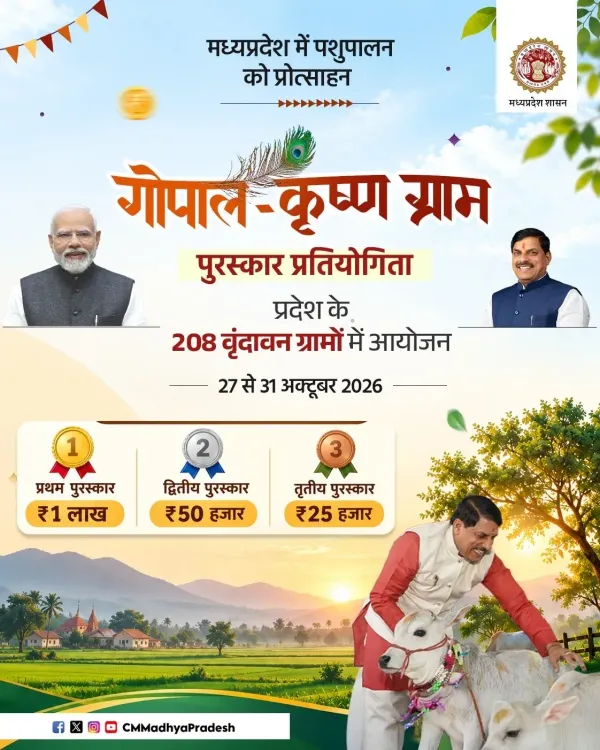
Madhya Pradesh's CMO has launched the Gopal-Krishna Gram Puraskar Pratiyogita across 208 Vrindavan villages from October 27-31, 2026, rewarding farmers who excel in cow welfare and animal husbandry under CM Dr. Mohan Yadav's rural welfare push.
Key Takeaways
The Gopal-Krishna Gram Puraskar Pratiyogita is being held across 208 Vrindavan villages in Madhya Pradesh.
The competition runs for five days — 27 to 31 October 2026 .
Outstanding pashupalaks (animal husbandry practitioners) will be formally awarded by the state government.
The initiative is backed by CM Dr.
Mohan Yadav and the MP Department of Animal Husbandry .
MP has expanded gaushalas and livestock development programmes steadily over the past decade as part of rural welfare strategy.
Competition results and potential expansion of the scheme beyond the initial 208 villages are the key developments to watch.
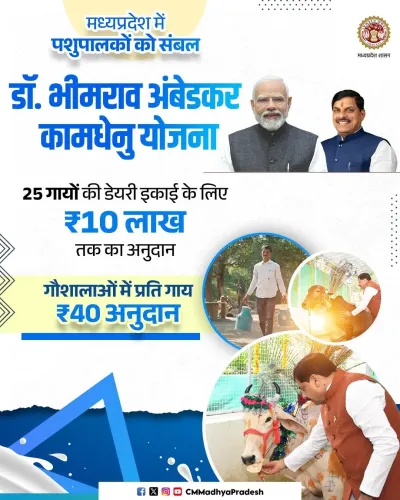
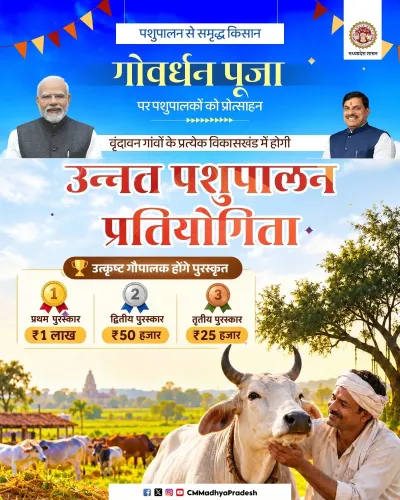
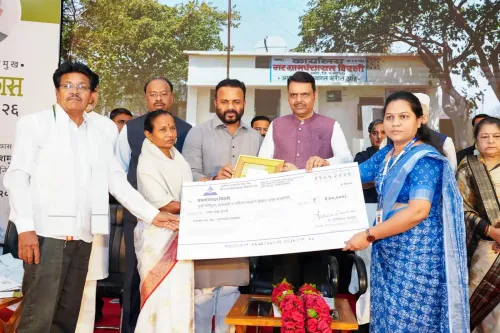
Cattle care meets competitive spirit across rural Madhya Pradesh — the Chief Minister's Office of Madhya Pradesh has announced the 'Gopal-Krishna Gram Puraskar Pratiyogita', a livestock award competition spanning 208 Vrindavan villages of the state, running from 27 to 31 October 2026. The initiative honours outstanding pashupalaks (animal husbandry practitioners) who demonstrate excellence in livestock rearing and cow welfare.
208 villages, five days, one mission for livestock welfare
The competition, rolled out simultaneously across 208 designated Vrindavan villages in Madhya Pradesh, is designed to identify and reward farmers who excel in goseva (cow service) and pashupalan (animal husbandry). The five-day window — 27 through 31 October — creates a focused, time-bound push across these villages, with top-performing livestock farmers set to receive awards from the state government. Chief Minister Dr. Mohan Yadav and the state's Department of Animal Husbandry are the key institutional drivers behind the event.
How MP's Vrindavan village model fits the bigger rural picture
Madhya Pradesh has, over the past decade, steadily expanded its network of gaushalas and livestock development programmes as part of a broader rural welfare strategy. The 'Vrindavan Gram' concept — naming select villages after the sacred town linked to Lord Krishna — carries both cultural symbolism and a policy purpose: anchoring livestock protection within a community identity that rural voters connect with deeply.
Award-based competitions of this kind are a recognised tool in state-level agricultural policy, using incentives to lift best practices on the ground. BJP-governed states in particular have paired cow-protection narratives with tangible economic benefits for farmers — a dual approach that serves both cultural constituencies and rural livelihood goals.
What pashupalaks stand to gain
For the farmers participating, the prize is more than a trophy. Recognition from the state signals access to networks, potential scheme benefits, and the kind of peer visibility that drives adoption of better livestock practices across neighbouring villages. The MP Department of Animal Husbandry has historically used such competitions as a pipeline to identify model farmers who then become local ambassadors for scientific rearing techniques.
Eyes will now turn to the results announced after 31 October — and whether the Gopal-Krishna Gram Puraskar expands beyond its current 208-village footprint.
Point of View
' the Madhya Pradesh government simultaneously invokes a powerful cultural identity and deploys a practical incentive structure for livestock farmers. For CM Dr. Mohan Yadav, who took office in December 2023, this initiative reinforces his administration's positioning on both cow welfare and farmer welfare — two constituencies that significantly overlap in MP's rural heartland. The broader question is whether award-based competitions translate into measurable improvements in livestock productivity and farmer incomes, or remain largely symbolic exercises in state branding.
NationPress
27 Oct 2026
Frequently Asked Questions
What is the Gopal-Krishna Gram Puraskar Pratiyogita in Madhya Pradesh?
It is a state government-organised livestock award competition held across 208 Vrindavan villages in Madhya Pradesh from October 27 to 31, 2026, recognising farmers who perform best in cow service and animal husbandry.
When is the Gopal-Krishna Gram Puraskar competition taking place?
The competition runs for five days, from 27 to 31 October 2026 , across 208 designated Vrindavan villages in Madhya Pradesh.
Who will receive awards in the Gopal-Krishna Gram Puraskar?
Outstanding pashupalaks — farmers who demonstrate excellence in goseva (cow welfare) and animal husbandry — will be recognised and awarded by the Madhya Pradesh state government.
What are Vrindavan Gram villages in Madhya Pradesh?
Vrindavan Gram is a designation given to select villages in Madhya Pradesh, connecting them culturally to the sacred town of Vrindavan and aligning them with the state's cow protection and livestock welfare programmes.
What is CM Dr. Mohan Yadav's role in MP's animal husbandry push?
Dr. Mohan Yadav, Chief Minister of Madhya Pradesh since December 2023, has championed rural welfare policies including goseva promotion and livestock development; the Gopal-Krishna Gram Puraskar is a key initiative under his administration.