President Murmu at MS University: AI gives answers, but right questions are yours to ask
Synopsis
At the 75th convocation of Maharaja Sayajirao University of Baroda, President Droupadi Murmu drew a sharp line between AI's capability to generate answers and the student's irreplaceable duty to ask the right questions — framing human agency, not algorithmic speed, as the true purpose of a university education.
Key Takeaways
President Droupadi Murmu addressed the 75th convocation of Maharaja Sayajirao University of Baroda in Vadodara on 23 September 2026 .
She declared that 'AI can provide solutions, but asking the right questions should be your responsibility.' Murmu called for a multidisciplinary approach , arguing that climate change, AI, poverty, and democracy cannot be solved by a single field of study.
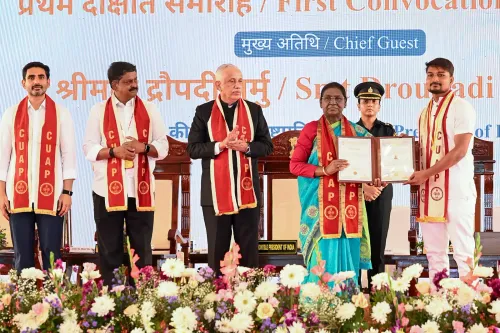
The convocation conferred degrees on 8,863 Bachelor's , 2,857 Master's , 229 PhD candidates, and 657 Postgraduate Diploma holders.
She urged students to combine technological capability with the constitutional values of justice, liberty, equality, and fraternity.
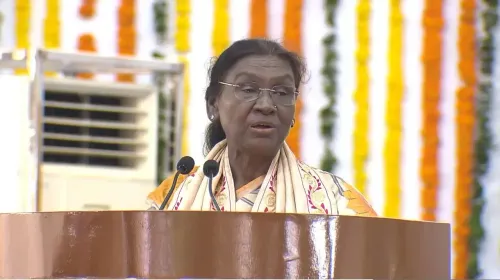
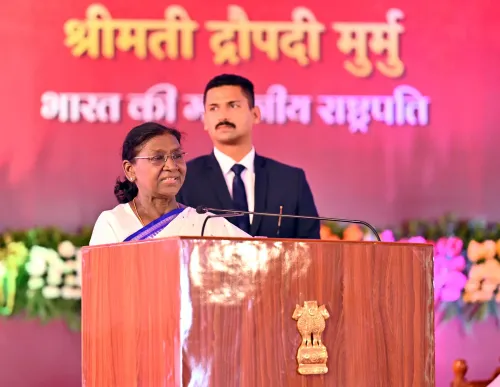
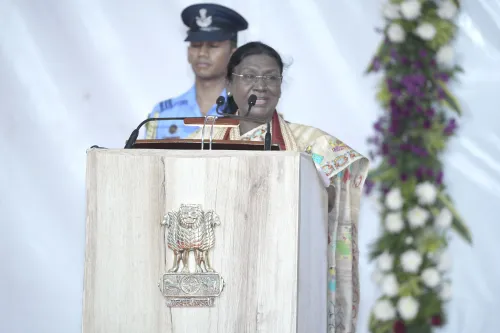
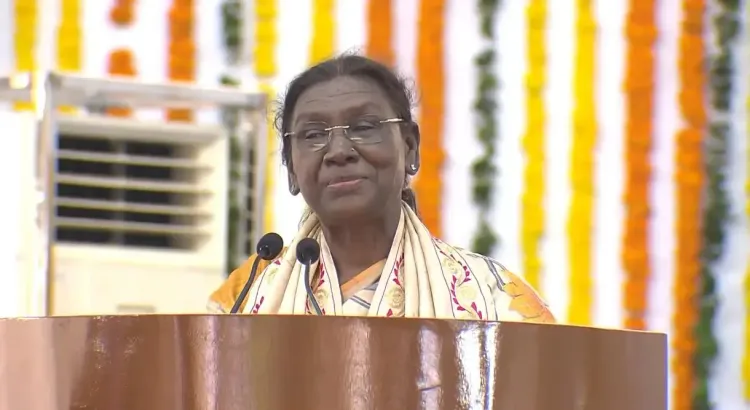
President Droupadi Murmu on Wednesday, 23 September 2026, called for a multidisciplinary approach in higher education at the 75th convocation of the Maharaja Sayajirao University of Baroda (MS University) in Vadodara, Gujarat, asserting that the most pressing challenges of our time — from climate change to artificial intelligence — cannot be solved by any single academic discipline.
The Core Message on AI and Human Judgement
At the heart of President Murmu's address was a pointed caution about over-reliance on technology. 'Artificial intelligence can provide solutions, but asking the right questions should be your responsibility,' she told graduating students. She added that while technology could deliver speed, students themselves must decide the direction in which it is applied — a distinction between capability and conscience that resonated across the university's broad academic spectrum.
This comes at a time when Indian universities are grappling with how to integrate AI tools into curricula without eroding critical thinking. Murmu's remarks signal that the highest constitutional office views human agency — not algorithmic output — as the non-negotiable core of education.
The Case for Multidisciplinary Education
President Murmu argued that contemporary problems are structurally interdisciplinary. 'Climate change is not only a subject of environmental studies. Artificial intelligence is not only a subject of computer science. Health is not only a subject of medicine or medical science. Poverty alleviation is not only the subject of an economist. Democracy is not only the subject of political science,' she said, making the case that siloed specialisations are inadequate for the complexity of the present moment.
She urged students to cultivate what she described as a composite intellectual sensibility: 'We need the curiosity of a scientist, the sensitivity of an artist, the perspective of a historian, an understanding of economics and the consciousness of sociology.' Notably, this framing positions humanistic and social understanding as equally vital as technical expertise — a counterweight to the STEM-first narrative dominant in much of India's higher education policy debate.
MS University's Academic Breadth in the Spotlight
President Murmu praised MS University specifically for its rare breadth, spanning faculties of Arts, Science, Education and Psychology, Commerce, Technology and Engineering, Medicine, Law, Fine Arts, Family and Community Sciences, Social Work, Performing Arts, Management Studies, Journalism and Communication, and Pharmacy. 'From arts to science, technology to medicine, law to social work, fine arts to performing arts, management to journalism, this university is providing education in many fields of knowledge,' she said, positioning the institution as a natural incubator for the cross-disciplinary thinking she was advocating.
Convocation by the Numbers
The 75th convocation saw degrees and diplomas conferred across the university's full range of faculties. According to the convocation declaration, 229 candidates qualified for Doctor of Philosophy degrees, 2,857 for Master's degrees, 8,863 for Bachelor's degrees, and 657 for Postgraduate Diplomas.
Constitutional Values as a Compass
Beyond technology and academia, President Murmu urged graduates to internalise constitutional ideals. She called on educated citizens to incorporate the values of 'justice, liberty, equality and fraternity' — enshrined in India's Constitution — into their lives and workplaces. Combining technological capability with human values and constitutional principles, she argued, is not optional but expected of every degree-holder.
As AI reshapes the contours of knowledge work, Murmu's address at Vadodara offers an early institutional marker: India's constitutional head is asking universities — and their graduates — to resist intellectual passivity and reclaim the act of questioning as a fundamentally human responsibility.
Point of View
It is a policy signal. What mainstream coverage tends to miss is the implicit critique of India's STEM-first education orthodoxy — Murmu's call for the 'sensitivity of an artist' and the 'consciousness of sociology' alongside technical skills is a quiet challenge to the dominant National Education Policy framing that still weights outcomes over inquiry. Whether universities translate this into revised pedagogy, or whether the speech fades as most convocation addresses do, will be the real measure of its impact.
NationPress
23 Sept 2026
Frequently Asked Questions
What did President Murmu say about artificial intelligence at the MS University convocation?
President Droupadi Murmu said 'Artificial intelligence can provide solutions, but asking the right questions should be your responsibility,' urging students to exercise human judgement over technological speed. She also noted that technology offers direction only when humans consciously decide how to apply it.
Why did President Murmu call for a multidisciplinary approach in education?
Murmu argued that major contemporary challenges — climate change, AI, poverty alleviation, public health, and democracy — are inherently interconnected and cannot be adequately addressed by any single academic discipline. She said solving today's important problems requires drawing knowledge from multiple fields simultaneously.
How many degrees were awarded at the MS University 75th convocation?
According to the convocation declaration, 8,863 candidates qualified for Bachelor's degrees, 2,857 for Master's degrees, 229 for Doctor of Philosophy degrees, and 657 for Postgraduate Diplomas at the 75th convocation of Maharaja Sayajirao University of Baroda.
What constitutional values did President Murmu ask students to uphold?
President Murmu urged graduates to incorporate the ideals of justice, liberty, equality, and fraternity — as enshrined in India's Constitution — into both their personal lives and their workplaces. She called on educated citizens to combine these values with their technological capabilities.
What is Maharaja Sayajirao University of Baroda known for?
MS University in Vadodara, Gujarat, is one of India's few universities with a genuinely comprehensive academic range, spanning faculties from Arts and Science to Fine Arts, Social Work, Performing Arts, Law, Medicine, and Pharmacy. President Murmu cited this breadth as making it uniquely placed to foster the cross-disciplinary thinking she was advocating.