NFR Boosts Rail Safety: 1,258 Batteries, 5 Stations Upgraded in March 2026
Synopsis
Northeast Frontier Railway replaced 1,258 signalling batteries, installed thick web switch machines at 5 stations, interlocked level crossings, and commissioned fire alarms across Assam, West Bengal, and Bihar in March 2026 — one of the zone's most comprehensive safety drives ahead of the monsoon season.
Key Takeaways
1,258 signalling batteries of varying capacities replaced across all NFR divisions in March 2026 to ensure uninterrupted signal power supply.
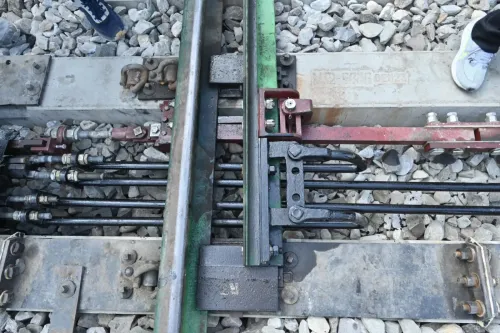
Thick web switch point machines with clamp-type locking installed at five stations across Katihar, Alipurduar, Rangiya, and Lumding divisions .
System Integrity Testing completed at seven stations and 32 level crossing gates across multiple NFR divisions.
Electric lifting barriers replaced older mechanical systems at two level crossing gates in Tinsukia division , modernising rail-road intersections.
Automatic Fire Detection and Alarm Systems , including advanced aspiration-type systems , commissioned at two stations in Tinsukia division .
246 glued joints and 92 signal LEDs replaced zone-wide, alongside improved earthing at Gauripur station, Alipurduar division .
Northeast Frontier Railway (NFR) has launched a sweeping infrastructure overhaul across its network in March 2026, replacing 1,258 signalling batteries, installing advanced switch point machines at five stations, and commissioning automatic fire detection systems — all aimed at making train operations across Northeast India safer and more reliable. The drive covers divisions spanning Assam, West Bengal, and Bihar, signalling one of the most comprehensive safety pushes the zone has undertaken in recent months.
Key Infrastructure Upgrades Across Divisions
Kapinjal Kishore Sharma, Chief Public Relations Officer (CPRO) of NFR, confirmed that thick web switch point machines with clamp-type locking have been installed at five stations across the Katihar, Alipurduar, Rangiya, and Lumding divisions. These advanced machines reduce the risk of rail fractures and point failures — a critical factor in preventing derailments on high-traffic corridors.
System Integrity Testing (SIT) has been conducted at seven stations across the Katihar (Bihar), Alipurduar (West Bengal), and Tinsukia (Assam) divisions. Additionally, an extensive SIT drive covering 32 level crossing gates has been completed across all divisions of the zone, ensuring that signalling systems meet prescribed safety benchmarks.
Level Crossing Safety Gets Major Attention
Multiple level crossing gates in the Lumding and Rangiya divisions have been interlocked to prevent simultaneous opening of road and rail barriers — a leading cause of accidents at unmanned or semi-manned crossings. This interlocking initiative directly addresses one of the most vulnerable points in India's railway safety matrix.
Further reinforcing this, 10 sliding booms have been commissioned at level crossing gates across the Katihar, Lumding, and Rangiya divisions. Electric lifting barriers have also replaced older mechanical systems at two level crossing gates in Tinsukia division, modernising rail-road intersections that serve dense traffic zones in Assam.
Fire Safety and Signalling Reliability Strengthened
Automatic Fire Detection and Alarm Systems have been commissioned at two stations in Tinsukia division, including an upgrade to advanced aspiration-type systems at two locations. Aspiration-type systems offer earlier detection of smoke particles compared to conventional detectors, making them a significant step up in station-level fire safety.
Signalling cable meggering — a critical test for insulation resistance — has been carried out at 11 stations and 12 level crossing gates, ensuring that electrical faults do not compromise signal integrity. The replacement of 246 glued joints and 92 integrated-type signal LEDs has also been completed across the zone.
Improved earthing arrangements have been provided at Gauripur station in Alipurduar division to enhance system stability and reduce the risk of electrical surges affecting signalling equipment.
Why This Matters: Northeast Rail Safety Under the Spotlight
The Northeast Frontier Railway, headquartered at Maligaon near Guwahati, operates across all Northeastern states as well as seven districts of West Bengal and five districts of north Bihar — a geographically challenging terrain with frequent floods, landslides, and extreme weather events that stress rail infrastructure year-round.
This comes amid a broader national push for railway safety following high-profile accidents in recent years that prompted the Indian Railways to accelerate the deployment of the Kavach anti-collision system and other signalling modernisation drives. NFR's March 2026 initiatives reflect that urgency at the zonal level, with a focus on ground-level hardware that directly prevents signal failures and crossing accidents.
Notably, level crossing accidents remain one of the top causes of rail fatalities in India. The interlocking of gates and installation of electric barriers in NFR's jurisdiction directly targets this risk, potentially saving dozens of lives annually on these corridors.
What to Expect Next
NFR officials have indicated that infrastructure monitoring and upgrades will continue on a rolling basis through the remaining financial year. With the monsoon season approaching — historically the most challenging period for rail infrastructure in the Northeast — the pace of these upgrades carries added urgency. Passengers and freight operators across Assam, Meghalaya, Arunachal Pradesh, Nagaland, Manipur, Mizoram, and Tripura can expect incremental improvements in punctuality and operational reliability as these systems go live.
Point of View
Long underfunded relative to its strategic importance, needs urgent hardware modernisation. The focus on level crossing interlocking and electric barriers is particularly telling: these are the unglamorous, ground-level fixes that save lives but rarely make headlines. What the mainstream narrative misses is that these upgrades are being pushed through ahead of monsoon season — the period when Northeast rail infrastructure faces its most severe stress from floods and landslides. The real test will be whether this pace of investment is sustained, or whether it remains a one-month showcase before budget pressures slow the momentum.
NationPress
19 Sept 2026
Frequently Asked Questions
What infrastructure upgrades did NFR complete in March 2026?
NFR completed multiple upgrades in March 2026, including installing thick web switch point machines at five stations, replacing 1,258 signalling batteries, commissioning 10 sliding booms at level crossings, and activating automatic fire detection systems at two stations in Tinsukia division. System Integrity Testing was also carried out at seven stations and 32 level crossing gates across the zone.
Which divisions of NFR were covered in the safety upgrade drive?
The safety upgrades covered the Katihar, Alipurduar, Rangiya, Lumding, and Tinsukia divisions of NFR, spanning the states of Assam, West Bengal, and Bihar. All divisions participated in the System Integrity Testing drive for level crossing gates.
Why is level crossing interlocking important for railway safety?
Level crossing interlocking prevents road and rail barriers from opening simultaneously, eliminating a major cause of fatal accidents at rail-road intersections. In India, level crossing accidents account for a significant share of annual rail fatalities, making interlocking a high-priority safety measure.
What is the Northeast Frontier Railway and where does it operate?
The Northeast Frontier Railway (NFR) is an Indian Railways zone headquartered at Maligaon near Guwahati, Assam. It operates across all Northeastern states as well as seven districts of West Bengal and five districts of north Bihar.
What are aspiration-type fire detection systems installed at NFR stations?
Aspiration-type fire detection systems actively draw air samples through a network of pipes to detect smoke particles at very early stages, offering faster and more sensitive detection than conventional heat or smoke detectors. NFR has upgraded two locations in Tinsukia division to this advanced system.