Did NHAI Achieve 4 Guinness World Records on the Bengaluru–Kadapa–Vijayawada Highway Project?

Synopsis
The NHAI has made headlines by setting four Guinness World Records while constructing the Bengaluru-Kadapa-Vijayawada Economic Corridor. This achievement emphasizes India's commitment to improving infrastructure and connects major regions, enhancing travel efficiency and economic growth.
Key Takeaways
NHAI has set four Guinness World Records in highway construction.
Innovative use of technology enabled rapid laying of bituminous concrete .
The 343 km corridor aims to improve regional connectivity.
Travel time will be reduced from 12 hours to 8 hours .
Significant economic advantages are expected upon completion.
New Delhi, Jan 11 (NationPress) The National Highways Authority of India (NHAI) has made an extraordinary milestone by setting four Guinness World Records during the ongoing construction of the Bengaluru–Kadapa–Vijayawada Economic Corridor on National Highway-544G, as per an official announcement on Sunday.
On January 6, near Puttaparthi in Andhra Pradesh, the NHAI achieved two remarkable records.
The first record was for the longest continuous laying of bituminous concrete, extending over 28.89 lane km, which is a 3-lane wide section of 9.63 km, completed within a span of 24 hours. The second record was for laying the highest quantity of 10,655 metric tons of bituminous concrete in just 24 hours. Both records were established globally for the first time as part of the six-lane highway project.
Continuing this remarkable achievement, two additional Guinness World Records were set on January 11. These include the continuous laying of 57,500 metric tons of bituminous concrete and a record for the continuous paving of 156 lane km, which is a 3-lane wide section of 52 km long, exceeding the prior world record of 84.4 lane km or a 2-lane wide 42.2 km long section. These impressive accomplishments were achieved across Package-2 and Package-3 of the same corridor.
The NHAI, in collaboration with the concessionaire M/s Rajpath Infracon Private Limited, accomplished this historic feat by utilizing advanced construction machinery, which included 70 tippers, five hot mix plants, a paver, and 17 rollers. A rigorous quality assurance process was in place, monitored by top institutions such as IIT Bombay and original equipment manufacturers (OEMs), ensuring compliance with the highest standards of quality and safety.
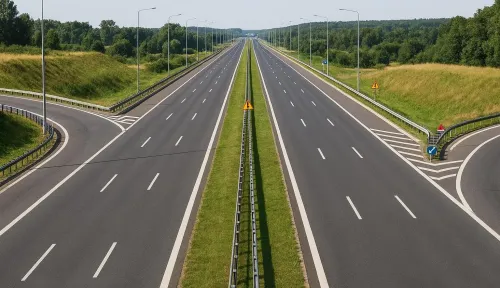
The 343 km long access-controlled six-lane Bengaluru–Kadapa–Vijayawada Economic Corridor is designed to provide a safe, high-speed, and scenic travel experience, featuring 17 interchanges, 10 wayside amenities, and a 5.3 km long tunnel, with approximately 21 km of the corridor traversing through forested areas.
Once completed, the corridor will deliver significant economic and logistical advantages by reducing the travel distance from the current 635 km to 535 km and cutting travel time from 12 hours to around 8 hours. It will substantially enhance regional connectivity, linking Bengaluru with Vijayawada and improving access between the Rayalaseema region and the coastal and northern areas of Andhra Pradesh, including the Koparthy Industrial Node.
Point of View
This achievement by NHAI not only highlights the advancements in infrastructure but also reflects the ongoing commitment of the government to enhance connectivity and foster economic growth in the region. The successful execution of these records serves as an encouraging example of how modern technology and strategic partnerships can deliver significant results for the nation.
NationPress
26 Aug 2026
Frequently Asked Questions
What records did NHAI set?
NHAI set four Guinness World Records, including the longest continuous laying of bituminous concrete and the highest quantity laid in 24 hours.
Where is the Bengaluru–Kadapa–Vijayawada Economic Corridor located?
The corridor runs between Bengaluru and Vijayawada in Andhra Pradesh, India.
What benefits will the corridor provide?
It will reduce travel distance and time, enhancing regional connectivity and providing significant economic benefits.