Nitish Kumar's Araria Visit: A Focus on Development and Progress
Synopsis
Bihar's Chief Minister Nitish Kumar visited Araria, emphasizing significant development initiatives and reviewing ongoing projects. His remarks highlighted improvements in education, healthcare, and infrastructure since he took office in 2005, contrasting the challenges faced under previous administrations.
Key Takeaways
Nitish Kumar's visit to Araria emphasizes ongoing development initiatives.
Improved healthcare services with free treatment in public hospitals since 2006.
Significant advancements in education , including girls' education initiatives.
Infrastructure development has reduced travel time to Patna .
Key programs like Saat Nischay Yojana aim for holistic development.
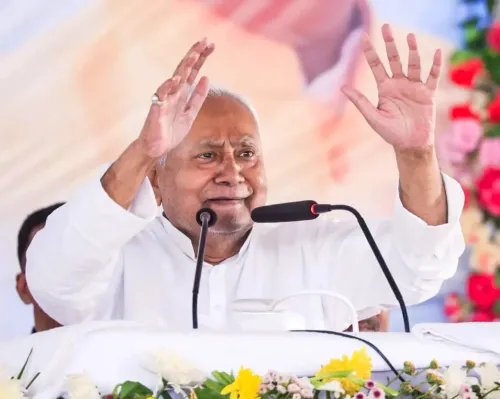
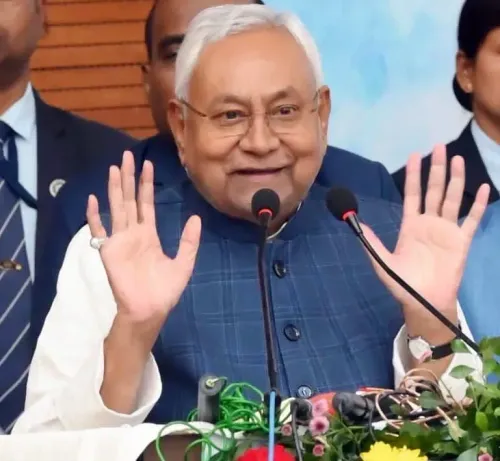
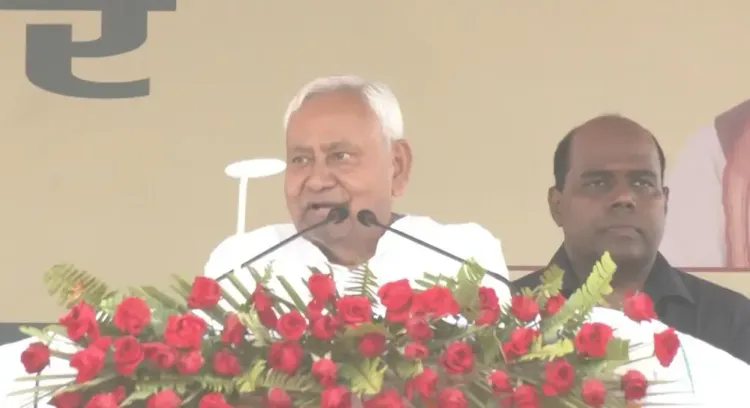
Patna, March 11 (NationPress) The Chief Minister of Bihar, Nitish Kumar, made a visit to Araria on Wednesday as part of his Samriddhi Yatra. During his speech to the audience, he urged some attendees to remain in their seats, showcasing his unique approach to engaging with the crowd.
“Where are you all headed? Please stay seated. I see some individuals leaving. I won't leave until you grasp all the information. So, sit tight, and I will explain your current situation,” he stated, capturing the crowd's attention.
He reviewed the ongoing development projects and underscored the accomplishments of his administration in diverse sectors.
Nitish Kumar criticized the prior administration, led by Lalu Prasad Yadav and Rabri Devi. He noted that upon taking office on November 24, 2005, the law and order in Bihar was severely compromised, with residents fearful of venturing outdoors after dark.
He remarked that essential sectors like healthcare, education, and road infrastructure were also in dire condition back then.
To promote communal harmony, the Chief Minister mentioned that the state government had initiated the fencing of graveyards in 2006 to mitigate disputes, and began fencing temples in 2016, which significantly curtailed theft incidents at religious sites.
In discussing the educational improvements, Nitish Kumar highlighted the introduction of numerous initiatives to enhance girls' education, including the bicycle scheme launched in 2006. He also noted the extensive recruitment of teachers, initially through employment schemes and subsequently via the Bihar Public Service Commission (BPSC).
Currently, Bihar employs approximately 5.24 lakh government teachers, with the recruitment process for an additional 45,000 teachers ongoing.
The Chief Minister also pointed out enhancements in healthcare services, stating that government hospitals previously lacked adequate facilities, but since 2006, free treatment has been provided in public hospitals.
He observed that Bihar had only six medical colleges earlier, but this number has now risen to twelve, with several more under construction across various districts.
Nitish Kumar discussed the expansion of Patna Medical College and Hospital (PMCH), which now accommodates 5,403 beds, along with improvements at the Indira Gandhi Institute of Medical Sciences (IGIMS).
When addressing infrastructure, he remarked that the government has established an extensive network of roads and bridges throughout the state, significantly decreasing travel time to Patna. He stated that residents from most districts can now reach the state capital in approximately five hours.
He also claimed that fish production in Bihar has increased by two-and-a-half times, and agricultural advancement has been supported through the Fourth Agricultural Road Map.
Emphasizing the government’s key initiatives, Nitish Kumar talked about the Saat Nischay Yojana launched in 2015, followed by Saat Nischay 2.0 in 2020, with progress now underway in its third phase. He also mentioned programs like free electricity and various schemes aimed at empowering women.
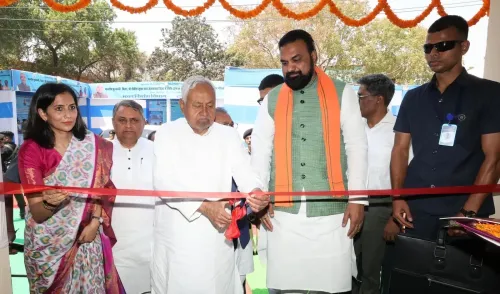
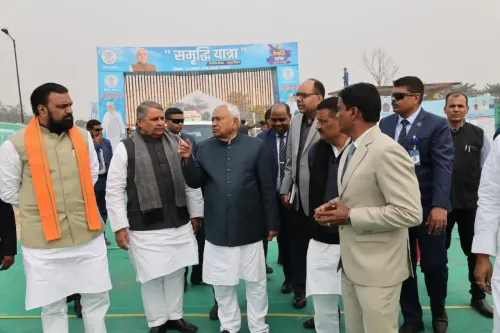
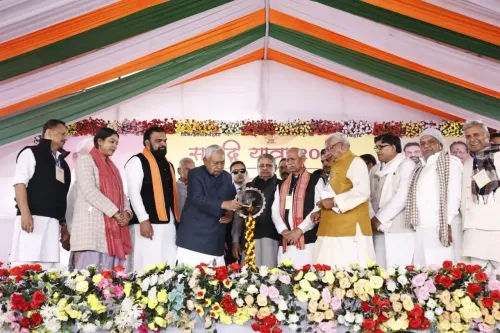
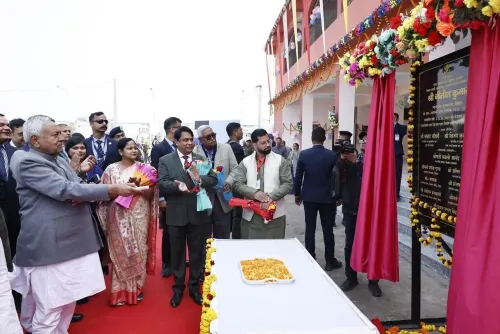
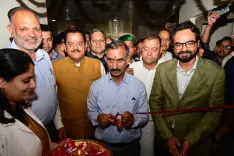
During his visit, the Chief Minister inaugurated and assessed the administrative building of a newly established police station in Araria. He also remotely inaugurated and laid foundation stones for multiple development projects, reviewed district-level scheme progress, and inspected stalls showcasing various government initiatives.
Nitish Kumar inaugurated the strengthening and renovation project of the Araria center under the Kosi Milk Project in Purnea and engaged with milk suppliers.
Additionally, he inaugurated a GNM hostel and interacted with the students at the Jananayak Karpuri Thakur Hostel in Araria, alongside students from other welfare department hostels.
Point of View
It is imperative to recognize the significance of Nitish Kumar's visit to Araria during his Samriddhi Yatra. His focus on development initiatives reflects a proactive approach to governance and a commitment to improving the state of Bihar across multiple sectors.
NationPress
26 Sept 2026
Frequently Asked Questions
What is the purpose of Nitish Kumar's Samriddhi Yatra?
The Samriddhi Yatra aims to highlight and review development initiatives undertaken by the Bihar government across various sectors.
How has healthcare improved in Bihar under Nitish Kumar?
Healthcare in Bihar has seen significant improvements since 2006, including the introduction of free treatment in public hospitals and an increase in the number of medical colleges.
What initiatives have been introduced to promote girls' education?
The government has launched several initiatives, including a bicycle scheme in 2006, to promote girls' education and enhance teacher recruitment.
How has infrastructure been developed in Bihar?
The Bihar government has constructed a vast network of roads and bridges, significantly reducing travel time to Patna and improving connectivity.
What are the flagship programs initiated by Nitish Kumar?
Key programs include the Saat Nischay Yojana and its subsequent phases, focusing on development, women's empowerment, and infrastructure improvements.