Siang hydropower project protests: Bandh turns violent in Arunachal's Upper Subansiri

Synopsis
A 12-hour bandh against Arunachal Pradesh's proposed 11,200 MW Siang Upper Multipurpose Project turned violent on 26 October, with protesters allegedly damaging NHPC equipment and vehicles in Daporijo, injuring two security personnel. With 27 villages reportedly facing submergence, 250 RAF troops deployed, and Congress demanding dialogue over force, this is no longer a local dispute — it is a test of how the state handles indigenous land rights versus large-scale energy ambitions.
Key Takeaways
A 12-hour bandh in Upper Subansiri district, Arunachal Pradesh on 26 October 2026 against the proposed Siang Upper Multipurpose Project (SUMP) turned violent.
Protesters allegedly damaged NHPC -rented office equipment, one NHPC vehicle, and two police vehicles in Daporijo ; constable-driver Hibu Lasha and a CRPF personnel were injured.
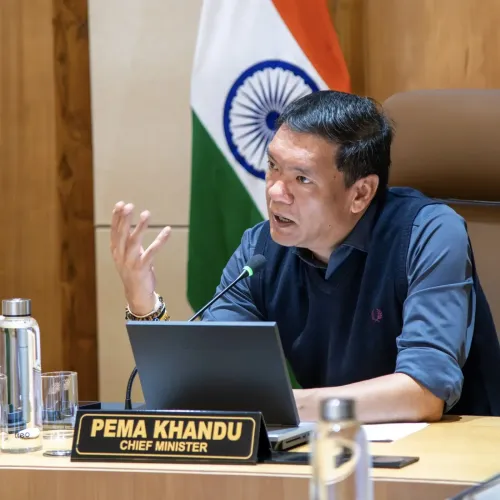
The 11,200 MW SUMP, developed by state-owned NHPC, is backed by Chief Minister Pema Khandu as a flood-regulation tool for the Siang basin.
APCC president Bosiram Siram claims the project would submerge 27 villages .
The Arunachal Pradesh Congress demanded a reduction in 250 additional RAF personnel deployed in protest areas and called for suspension of pre-feasibility surveys pending consultation.
Property assessment surveys in Jarring , Gusar , and Lable were conducted peacefully despite overall tensions.
Normal life came to a standstill in Arunachal Pradesh's Upper Subansiri district on Monday, 26 October, as a 12-hour bandh called by the All Tagin Students' Union (ATSU) and allied organisations against the proposed Siang Upper Multipurpose Project (SUMP) turned violent, with protesters allegedly damaging government company equipment and vehicles, according to police. The shutdown marks one of the most disruptive episodes yet in a widening agitation over the 11,200 MW mega dam project in the state.
Violence in Daporijo
Police officials said protesters damaged equipment at an office rented by the National Hydroelectric Power Corporation (NHPC) and also targeted one of the corporation's vehicles during the shutdown. Two police vehicles were additionally damaged in Daporijo, leaving a police constable-driver, Hibu Lasha, and a Central Reserve Police Force (CRPF) personnel injured. Both were receiving treatment in Ziro, according to officials. Police conducted a flag march in Daporijo town and appealed to youths to maintain peace and refrain from further violence.
Who Called the Bandh and What Remained Peaceful
The 12-hour shutdown, which began at 5 am, was organised by the ATSU in collaboration with the Dumporijo Students' Union (DSU), SINALITASU, the Taliha Students' Union, and various land-affected groups and forums. Despite tensions elsewhere, property assessment surveys in Jarring, Gusar, and Lable were conducted peacefully, officials noted.
The Case For and Against the SUMP
Chief Minister Pema Khandu and Deputy Chief Minister Chowna Mein have previously argued that the proposed SUMP, being developed by the state-owned NHPC, could play a critical role in regulating downstream water flows and reducing flooding risks in the Siang basin and downstream areas of both Arunachal Pradesh and Assam. Protesting organisations, however, have raised concerns about the impact on ancestral land, customary rights, livelihoods, and environmental and seismic risks — warning that the project could upend the futures of affected communities.
Arunachal Pradesh Congress Committee (APCC) president Bosiram Siram claimed that the SUMP's construction would result in the submergence of 27 villages. This comes amid a broader pattern of grassroots resistance to large hydropower infrastructure in the Northeast, where ecological sensitivities and indigenous land rights frequently collide with the Centre's push for renewable capacity.
Congress Demands Dialogue, Slams RAF Deployment
The Arunachal Pradesh Congress on Monday demanded a substantial reduction in the deployment of 250 additional Rapid Action Force (RAF) personnel in protest-affected areas, accusing the state government of relying on force rather than engagement. In a statement, the party urged the government to initiate dialogue with affected residents, suspend pre-feasibility survey activities until meaningful consultations are held, and order an impartial inquiry into the reported use of tear gas against civilians during the bandh.
The Congress also sought clarification on assurances reportedly given by Chief Minister Khandu during a meeting with Adi youths from the affected areas, asking the government to disclose which commitments had been fulfilled and which remained pending. The party called for the release of detained youths where continued detention was not legally justified, and demanded a review of protest-related FIRs and allegations of arbitrary arrests.
Calls for Structured Consultation
The APCC urged the state government to hold time-bound discussions with the Siang Indigenous Farmers' Forum (SIFF), the Adi Bane Kebang Union (ABKU), the Siang Area Youth Association (SAAYA), village elders, traditional institutions, and other concerned organisations. While condemning violence, arson, and damage to public and private property, the party cautioned against collective punishment and the suppression of legitimate democratic dissent. The standoff shows little sign of resolution; how the state government responds to calls for structured dialogue will determine whether tensions escalate further in the weeks ahead.
Point of View
Inverting the standard protocol. A project that submerges 27 villages demands consent-first sequencing, not security-first. The government's own narrative — that the SUMP will protect Assam and Arunachal from Siang flooding — may carry merit, but it has been communicated top-down rather than built from the ground up with the very people who stand to lose ancestral land. If this pattern continues, the SUMP risks becoming another Northeast mega-project that generates litigation and unrest long after the first turbine spins.
NationPress
26 Oct 2026
Frequently Asked Questions
What is the Siang Upper Multipurpose Project (SUMP)?
The SUMP is a proposed 11,200 MW hydropower and flood-regulation project on the Siang river in Arunachal Pradesh, being developed by the state-owned National Hydroelectric Power Corporation (NHPC). Chief Minister Pema Khandu has cited its potential to regulate downstream water flows and reduce flooding in the Siang basin and parts of Assam.
Why did protesters call a bandh in Upper Subansiri on 26 October?
The All Tagin Students' Union (ATSU) and allied groups called the 12-hour bandh to oppose the proposed SUMP, citing concerns over ancestral land submergence, customary rights, environmental and seismic risks, and inadequate consultation with affected communities.
What violence occurred during the bandh?
Protesters allegedly damaged equipment at an NHPC-rented office and one NHPC vehicle during the shutdown. Two police vehicles were also damaged in Daporijo, injuring police constable-driver Hibu Lasha and a CRPF personnel, both of whom were undergoing treatment in Ziro.
What is the Arunachal Pradesh Congress demanding?
The Congress demanded a reduction in the 250 additional RAF personnel deployed in protest areas, suspension of pre-feasibility surveys until consultations are held, an impartial inquiry into alleged tear gas use against civilians, and time-bound dialogue with affected community groups including SIFF, ABKU, and SAAYA.
How many villages could be affected by the SUMP dam?
APCC president Bosiram Siram has claimed that construction of the SUMP dam would lead to the submergence of 27 villages, though this figure has not been independently verified. Affected communities have sought adequate safeguards for residents whose ancestral land and livelihoods could be displaced by the project.