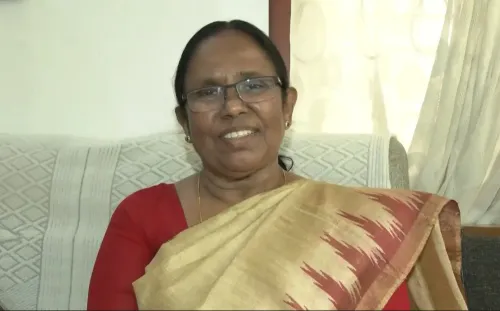
K.K. Shailaja warns CPI-M: Kerala defeat no minor setback, course correction urgent
Synopsis
In a rare public self-critique, CPI-M Central Committee member K.K. Shailaja has declared the Left's collapse from 99 to 35 seats in Kerala no ordinary loss — and named the causes: organisational decay, a generational communication failure, and an inability to adapt to social media. Coming from a leader who herself lost twice in succession, the article in 'Chintha' is the sharpest internal alarm the party has heard in years.
Key Takeaways
Shailaja called the Kerala Assembly election defeat a serious setback in an article in the CPI-M journal 'Chintha' .
The LDF fell from 99 seats to 35 in the Assembly election, with several alliance partners winning no seats at all.
Shailaja flagged the BJP winning three seats in Kerala as a significant warning.
She identified organisational decline, a generational disconnect, and poor social media outreach as key failures.
Shailaja herself lost twice consecutively — from Vadakara in the 2024 Lok Sabha polls and from Peravoor in the Assembly election.
She called for a review of the last three election defeats and immediate corrective steps.
CPI-M Central Committee member K.K. Shailaja has delivered a rare and pointed internal critique of her party, describing the Left Democratic Front's rout in the Kerala Assembly elections as a serious setback that demands immediate course correction. Writing in the party's ideological journal 'Chintha', Shailaja cautioned that the Left cannot afford to treat this defeat as a routine electoral reverse.
Scale of the Defeat
The LDF's seat count collapsed from 99 to 35 in the Assembly election — a fall Shailaja described as a major warning sign. Several alliance partners failed to win even a single seat. She also flagged the BJP winning three seats in Kerala as a serious development, signalling that the Left's traditional dominance over the political landscape can no longer be taken for granted.
Notably, the reverses extended to the Left's own strongholds, where even loyal voters reportedly shifted allegiance. 'Even those who stood firmly with the Left have moved away. Though the problems were noticed, efforts were not made to resolve them,' Shailaja wrote, calling for introspection into the behaviour, language and lifestyle of party leaders and workers.
Organisational Weaknesses Flagged
Shailaja pointed to a visible decline in party branches and local committees, stressing that disciplined grassroots activity must be urgently rebuilt. She called for a comprehensive review spanning the last three election defeats and said corrective steps must follow without delay.
She also identified a generational disconnect as a structural problem. A child who was eight years old in 2016 became a voter in 2026, she noted, and many young voters may not understand Kerala's political journey or the role Left governments played in social development. The party, she argued, had failed to communicate its achievements to this new generation in a language they understood.
Media and Youth Outreach Failures
The former minister said the Left had not sufficiently adapted to the changing media landscape or to social media platforms where younger voters are most active. This failure to meet the youth on their own terms, she argued, contributed to vote erosion that went unaddressed for too long.
Shailaja defended the Left's substantive record — decades of land reforms, public education expansion, and healthcare initiatives that transformed Kerala's social indices — but acknowledged the party had not been able to effectively convey these achievements to a new electorate.
The Path Back
Shailaja expressed confidence that a comeback remained achievable, provided the party corrected its mistakes, countered misinformation, and rebuilt its connection with voters — including those who had drifted away due to local grievances or misunderstandings. 'Such people should be brought back,' she wrote.
She also warned against the growing influence of communal politics in the state, arguing that the Left's continued presence was essential to protecting Kerala's secular character.
This comes amid a broader reckoning within the CPI-M following successive electoral setbacks. Shailaja herself experienced back-to-back defeats — first from the Vadakara Lok Sabha seat in 2024, and then in the Assembly election when she contested from Peravoor after being moved from her traditional Mattannur seat, losing to sitting Congress legislator Sunny Joseph. Her willingness to speak candidly despite her own political vulnerabilities lends weight to the critique. Whether the party's leadership acts on it remains to be seen.
Point of View
But for who is saying it and where. Publishing a candid post-mortem in 'Chintha' — the party's own ideological journal — is an unusual act of internal pressure, and the LDF's collapse from 99 to 35 seats makes the critique hard to dismiss. Yet the deeper question is structural: the CPI-M has faced three successive setbacks without a visible course correction, suggesting the problem may be less about communication strategy and more about an organisational culture resistant to change. The generational gap Shailaja identifies is real, but adapting to Instagram reels will not substitute for rebuilding credible grassroots presence. The party's leadership must decide whether this article is the beginning of genuine reform or another cycle of introspection that produces no institutional change.
NationPress
23 Jun 2026
Frequently Asked Questions
What did K.K. Shailaja say about the CPI-M's Kerala defeat?
K.K. Shailaja described the Left's defeat in the Kerala Assembly elections as a serious setback, not a routine loss, writing in the CPI-M journal 'Chintha' that the party must undertake an honest review of the last three election defeats and take corrective steps without delay. She highlighted the LDF's fall from 99 to 35 seats as a major warning sign.
How many seats did the LDF win in the Kerala Assembly election?
The Left Democratic Front won 35 seats in the Kerala Assembly election, down sharply from 99 seats in the previous term. Several alliance partners failed to win even a single seat, according to Shailaja's article.
What organisational failures did Shailaja identify in the CPI-M?
Shailaja pointed to a decline in party branches and local committees, a failure to connect with younger voters through social media, and an inability to communicate the Left's governance achievements to a new generation of voters. She also called for introspection into the behaviour and lifestyle of party leaders and workers.
Who is K.K. Shailaja and what is her political background?
K.K. Shailaja is a CPI-M Central Committee member and former Health Minister in the first Pinarayi Vijayan cabinet (2021–26), widely recognised for Kerala's pandemic response. She lost the Vadakara Lok Sabha seat in 2024 and subsequently lost the Assembly election from Peravoor to Congress legislator Sunny Joseph after being shifted from her traditional Mattannur seat.
Why is the BJP winning three seats in Kerala significant according to Shailaja?
Shailaja described the BJP's winning of three seats in Kerala as a serious development, suggesting it signals an erosion of the Left's ability to prevent the saffron party from gaining a foothold in a state where it had historically been marginal. She warned that the Left's presence remains essential for protecting Kerala's secular character.