Odisha CMO: 24/7 Watch on Rivers as Cyclone Akvan Closes In
Synopsis
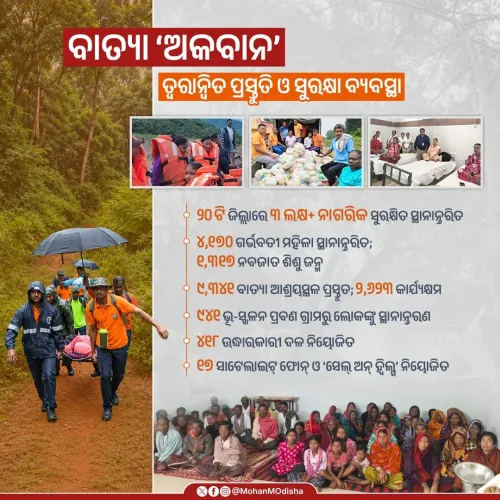
The Chief Minister's Office of Odisha confirmed on 20 November 2026 that round-the-clock monitoring, night patrolling, and field inspections are underway across the state's rivers, reservoirs, and barrages to tackle Cyclone Akvan and potential flooding.
Key Takeaways
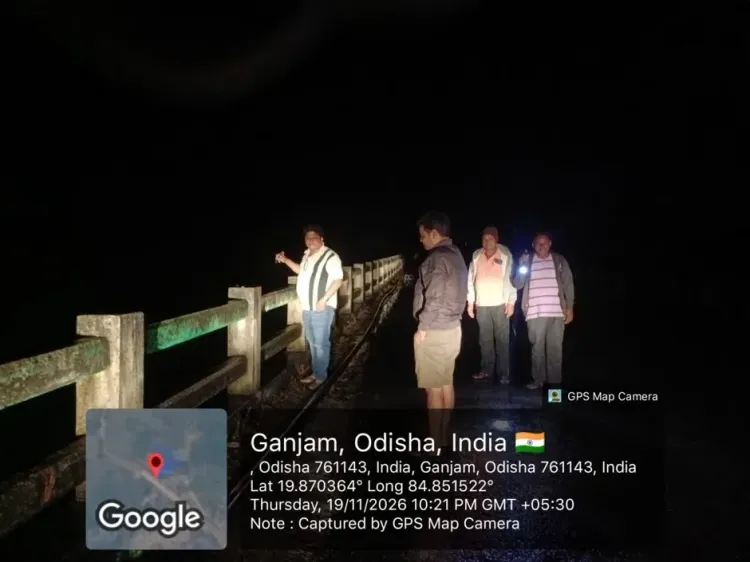
24-hour monitoring and night patrolling are active across rivers, reservoirs, barrages, and vulnerable locations statewide as of 20 November 2026 .
The Chief Minister's Office of Odisha announced the measures in a bilingual Odia-English post as Cyclone Akvan threatens the coast.
Field inspections are running in parallel with advance preparations for water drainage and flood management .
Odisha's proactive disaster response framework traces back to institutional lessons from the devastating 1999 super cyclone .
Authorities are focusing on coastal communities and flood-prone river-bank populations as the most at-risk groups.
Officials urge watch for subsequent statements on evacuation orders and cyclone track updates as the storm's path becomes clearer.
With Cyclone Akvan bearing down on the Bay of Bengal coast, Odisha has thrown its full disaster-management machinery into gear — round-the-clock surveillance, night patrols, and boots-on-the-ground field inspections running simultaneously across the state as of Friday, 20 November 2026.
The Chief Minister's Office of Odisha confirmed in a bilingual post in Odia and English that 24-hour monitoring and night patrolling are now underway at rivers, reservoirs, barrages, and 'vulnerable locations' statewide. Advance preparations for water drainage and flood management are also in progress alongside field inspections — a signal that authorities are not waiting for the cyclone to make landfall before acting.
What 'round-the-clock monitoring' actually means on the ground
In Odisha's disaster-response architecture, 24-hour surveillance of water bodies is not a rhetorical assurance — it is a structured protocol with personnel stationed at key barrages and reservoirs to track water levels in real time and coordinate controlled releases before they become emergency discharges. Night patrolling of river embankments is a parallel layer: field teams identify breaches or seepage before they become catastrophic. The CMO's mention of water drainage and flood management preparations suggests sluice gates and urban drainage systems are already being pre-positioned or cleared.Odisha's hard-earned playbook — written in 1999
Odisha's institutional muscle for cyclone response was forged in the crucible of the 1999 super cyclone — one of the most devastating tropical storms in Indian history — which exposed catastrophic gaps in early warning and community protection. In the decades since, the state has built what is widely regarded as one of India's most capable state-level disaster management systems: pre-positioned boats and pumps, trained local responders, and precisely this kind of pre-landfall activation of monitoring grids. The pattern is now almost reflexive — whenever a Bay of Bengal system organises and targets the Odisha coast, the machinery spins up well ahead of any official warning hierarchy.Coastal communities in the crosshairs
The populations most immediately at risk are those in low-lying coastal districts and communities living along rivers that swell rapidly when cyclone-driven rain bands interact with existing reservoir levels. By activating field inspections alongside monitoring, the government is trying to compress the gap between detection and response — a lesson hammered home by repeated landfalls that struck faster or at higher intensity than forecast. Watch for follow-on official statements on evacuation orders, inter-district relief coordination, and cyclone track updates as Akvan's trajectory sharpens. Odisha has survived enough Bay of Bengal cyclones to know that preparation measured in hours before landfall is worth infinitely more than any response mounted in the hours after.Point of View
Odisha has arguably become a template state for India's cyclone-preparedness doctrine, and each activation reinforces the argument for sustained investment in early-warning and local response capacity. The key variable to watch is whether the advance preparations are sufficient for Akvan's actual intensity, which will serve as the real test of institutional resilience.
NationPress
20 Nov 2026
Frequently Asked Questions
What is Cyclone Akvan and where is it headed?
Cyclone Akvan is a Bay of Bengal storm system that the Odisha government flagged on 20 November 2026 as a threat to the state's coast, potentially bringing heavy rain and flooding. Its precise track continues to be monitored by authorities.
What steps has the Odisha government taken for Cyclone Akvan?
The Chief Minister's Office confirmed round-the-clock monitoring and night patrolling of rivers, reservoirs, and barrages, alongside field inspections and advance preparations for water drainage and flood management.
Which areas in Odisha are most at risk from Cyclone Akvan?
Low-lying coastal districts and communities along rivers that swell during cyclone-driven rainfall are considered most vulnerable, based on the government's focus on barrages and reservoirs in its current preparations.
How has Odisha built its cyclone disaster management system?
Odisha's advanced disaster management system was largely developed after the catastrophic 1999 super cyclone, emphasising early warning, pre-positioned resources, and pre-landfall activation of monitoring grids across the state.
Will there be evacuations in Odisha due to Cyclone Akvan?
No formal evacuation orders have been announced as of 20 November 2026, but authorities are conducting field inspections and advance preparations, with evacuation decisions likely to follow updates on the cyclone's track and intensity.