Odisha CM Majhi boosts kendu leaf workers with Rs 74.78 cr package
Synopsis
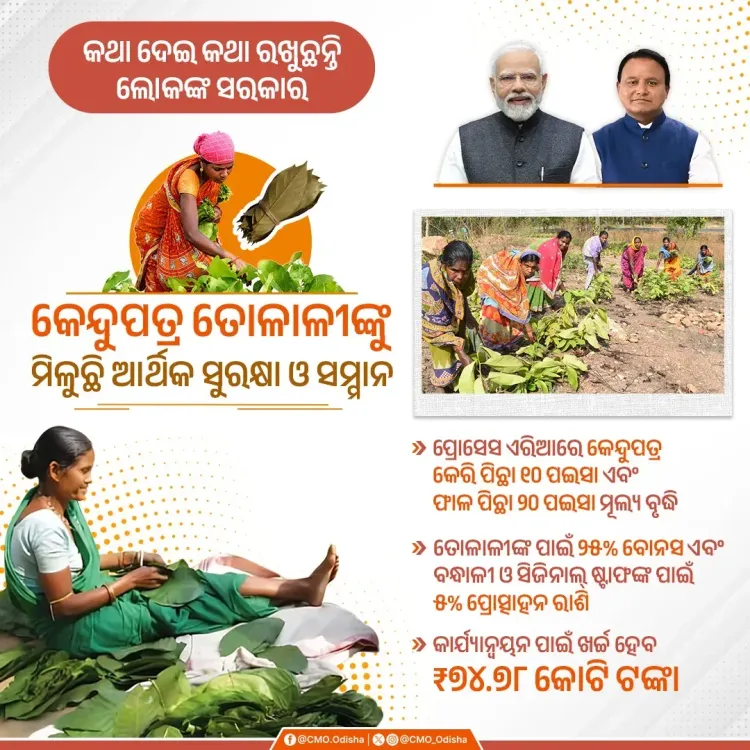
The Odisha government under CM Mohan Charan Majhi has approved Rs 74.78 crore for kendu leaf workers, including a 25% bonus for pluckers and a 5% incentive for binders and seasonal staff, alongside a procurement price revision aimed at strengthening livelihoods in tribal forest communities.
Key Takeaways
The Odisha government has approved a Rs 74.78 crore welfare package for kendu leaf workers.
Kendu leaf pluckers ( tholali ) will receive a 25 per cent bonus on their earnings.
Binders ( bandhali ) and seasonal staff will receive a 5 per cent incentive .
The package also includes a revision in the procurement price of kendu leaves .
The decision was taken under the leadership of CM Mohan Charan Majhi , who took office in June 2024 .
Kendu leaf trade in Odisha is governed by the Kendu Leaves (Control of Trade) Act, 1961 , which established the state monopoly and worker welfare framework.
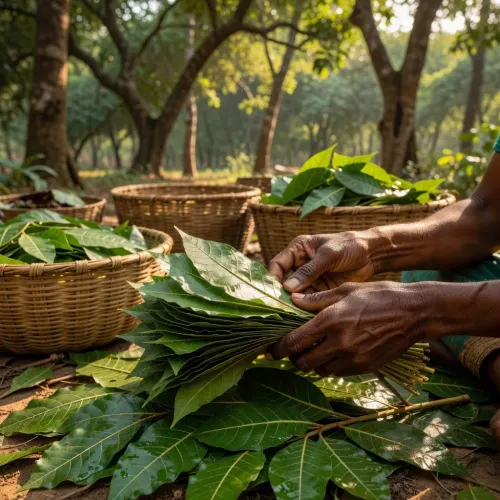
The Chief Minister's Office of Odisha announced on Tuesday, 14 July 2026, that the state government under Chief Minister Mohan Charan Majhi has approved a welfare package worth Rs 74.78 crore for kendu leaf pluckers, binders, and seasonal staff engaged in the state's minor forest produce trade.
The announcement states that the package includes a 25 per cent bonus for kendu leaf pluckers (tholali), a 5 per cent incentive for binders (bandhali) and seasonal staff (sijinal staff), and a revision in the procurement price of kendu leaves. The government described the decision as a step toward 'financial empowerment and livelihood security' of these workers.
Context
Kendu leaves — the primary raw material for the bidi industry — are one of Odisha's most significant minor forest produce. Hundreds of thousands of workers, concentrated in the state's Scheduled Areas and tribal districts, depend on the annual kendu leaf collection season for a substantial share of their household income. The trade is governed by the Kendu Leaves (Control of Trade) Act, 1961, which established a state monopoly over procurement and created a formal welfare framework for collection workers.Policy Backdrop
Odisha has periodically revised kendu leaf procurement prices and announced bonus payments to pluckers since the 1990s, using these instruments to stabilise forest-dependent livelihoods against pressures such as shifting cultivation patterns and seasonal migration. The state's approach broadly aligns with national frameworks for the marketing of minor forest produce, while operating through its own procurement and trade arrangements. The BJP-led government that took office under CM Majhi in June 2024 has positioned tribal and forest-worker welfare as a policy priority.Stakeholders and Impact
The primary beneficiaries are kendu leaf pluckers, who perform the most labour-intensive work during the collection season and will receive the larger 25 per cent bonus. Binders and seasonal contractual staff, whose roles support processing and storage, are covered under the 5 per cent incentive component. For households in tribal and forest-fringe communities where kendu leaf income forms a critical seasonal buffer, the price revision and bonus together represent a direct increase in take-home earnings. The Rs 74.78 crore outlay signals a significant commitment of state resources to this segment of the informal forest economy.What's Next
Attention will now turn to the disbursement timeline for the announced bonuses and incentives, and whether the revised procurement price will be notified through a formal policy circular before the current collection season closes. Any further revisions to kendu leaf policy are also likely to feature in the next state budget cycle. The scale of the package and its direct reach to tribal forest workers could set a benchmark for how the Majhi government frames its welfare commitments ahead of future electoral cycles in Odisha.Point of View
A constituency that proved decisive in the 2024 assembly election. By combining a procurement price revision with differentiated bonus rates — higher for pluckers, lower for support staff — the government is targeting the most economically vulnerable tier of the kendu leaf supply chain. The announcement fits a broader pattern of BJP-governed states using minor forest produce policy as a lever for tribal outreach, complementing central schemes but with state-specific visibility. The real test will be disbursement speed and whether the price revision is formalised before the current season ends.
NationPress
14 Jul 2026
Frequently Asked Questions
What is the kendu leaf bonus announced by the Odisha government in 2026?
The Odisha government announced a 25 per cent bonus for kendu leaf pluckers and a 5 per cent incentive for binders and seasonal staff as part of a Rs 74.78 crore welfare package approved in July 2026.
Who are kendu leaf pluckers and why do they need government support?
Kendu leaf pluckers are seasonal workers, largely from tribal communities in Odisha's Scheduled Areas, who collect leaves used in bidi manufacturing. Their incomes are seasonal and vulnerable to price fluctuations, making state-administered bonuses and price revisions a key livelihood support.
What is the Kendu Leaves (Control of Trade) Act, 1961?
It is a law under which Odisha nationalised the kendu leaf trade, giving the state government a monopoly over procurement and establishing a framework for worker welfare, including bonus payments to pluckers.
How much is the Odisha government spending on kendu leaf workers in 2026?
The state government has approved an expenditure of Rs 74.78 crore covering procurement price revision, a 25% bonus for pluckers, and a 5% incentive for binders and seasonal staff.
Who is the Chief Minister of Odisha in 2026?
Mohan Charan Majhi is the Chief Minister of Odisha, heading a BJP-led government that took office in June 2024 .