Puri hails Oil India's record ₹2,870 cr Q1 PAT, 2.5x YoY surge
Synopsis
Union Petroleum Minister Hardeep Singh Puri announced Oil India Limited's record standalone Q1 FY27 PAT of ₹2,870 crore, up 2.5x YoY, alongside a new Andaman gas discovery and a 167% PAT surge at subsidiary NRL, framing the results as proof of India's energy self-reliance drive under PM Modi.
Key Takeaways
Oil India Limited posted its highest-ever standalone PAT of ₹2,870 crore in Q1 FY27 , up 2.5 times year-on-year .
Consolidated PAT rose 97% YoY to ₹4,027 crore , reflecting group-wide financial strength.
Subsidiary Numaligarh Refinery Limited recorded a 167% PAT growth to ₹1,305 crore .
Crude oil production grew 11% YoY , with a record daily output of 10,921 metric tonnes .
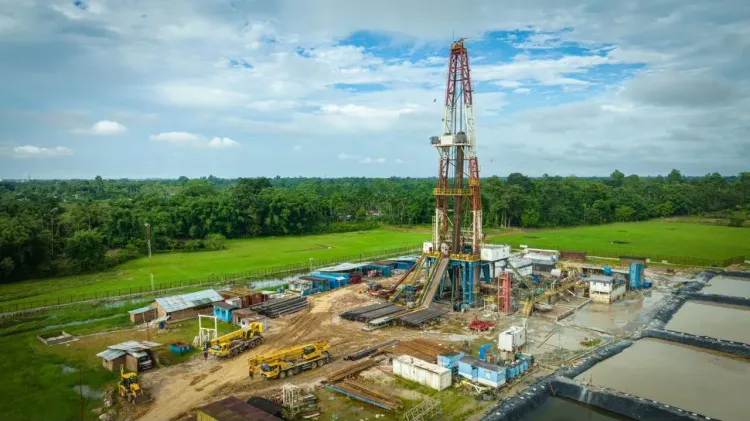
OIL reported a new natural gas discovery in the Andaman Basin and a record 3,116-metre horizontal displacement in Assam .
Minister Puri linked the results to PM Modi's Atmanirbhar Bharat energy self-reliance agenda.
Oil India Limited has just posted the biggest quarterly profit in its history — and Union Petroleum Minister Hardeep Singh Puri is making sure the country knows it. On Saturday, 8 August 2026, the Minister took to X to announce that the Maharatna PSU delivered a standalone Profit After Tax of ₹2,870 crore for Q1 FY27, a staggering 2.5 times jump year-on-year — a number that reframes what India's upstream oil sector is capable of.
What drove the record standalone profit
The headline PAT figure was powered by an 11% growth in crude oil production, with OIL clocking a highest-ever daily output of 10,921 metric tonnes. These are not marginal gains — they represent a structural step-up in the company's production capacity, built on years of enhanced recovery work and new acreage under the Hydrocarbon Exploration and Licensing Policy (HELP), which replaced the earlier NELP regime in 2016 to streamline exploration licensing.
At the consolidated level, the numbers are even more striking. Consolidated PAT rose 97% year-on-year to ₹4,027 crore, reflecting a company-wide turnaround that runs well beyond the parent entity alone.
NRL's 167% PAT surge and the Assam-Andaman frontier
Numaligarh Refinery Limited (NRL), OIL's subsidiary based in Assam, posted a 167% growth in PAT to ₹1,305 crore — the sharpest percentage rise in the group. That number, combined with OIL's record 3,116-metre horizontal displacement in Assam's drilling operations, signals that the northeast is pulling serious weight in India's upstream story.
Then there is the frontier play: OIL has reported a new natural gas discovery in the Andaman Basin. India's import dependence on crude has historically exceeded 80 percent, making any domestic discovery in an underexplored offshore basin a strategically significant data point — even if the commercial scale of the find is yet to be established.
Aatmanirbharta in energy: the policy frame behind the numbers
Minister Puri framed the results explicitly within Prime Minister Narendra Modi's Atmanirbhar Bharat vision, launched in May 2020, which elevated energy self-reliance to a national-security priority. Maharatna PSUs like OIL have since received policy support for new acreage awards, enhanced recovery programmes, and infrastructure upgrades across both mature and frontier basins.
The Q1 FY27 performance is the clearest financial evidence yet that those policy levers are translating into output — and profit. The next test will be whether Q2 FY27 can sustain the momentum, and whether the Andaman and expanded Assam blocks convert exploration success into long-term production growth.
India's energy Aatmanirbharta is no longer just a slogan on a government poster. For one quarter at least, it has a balance sheet to back it up.
Point of View
Maharatna autonomy, and the Atmanirbhar Bharat narrative — is producing measurable upstream gains, not just rhetoric. Minister Puri's decision to personally amplify the numbers on X signals that the petroleum sector is being positioned as a flagship economic achievement ahead of the political cycle. The Andaman Basin gas discovery, if commercially viable, could significantly alter India's long-term import calculus — but the 80%-plus crude import dependence means one quarter's record, however impressive, is a waypoint, not a destination. The real test is whether OIL and its peers can sustain production growth across multiple quarters and convert frontier exploration into proven reserves.
NationPress
22 Sept 2026
Frequently Asked Questions
What is Oil India Limited's Q1 FY27 standalone profit?
Oil India Limited posted a standalone Profit After Tax of ₹2,870 crore in Q1 FY27, its highest-ever quarterly standalone PAT, representing a 2.5 times increase year-on-year .
What is the consolidated PAT of Oil India for Q1 FY27?
Oil India's consolidated PAT for Q1 FY27 stood at ₹4,027 crore , up 97% year-on-year , including strong contributions from its subsidiary Numaligarh Refinery Limited.
What did Numaligarh Refinery Limited earn in Q1 FY27?
Numaligarh Refinery Limited (NRL) , a subsidiary of Oil India, posted a PAT of ₹1,305 crore in Q1 FY27, marking a 167% growth year-on-year .
Where has Oil India made a new gas discovery?
Oil India Limited reported a new natural gas discovery in the Andaman Basin , an underexplored offshore frontier that could add to India's domestic energy reserves.
What is India's energy Aatmanirbharta policy?
Energy Aatmanirbharta refers to India's push for energy self-reliance under the Atmanirbhar Bharat initiative launched in May 2020 , aimed at reducing the country's crude oil import dependence — which historically exceeds 80 percent — through higher domestic production and exploration.