APAAR ID & ABC: India's 'One Nation, One Student ID' hits 26.3 crore registrations
Synopsis
India's APAAR student ID has quietly crossed 26.3 crore verified registrations — one of the largest unified academic identity rollouts in the world. With schools, IITs, IIMs, and skill institutions all feeding into the same ABC system, and a sovereign blockchain layer on the horizon, the country is building a lifelong learning infrastructure that most developed nations don't yet have.
Key Takeaways
26.3 crore verified APAAR IDs have been generated across India as of June 2026 .
Schools are the largest contributor, with 16.62 crore institutions linked and 71.46 crore records uploaded.
More than 100 Institutes of National Importance — including AIIMS , IITs , IIMs , and NITs — are registered on the ABC portal.
UGC mandated all HEIs to upload credit data to the ABC portal by 30 June .
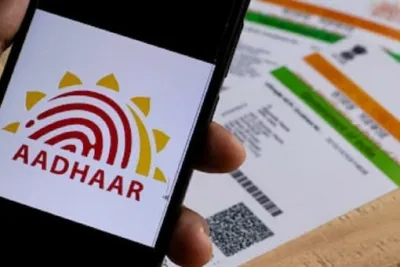
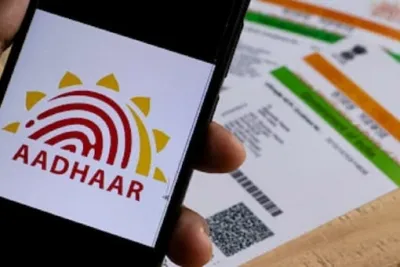
APAAR IDs are accessible via DigiLocker , Aadhaar , and offline through Common Service Centres in remote areas.
The Bharat Praman Chain , a sovereign blockchain platform for tamper-resistant academic credentials, is the next planned layer of the system.
India's Automated Permanent Academic Account Registry (APAAR) — a unique 12-digit student identification number — has crossed 26.3 crore verified IDs as of June 2026, marking a significant milestone in the country's push to build a unified, lifelong digital learning ecosystem. Linked to the Academic Bank of Credits (ABC) system under the Ministry of Education, APAAR enables students to store academic records, transfer credits seamlessly across institutions, and maintain a single verified academic identity throughout their lives.
What APAAR and ABC Do
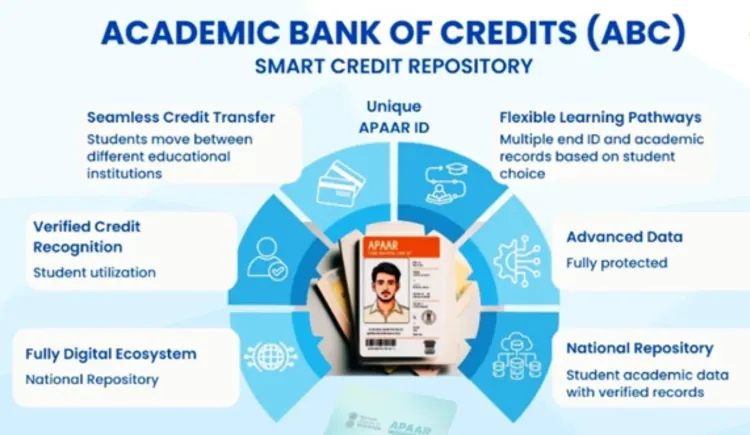
APAAR functions as a student's permanent academic passport. Accessible through DigiLocker and linked to Aadhaar, it consolidates educational records spanning school, higher education, skill development, and other recognised learning programmes onto a single platform. The Academic Bank of Credits (ABC), regulated by the University Grants Commission (UGC), acts as the underlying digital infrastructure — storing, managing, transferring, and redeeming academic credits earned from recognised institutions.
Together, they operationalise the flexible, multi-entry-and-exit learning architecture envisioned under the National Education Policy (NEP) 2020 and the National Credit Framework (NCrF). Institutions upload credit data directly to the ABC portal, enabling students to accumulate and redeem credits across multiple Higher Education Institutions (HEIs). Certificates and degrees are issued and securely stored via the National Academic Depository (NAD).
Scale Achieved So Far
The numbers reflect rapid adoption across India's sprawling education system. Schools are the largest contributor, with 16.62 crore institutions linked and 71.46 crore records uploaded. Central, state, private, and deemed universities together account for more than 4.34 crore APAAR IDs and educational records. 1,262 autonomous colleges are registered under ABC, generating 33 lakh APAAR IDs, while more than 100 Institutes of National Importance — including AIIMS, IITs, IIMs, and NITs — are registered with credits and IDs steadily growing. Among skill institutions, 96 are registered, generating 1.51 crore IDs and 6.55 crore records.
Notably, the UGC had mandated that by 30 June, all HEIs upload credit data to the ABC portal — a deadline that has spurred institutional compliance across the country.
Bridging the Digital Divide
A key design feature of the system is its offline reach. APAAR IDs can be generated at the nearest Common Service Centre (CSC), extending access to remote and underserved communities that may lack direct internet connectivity. This positions the initiative as part of India's broader Digital Public Infrastructure (DPI) for education under the Digital India Programme, going beyond urban higher-education institutions.
What Comes Next: Bharat Praman Chain
As the platforms scale, the next layer of infrastructure is already taking shape. The Bharat Praman Chain — a sovereign blockchain platform designed for secure, tamper-resistant digital credentials — is being developed to further strengthen the authenticity of academic records. It is built to comply with the Digital Personal Data Protection Act and is designed to directly operationalise the flexibility principles of NEP 2020. By providing a unified academic identity infrastructure backed by blockchain, India would join a rare group of countries with a sovereign, end-to-end credentialing system at this scale.
As adoption deepens and emerging technologies are layered in, the APAAR-ABC framework is set to become the backbone of a future-ready, learner-centric education system in India.
Point of View
But scale alone does not equal utility — the harder question is whether students, especially from low-income and rural backgrounds, are actively using their IDs to transfer credits or access opportunities, rather than simply being registered. The UGC's 30 June deadline for HEI credit uploads is a positive enforcement signal, but compliance data and student-level usage metrics remain opaque. India's bet on a sovereign blockchain layer via Bharat Praman Chain is architecturally ambitious and globally rare, but it will only matter if the base layer — accurate, timely credit uploads by institutions — is reliable. The digital divide bridge through CSCs is the right instinct; whether it translates to genuine inclusion or just registration numbers is the accountability test this initiative still needs to pass.
NationPress
2 Jul 2026
Frequently Asked Questions
What is APAAR and how does it work?
APAAR, or the Automated Permanent Academic Account Registry, is a unique 12-digit student identification number that creates a single digital academic identity for every learner in India. It is accessible through DigiLocker, linked to Aadhaar, and consolidates records from schools, universities, and skill institutions onto one platform. Students can use it to store achievements, transfer credits, and maintain a verified academic history throughout their lives.
What is the Academic Bank of Credits (ABC)?
The Academic Bank of Credits is a digital platform regulated by the University Grants Commission (UGC) under the Ministry of Education that stores, manages, transfers, and redeems academic credits earned by students from recognised institutions. It supports the multiple entry and exit options envisioned under NEP 2020, allowing learners to accumulate credits across different Higher Education Institutions over time.
How many APAAR IDs have been generated so far?
As of June 2026, over 26.3 crore verified APAAR IDs have been generated across India. Schools are the largest contributor, with 16.62 crore institutions linked and 71.46 crore records uploaded, while central, state, private, and deemed universities account for more than 4.34 crore IDs.
Who can get an APAAR ID and how?
All school and college students in India are eligible for an APAAR ID. Students can register on the ABC portal directly, or visit the nearest Common Service Centre (CSC), which extends access to remote and underserved areas. The ID is linked to Aadhaar and DigiLocker for secure, verified access.
What is Bharat Praman Chain and how does it relate to APAAR?
Bharat Praman Chain is a sovereign blockchain platform being developed to provide tamper-resistant, secure digital academic credentials in India. It is designed to comply with the Digital Personal Data Protection Act and will serve as the next layer of the APAAR-ABC ecosystem, strengthening the authenticity of academic records and extending access through Common Service Centres.