Jal Shakti Minister Paatil marks World Blood Donor Day
Synopsis
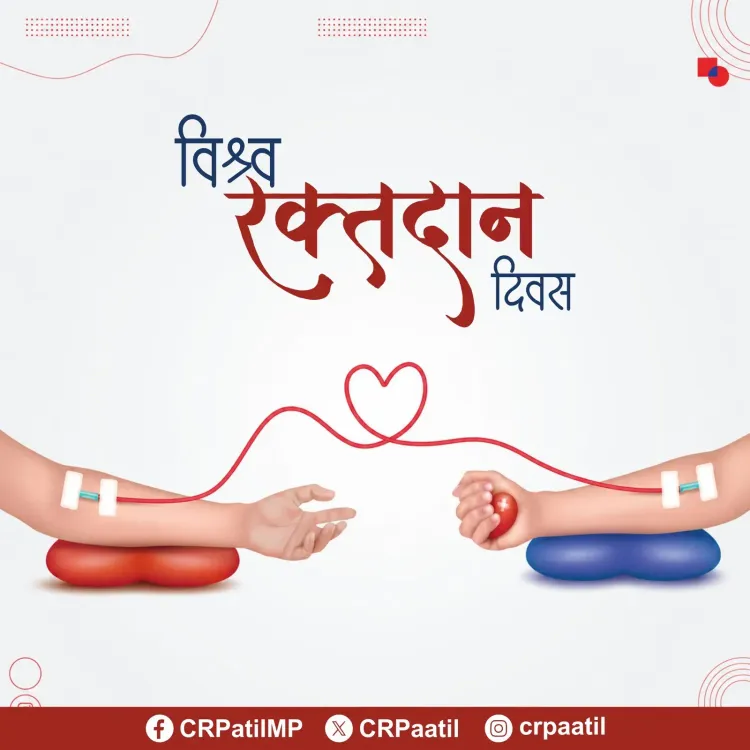
Union Jal Shakti Minister C. R. Paatil on 14 June 2026 marked World Blood Donor Day by saluting voluntary blood donors, calling the act a supreme altruism that gives new life without discrimination — echoing India's long-standing National Blood Policy push for voluntary, unpaid donation.
Key Takeaways
Paatil , Union Minister of Jal Shakti, posted a tribute to voluntary blood donors on World Blood Donor Day, 14 June 2026 .
He described voluntary blood donation as a 'supreme altruism' capable of giving new life to a stranger without discrimination.
World Blood Donor Day is a WHO -established annual observance, instituted in 2004 , held every 14 June .
India's National Blood Policy (2002) mandates promotion of voluntary, non-remunerated donation and the phasing out of replacement donation.
The National Blood Transfusion Council , set up in 1996 , oversees blood safety standards under the Ministry of Health and Family Welfare.
Voluntary donors and transfusion-dependent patients — including those with thalassaemia and sickle cell anaemia — are the primary beneficiaries of sustained donation drives.
Union Jal Shakti Minister C. R. Paatil on Sunday, 14 June 2026 paid tribute to voluntary blood donors on World Blood Donor Day, calling the act of voluntary donation a supreme form of altruism that can give new life to a stranger without discrimination.
Context
In his post on X, Minister Paatil wrote: 'Vishwa Raktadaata Diwas manavata, samvedanshilata aur jeevan raksha ke sankalp ka prateek hai' — 'World Blood Donor Day is a symbol of humanity, compassion and the resolve to save lives.' He extended a 'humble salute' (vinamra naman) to the spirit of service, dedication and human sensitivity shown by all blood donors.
World Blood Donor Day is observed every year on 14 June, a date established by the World Health Organization through a resolution in 2004 to promote voluntary, unpaid blood donation globally. The day also marks the birth anniversary of Karl Landsteiner, the scientist who discovered the ABO blood group system.
Policy Backdrop
India adopted its National Blood Policy in 2002 with the explicit goal of promoting voluntary, non-remunerated blood donation and phasing out the practice of replacement or paid donation. The policy recognised that a safe and adequate blood supply can only be sustained through a committed base of voluntary donors.
Oversight of blood safety standards in India rests with the National Blood Transfusion Council, constituted in 1996 under the Ministry of Health and Family Welfare. Successive governments have run periodic national campaigns to raise the share of voluntary donations and reduce dependence on family replacement donors, a practice that carries higher risk of transfusion-transmissible infections.
Stakeholders and Impact
Voluntary blood donors and transfusion recipients are the primary stakeholders in India's blood safety ecosystem. Patients undergoing surgery, cancer treatment, and those with conditions such as thalassaemia and sickle cell anaemia depend critically on a reliable, screened blood supply.
Central ministers across successive governments have routinely used global health observances to amplify public awareness on voluntary health contributions. Paatil's message, coming from a senior BJP leader and former Gujarat state president, reinforces the broader governmental push to normalise voluntary donation as a civic duty rather than an emergency response.
What's Next
The National Blood Transfusion Council is expected to review targets for voluntary donation as a percentage of total blood collected in the coming financial year. Civil society organisations and hospital blood banks typically use the week around 14 June to run donation camps and awareness drives across the country.
With India's demand for safe blood continuing to grow alongside an expanding surgical and oncology caseload, the annual observance serves as a reminder of the gap that voluntary donors alone can fill sustainably.
Point of View
But it reinforces the government's two-decade-old framing of voluntary blood donation as a patriotic and humanitarian duty — a narrative that dovetails with the BJP's broader emphasis on seva (service) as a cultural value. The timing, on the WHO-designated day itself, suggests coordinated social-media messaging across the party's ministerial ranks rather than a spontaneous personal tribute. Analysts will watch whether the observance is followed by any concrete target revision from the National Blood Transfusion Council, which would give the messaging substantive policy weight.
NationPress
22 Sept 2026
Frequently Asked Questions
What is World Blood Donor Day and when is it observed?
World Blood Donor Day is an annual global observance held on 14 June every year, established by the World Health Organization in 2004 to promote voluntary, unpaid blood donation and thank existing donors.
What did C. R. Paatil say on World Blood Donor Day 2026?
C. R. Paatil , Union Minister of Jal Shakti, said that World Blood Donor Day is a symbol of humanity, compassion and the resolve to save lives, and paid a humble salute to the service, dedication and sensitivity of all voluntary blood donors.
What is India's National Blood Policy?
India adopted its National Blood Policy in 2002 to promote voluntary, non-remunerated blood donation, phase out replacement and paid donation, and ensure a safe, adequate national blood supply under the oversight of the National Blood Transfusion Council .
Who oversees blood safety standards in India?
The National Blood Transfusion Council , constituted in 1996 under the Ministry of Health and Family Welfare , is the apex body responsible for setting and monitoring blood safety standards across India.
Why is voluntary blood donation important in India?
Voluntary, unpaid donation is considered the safest source of blood because it reduces the risk of transfusion-transmissible infections. Patients undergoing surgery, cancer treatment, and those with conditions like thalassaemia and sickle cell anaemia depend on a reliable voluntary donor base.