HP CMO Greets Blood Donors on World Blood Donor Day
Synopsis
The Chief Minister's Office of Himachal Pradesh marked World Blood Donor Day on 14 June 2026, calling blood donation one of humanity's highest services and urging residents to donate, aligning with India's National Blood Policy push for voluntary, unpaid donation.
Key Takeaways
The Chief Minister's Office of Himachal Pradesh posted greetings on World Blood Donor Day, 14 June 2026 .
The message called blood donation 'one of the highest forms of service to humanity.' It noted that a single unit of blood can give 'a new life to someone in need.' World Blood Donor Day was established by the WHO in 2004 via resolution WHA57.14 to promote voluntary, unpaid donation.
India's National Blood Policy prioritises voluntary non-remunerated donation to improve blood safety and reduce reliance on replacement donors.
State-level digital outreach on health days complements on-ground blood donation camps organised by district health authorities.
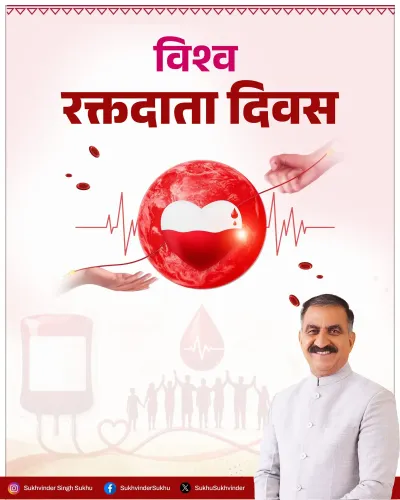
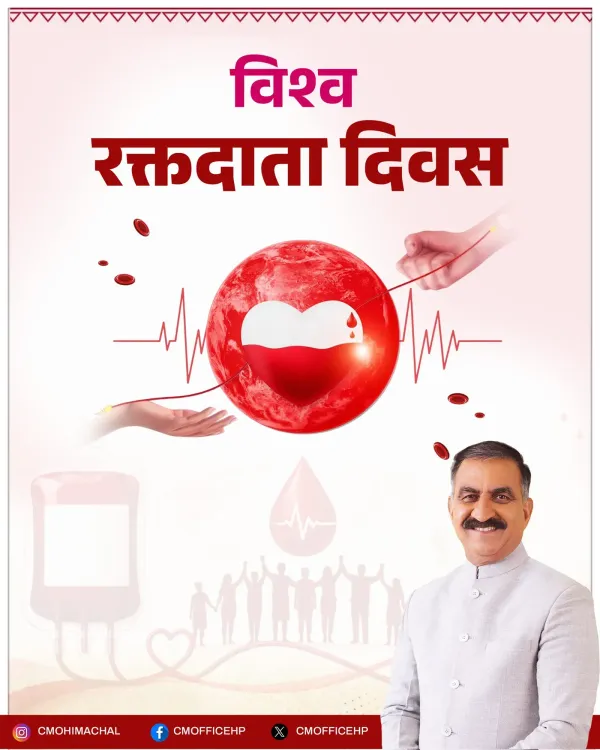
The Chief Minister's Office of Himachal Pradesh on Sunday, 14 June 2026, extended greetings to all residents of the state and to blood donors on the occasion of World Blood Donor Day, reaffirming that blood donation stands among the highest acts of human service.
The post, shared in Hindi, reads: 'सभी प्रदेशवासियों एवं रक्तदाताओं को विश्व रक्तदाता दिवस की हार्दिक शुभकामनाएं' — 'Heartfelt greetings to all residents and blood donors on World Blood Donor Day.' It further states that 'blood donation is one of the highest forms of service to humanity' and that 'a single unit of your blood can give a new life to someone in need.'
Context
World Blood Donor Day is observed every year on 14 June to raise awareness about the need for safe blood and to thank voluntary, unpaid donors worldwide. The date marks the birthday of Karl Landsteiner, the scientist who discovered the ABO blood group system. The observance was formally established by the World Health Organization (WHO) through resolution WHA57.14 in 2004, and has since been marked by governments and health bodies across the globe.
Policy Backdrop
India's National Blood Policy prioritises voluntary, non-remunerated blood donation as the cornerstone of a safe national blood supply, aiming to reduce dependence on replacement donors — a practice associated with higher risks of transfusion-transmitted infections. The National Blood Transfusion Council (NBTC) coordinates this effort across states, encouraging state health departments to organise donation camps and public awareness drives aligned with international health days.
Himachal Pradesh, like other Indian states, routinely marks international health observances through official digital outreach. Such messages complement on-ground activities by state blood banks and district health authorities, reinforcing the policy push toward voluntary donation.
Stakeholders and Impact
The primary beneficiaries of a robust voluntary blood donation culture are patients requiring transfusions — including those undergoing surgery, cancer treatment, or managing conditions such as thalassaemia and sickle-cell anaemia. Voluntary donors are the backbone of this system; WHO estimates that countries relying predominantly on voluntary donations have safer blood supplies than those dependent on paid or replacement donors.
For Himachal Pradesh, a hilly state with dispersed populations and limited inter-district connectivity, maintaining adequate blood bank stocks in district hospitals is a logistical priority. Public messaging from the Chief Minister's Office lends visibility to donation drives and encourages civic participation at the grassroots level.
What's Next
State health department officials and district blood banks across Himachal Pradesh are expected to organise voluntary donation camps in the days surrounding World Blood Donor Day, in line with national guidelines. Sustained community participation in such camps will determine whether the state can maintain adequate blood reserves, particularly in remote hill districts where supply logistics remain a challenge. The broader goal, consistent with WHO targets, is to achieve 100 per cent voluntary non-remunerated donation across all blood banks in the country.
Point of View
But it carries policy weight in a state where dispersed hill geography makes blood supply logistics genuinely difficult. By amplifying the voluntary donation ethic from an official platform, the government nudges civic behaviour in a direction aligned with India's National Blood Policy and WHO targets. Such messaging, while ceremonial in tone, serves as a low-cost force multiplier for district-level donation camps. The real test is whether the outreach translates into measurable increases in voluntary donor registrations and blood bank stock levels across Himachal Pradesh's more remote districts.
NationPress
14 Sept 2026
Frequently Asked Questions
When is World Blood Donor Day celebrated?
World Blood Donor Day is celebrated every year on 14 June , a date chosen to honour the birthday of Karl Landsteiner, who discovered the ABO blood group system. It was established by the WHO in 2004.
Why did the Himachal Pradesh CMO post about World Blood Donor Day?
The Chief Minister's Office of Himachal Pradesh posted greetings to mark World Blood Donor Day on 14 June 2026 , extending wishes to all state residents and blood donors and highlighting that a single unit of blood can save a life.
What is India's National Blood Policy?
India's National Blood Policy prioritises voluntary, non-remunerated blood donation to ensure a safe and adequate national blood supply, reduce dependence on replacement donors, and lower the risk of transfusion-transmitted infections. It is coordinated by the National Blood Transfusion Council .
Why is voluntary blood donation important?
Voluntary, unpaid blood donation is considered the safest source of blood because donors motivated by altruism are less likely to conceal health conditions. The WHO recommends that all countries aim for 100 per cent voluntary non-remunerated donation.
How does Himachal Pradesh promote blood donation?
Himachal Pradesh promotes blood donation through official public messaging on health observances, state health department campaigns, and district-level voluntary donation camps organised in coordination with blood banks across the state.