Piyush Goyal: India advancing on social and infra fronts
Synopsis
Union Minister Piyush Goyal on 20 June 2026 declared that India is advancing with heavy investment in both social upliftment and infrastructure, echoing the government's decade-long dual-track policy of raising capital expenditure while expanding welfare coverage under schemes such as the National Infrastructure Pipeline and Ayushman Bharat.
Key Takeaways
Piyush Goyal , Union Commerce and Industry Minister, posted on 20 June 2026 that India is moving forward with heavy investment in both social upliftment and infrastructure.
The National Infrastructure Pipeline , announced in 2019-20 , envisages an outlay of Rs 111 lakh crore across roads, railways, ports and urban projects.
Central government capital expenditure has risen from under 1.5 per cent of GDP to over 3 per cent since 2014 .
Social schemes including Ayushman Bharat (2018) and Swachh Bharat Mission (2014) form the welfare pillar of this dual-track approach.
The next Union Budget's allocations will be the key test of whether the stated commitment to both tracks is reflected in fresh outlays.
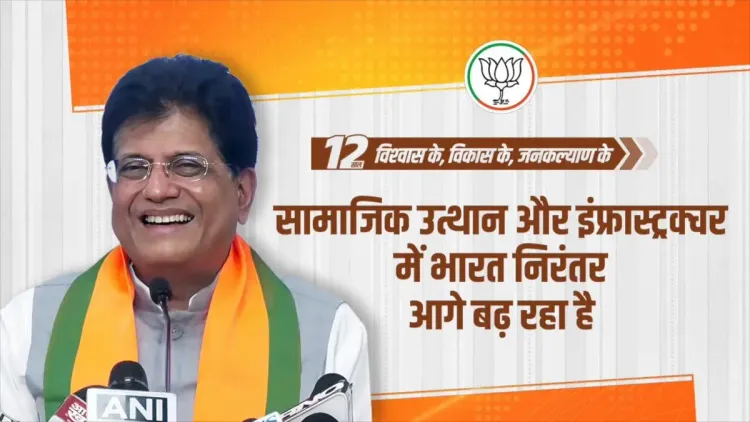
Union Commerce and Industry Minister Piyush Goyal on Saturday, 20 June 2026 underscored India's simultaneous push on social welfare and physical infrastructure, posting on X that the country is moving forward with heavy investment in both domains.
In his post, the minister wrote: 'सामाजिक उत्थान और इंफ्रास्ट्रक्चर दोनों में भारी निवेश के साथ भारत आगे बढ़ रहा है।' — translated: 'India is moving forward with heavy investment in both social upliftment and infrastructure.'
Context
The statement comes against the backdrop of a decade-long policy orientation that has paired stepped-up capital spending on physical assets with expanded social-sector coverage. Since 2014, successive Union Budgets have raised capital expenditure from under 1.5 per cent of GDP to over 3 per cent, while welfare outlays on health, housing and sanitation have grown in parallel. Goyal's post reflects this established dual-track approach to growth and inclusion.
Policy Backdrop
The National Infrastructure Pipeline (NIP), announced in the Union Budget 2019-20, laid out an outlay of Rs 111 lakh crore across roads, railways, ports and urban projects over five years. On the social side, programmes such as Ayushman Bharat — the national health protection mission launched in 2018 — and the Swachh Bharat Mission, begun in 2014 to eliminate open defecation, have extended coverage to millions of low-income families. Together, these initiatives represent the government's stated commitment to developing hard infrastructure and human welfare in tandem.
Budget documents consistently show that the two tracks are not treated as competing priorities. Capital expenditure on roads, railways and digital infrastructure has risen sharply even as spending on housing, health insurance and sanitation has expanded — a pattern that Goyal's post publicly reaffirms at the ministerial level.
Stakeholders and Impact
The dual investment drive directly affects Indian citizens at both ends of the economic spectrum. Infrastructure developers and contractors benefit from sustained public capital expenditure, which also generates employment in construction and allied sectors. Low-income households, meanwhile, gain from social schemes that reduce out-of-pocket health costs and improve living conditions. The minister's framing positions these two streams as mutually reinforcing rather than trade-offs in a resource-constrained budget environment.
The message also carries significance for investor confidence: a senior cabinet minister and Leader of the House in the Rajya Sabha publicly signalling continuity in infrastructure and welfare spending sends a stable policy signal to domestic and international stakeholders watching India's fiscal priorities.
What's Next
Attention will now turn to the next Union Budget and its capital expenditure and social-sector allocations, which will be the clearest test of whether the dual-track commitment translates into fresh outlays. Quarterly progress reports on NIP project completions and scheme beneficiary numbers will also be closely watched by analysts and opposition benches alike. If allocations hold or rise, the minister's assertion will find concrete backing in the numbers; if they slip, the statement will invite scrutiny.
Point of View
A senior cabinet minister and Rajya Sabha floor leader signals policy continuity at a time when pre-budget speculation typically intensifies. The statement also pre-empts any opposition framing that welfare spending crowds out capital investment, or vice versa. Whether the next budget's numbers bear out this dual commitment will determine how much political weight the assertion ultimately carries.
NationPress
20 Jun 2026
Frequently Asked Questions
What did Piyush Goyal say about India's infrastructure investment?
Piyush Goyal posted on X on 20 June 2026 that India is moving forward with heavy investment in both social upliftment and infrastructure, reaffirming the government's dual-track policy approach.
What is the National Infrastructure Pipeline?
The National Infrastructure Pipeline is a government plan announced in the Union Budget 2019-20 with an outlay of Rs 111 lakh crore for investment across roads, railways, ports and urban projects over five years.
How has India's capital expenditure changed since 2014?
Central government capital expenditure has risen from under 1.5 per cent of GDP to over 3 per cent since 2014, reflecting a sustained push to build physical infrastructure alongside social welfare programmes.
What social schemes back up India's welfare investment claims?
Key social schemes include Ayushman Bharat, a national health protection mission launched in 2018 providing insurance to low-income families, and the Swachh Bharat Mission, a sanitation programme started in 2014 to eliminate open defecation.
What should we watch for after Piyush Goyal's infrastructure statement?
The next Union Budget's capital expenditure and social-sector allocations, along with quarterly progress reports on National Infrastructure Pipeline projects and scheme beneficiary numbers, will be the clearest indicators of whether the dual-track commitment is backed by fresh spending.