Piyush Goyal: India's shift from 'impossible' to 'will happen' is Real Power
Synopsis
Union Commerce Minister Piyush Goyal on June 23, 2026 declared that India has moved from a defeatist 'it cannot happen' mindset to a confident 'it will happen' spirit — calling this transformation the country's greatest achievement and its real power.
Key Takeaways
Union Commerce and Industry Minister Piyush Goyal posted on June 23, 2026 invoking a fundamental shift in India's national temperament.
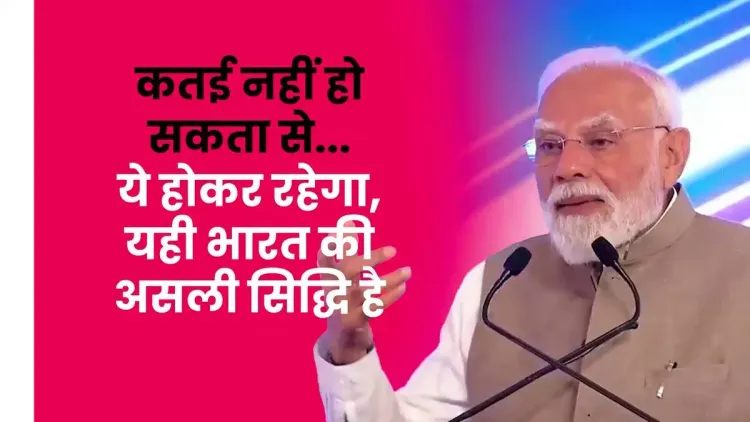
He described the change as moving from 'katai nahin ho sakta' ('it simply cannot happen') to 'ye hokar rahega' ('this will happen').
Goyal called this attitudinal transformation India's 'Real Power' and its true siddhi (accomplishment).
The post aligns with a policy arc running from 1991 liberalisation through Make in India (2014) and Atmanirbhar Bharat (2020) .
As Leader of the House in the Rajya Sabha , Goyal's messaging carries both ministerial authority and direct legislative relevance.
Upcoming parliamentary sessions and PLI scheme updates will be watched for concrete follow-through on the confidence narrative.
Union Commerce and Industry Minister Piyush Goyal on Tuesday, June 23, 2026, invoked a sweeping shift in India's national temperament, declaring that the country has moved from a defeatist refrain of 'it simply cannot happen' to a confident assertion of 'this will happen' — and that this attitudinal transformation is India's greatest achievement and its real source of power.
Context
Posting in Hindi on X, Goyal wrote: 'वो दिन चले गए, जब एक ही बात सुनाई देती थी- कतई नहीं हो सकता।' ('Those days are gone when only one thing could be heard — it simply cannot happen.') He continued: 'कतई नहीं हो सकता' से 'ये होकर रहेगा' ('From 'it simply cannot happen' to 'this will happen'') — adding that this shift in spirit is India's 'Real Power' and its true siddhi (accomplishment).
The post carries a video, underscoring that the message is part of a deliberate, produced communication rather than an off-the-cuff remark. As Leader of the House in the Rajya Sabha and a senior BJP leader, Goyal's public statements on national ambition carry both ministerial and political weight.
Policy Backdrop
The sentiment Goyal articulates maps directly onto a policy trajectory that stretches back decades. India's 1991 economic liberalisation dismantled the licence-raj framework and opened the economy to market forces, planting the first seeds of a higher-aspiration growth culture. The Make in India initiative, launched in 2014, sought to reposition the country as a global manufacturing destination, while the Atmanirbhar Bharat programme, announced in 2020, pushed further toward supply-chain resilience and domestic capability.
Production-linked incentive schemes across more than a dozen sectors, improved ease-of-doing-business rankings, and an accelerating pace of bilateral and multilateral trade negotiations have all been cited by the government as concrete markers of this shift from aspiration to execution.
Stakeholders and Impact
The message is pitched squarely at Indian entrepreneurs and the broader business community, for whom the psychological environment of governance — whether the state says 'yes' or 'no' by default — has direct bearing on investment decisions, risk appetite and innovation cycles.
For ordinary citizens, the framing presents national confidence itself as a policy outcome, arguing that a change in collective mindset is as consequential as any single scheme or statute. The post thus functions simultaneously as political communication, governance branding and a call to sustained ambition.
What's Next
Observers will watch for whether this message is followed by concrete announcements — such as expansions to production-linked incentive schemes or movement on pending trade agreements — that give the attitudinal claim a legislative or regulatory anchor. Parliamentary sessions in the months ahead are expected to include debates on commerce-related legislation, where Goyal, as Leader of the House in the Rajya Sabha, will be central to steering the government's agenda.
If the post is the opening note of a broader campaign, it signals that the BJP-led government intends to make 'national confidence' a defining theme of its political messaging heading into the second half of 2026 — framing India's story not just through data points, but through a transformation of spirit.
Point of View
But as a civilisational attitude shift. By anchoring 'Real Power' in a change of spirit rather than a single policy win, the message is deliberately broad — it is difficult to falsify and easy to personalise across voter segments. The invocation of siddhi (accomplishment) adds a cultural-philosophical register that resonates beyond urban, English-speaking audiences. Placed in mid-2026, this kind of messaging typically precedes or accompanies a larger campaign push, suggesting the government may be building rhetorical scaffolding for announcements to come.
NationPress
23 Jun 2026
Frequently Asked Questions
What did Piyush Goyal say about India's Real Power?
Piyush Goyal said that India's shift in mindset — from 'it simply cannot happen' to 'this will happen' — is the country's greatest achievement and its real power, posting this message in Hindi on X on June 23, 2026.
What is the meaning of 'katai nahin ho sakta' in Goyal's post?
'Katai nahin ho sakta' is a Hindi phrase meaning 'it simply cannot happen.' Goyal used it to describe the old, defeatist attitude that he says India has now left behind.
What is Atmanirbhar Bharat and how does it relate to Goyal's statement?
Atmanirbhar Bharat, announced in 2020, is India's self-reliance programme aimed at building domestic manufacturing and supply-chain resilience. Goyal's message about national confidence directly echoes the programme's philosophy of India doing for itself what it once thought impossible.
What is Piyush Goyal's current role in the Indian government?
Piyush Goyal is the Union Minister of Commerce and Industry and also serves as Leader of the House in the Rajya Sabha, making him one of the most senior figures in the BJP-led central government.
What should we watch for after Piyush Goyal's 'Real Power' post?
Analysts will watch for expansions to production-linked incentive schemes, progress on trade agreements, and commerce-related legislation in upcoming parliamentary sessions as potential policy follow-through to the confidence narrative Goyal outlined.