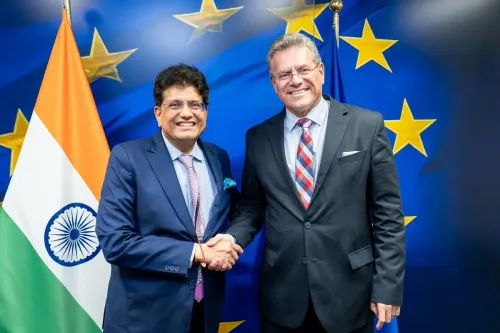
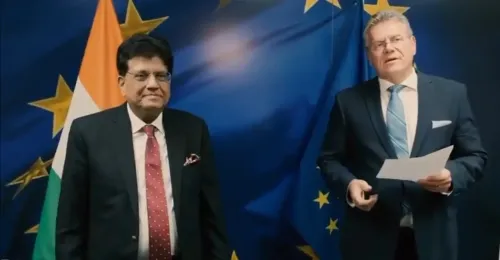
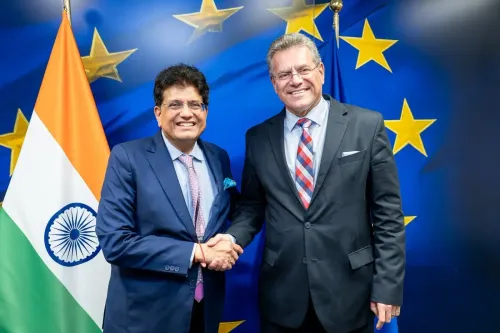
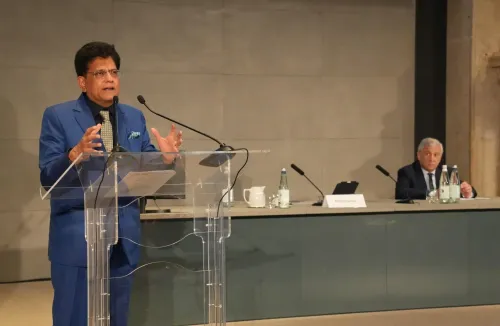
Piyush Goyal meets EU Trade Commissioner Sefcovic on India-EU FTA
Synopsis
Union Commerce Minister Piyush Goyal met EU Trade Commissioner Maros Sefcovic on 15 July 2026 to review India-EU FTA implementation progress and explore cooperation in trade, investment, critical technologies, and resilient supply chains — advancing a deal first launched in 2007.
Key Takeaways
Piyush Goyal and EU Trade Commissioner Maros Sefcovic met on 15 July 2026 to review progress on the India-EU Free Trade Agreement .
The two sides explored deeper cooperation in trade, investment, critical technologies, and resilient supply chains .
The India-EU BTIA was first launched in 2007 , suspended in 2013 , and formally resumed in June 2022 .
The India-EU Trade and Technology Council , set up in 2023 , complements the FTA process on critical-technology and supply-chain issues.
Bilateral India-EU trade has exceeded $120 billion annually, making the EU one of India's largest trading partner blocs.
A concluded FTA would be the most significant trade agreement India has signed in terms of the economic scale of the partner.
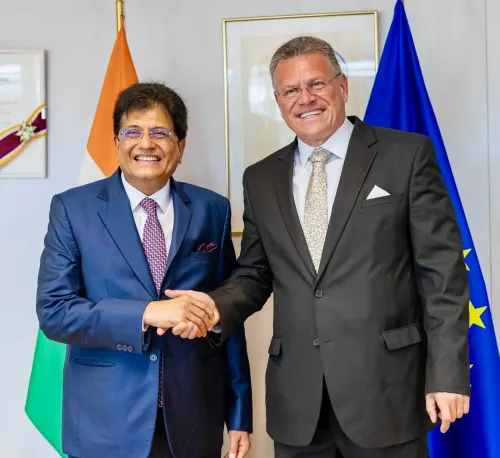
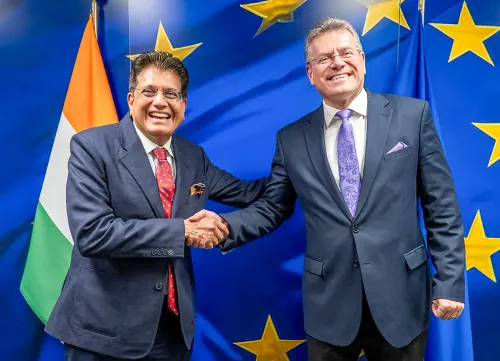
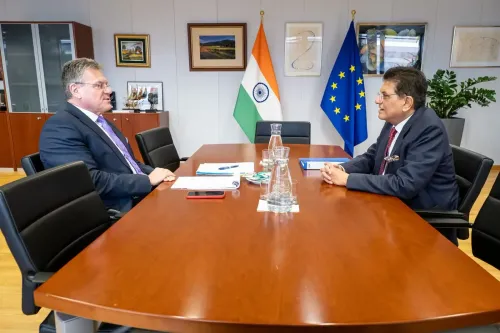
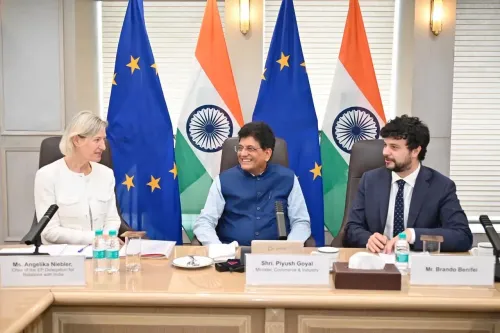
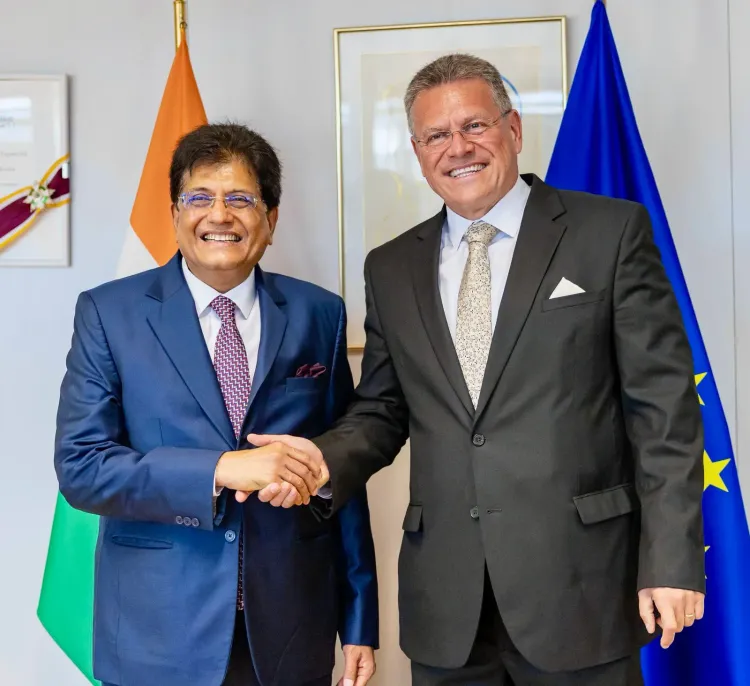
Union Commerce and Industry Minister Piyush Goyal met EU Trade and Economic Security Commissioner Maros Sefcovic on Wednesday, 15 July 2026, reviewing progress on the India-EU Free Trade Agreement and exploring deeper cooperation in trade, investment, critical technologies, and resilient supply chains.
Context
Goyal described the meeting as 'wonderful,' noting that the two sides reviewed the implementation progress of the India-EU FTA and identified new avenues for cooperation. The bilateral engagement covers goods, services, investment, critical technologies, and supply-chain resilience — areas that have grown in strategic importance for both sides. The minister also underscored the personal rapport between the two officials, calling Sefcovic 'my friend.'
Policy Backdrop
The India-EU Broad-based Trade and Investment Agreement (BTIA) has a long and complicated history: talks were first launched in 2007, suspended in 2013 after six years of stalled negotiations, and formally resumed in June 2022. The India-EU Trade and Technology Council, established in 2023, was designed to run in parallel with the FTA process, specifically to address critical technologies and supply-chain vulnerabilities that a goods-and-services agreement alone cannot resolve. The European Union remains one of India's largest trading partners, with bilateral trade exceeding $120 billion annually in recent years.
India has simultaneously accelerated bilateral FTAs with Australia, the UAE, and the United Kingdom as part of a broader strategy to diversify export markets and attract foreign investment. The EU, for its part, is actively seeking to reduce strategic dependencies on single suppliers — particularly in critical minerals and semiconductors — aligning with its Global Gateway and Indo-Pacific strategies. Both imperatives create a structural incentive for faster conclusion of the India-EU deal.
Stakeholders and Impact
Indian exporters in sectors such as textiles, pharmaceuticals, engineering goods, and IT services stand to gain significantly from improved market access under a concluded FTA. EU investors eyeing India's manufacturing base — particularly in electronics, clean energy, and defence — are closely watching investment facilitation provisions under negotiation. The critical-technologies dimension of the talks is especially significant for Indian firms in semiconductors and green-hydrogen supply chains, where European capital and know-how are in demand.
Commissioner Sefcovic oversees the EU's trade agreements and supply-chain resilience agenda, making him the key interlocutor for India on both the FTA text and the broader economic-security framework. His engagement with Goyal signals that the EU continues to treat the India relationship as a priority within its global trade diversification push.
What's Next
Attention will now turn to the next formal round of India-EU FTA negotiations and any joint statement emerging from the forthcoming India-EU Summit on market-access concessions or investment facilitation. Progress on critical-technology cooperation and resilient supply chains — flagged explicitly in Tuesday's meeting — will be a key indicator of whether the two sides are moving beyond procedural rounds toward substantive convergence. A concluded agreement would mark the most significant trade deal in India's post-liberalisation history in terms of the economic size of the partner.
Point of View
Both sides are signalling that this is no longer just an FTA negotiation — it is a strategic economic-security partnership. For India, the meeting fits a deliberate pattern of high-level ministerial engagement designed to compress negotiating timelines ahead of what is expected to be a consequential India-EU Summit. The EU's parallel push to de-risk critical supply chains gives New Delhi unusual leverage to seek concessions on services and investment that had previously been stumbling blocks.
NationPress
15 Jul 2026
Frequently Asked Questions
What is the India-EU FTA and where do negotiations stand?
The India-EU Free Trade Agreement, formally known as the Broad-based Trade and Investment Agreement (BTIA), covers goods, services, investment, and regulatory cooperation. Talks began in 2007, were suspended in 2013, and resumed in June 2022. As of July 2026, both sides are actively reviewing implementation progress and exploring cooperation in critical technologies and supply chains.
Who is Maros Sefcovic and why did he meet Piyush Goyal?
Maros Sefcovic is the EU Trade and Economic Security Commissioner responsible for the EU's trade agreements and supply-chain resilience agenda. He met Commerce Minister Piyush Goyal on 15 July 2026 to review progress on the India-EU FTA and explore avenues for deeper bilateral cooperation.
What areas did Goyal and Sefcovic discuss?
The two officials reviewed progress on the India-EU FTA and discussed deepening cooperation in trade, investment, critical technologies, and resilient supply chains, according to Goyal's post on X.
How big is India-EU bilateral trade?
Bilateral trade between India and the European Union has exceeded $120 billion annually in recent years, making the EU one of India's largest trading partner blocs.
What is the India-EU Trade and Technology Council?
The India-EU Trade and Technology Council was established in 2023 to complement the FTA negotiations by specifically addressing critical technologies and supply-chain vulnerabilities that a conventional trade agreement cannot fully cover.