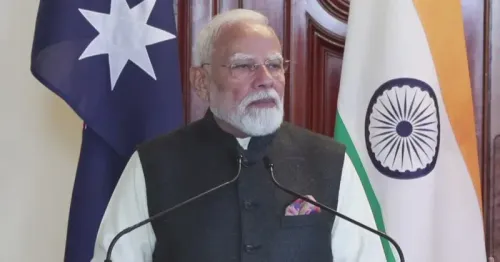
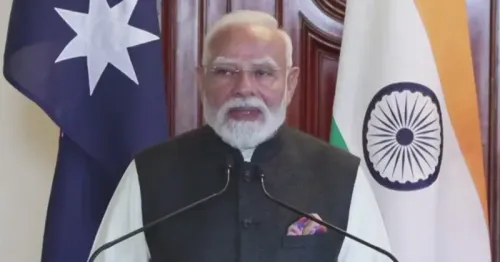
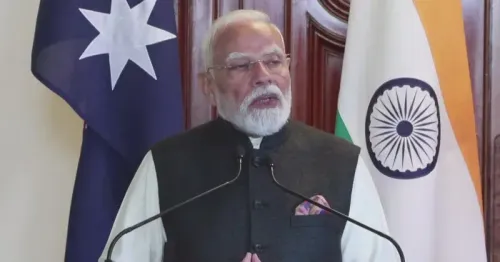
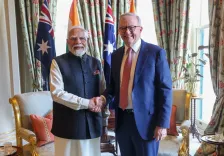
PM Modi Addresses Joint Press Meet with Australia's PM Albanese

Synopsis
Prime Minister Narendra Modi addressed a joint press conference with Australian PM Anthony Albanese on 9 July 2026, reinforcing the India-Australia Comprehensive Strategic Partnership across defence, trade, critical minerals and Indo-Pacific security within the Quad framework.
Key Takeaways
PM Modi and Australian PM Anthony Albanese held a joint press conference on 9 July 2026 .
The meeting builds on the Comprehensive Strategic Partnership upgraded in March 2023 .
The India-Australia ECTA , signed in 2022 , forms the trade backbone of the bilateral relationship.
Both nations cooperate within the Quad framework alongside the United States and Japan .
Critical minerals , clean energy, defence, and education are the four key pillars of current engagement.
The India-Australia 2+2 Ministerial Dialogue has provided annual security coordination since 2017 .
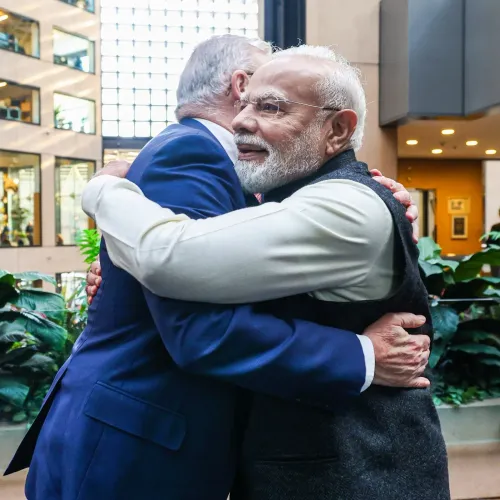
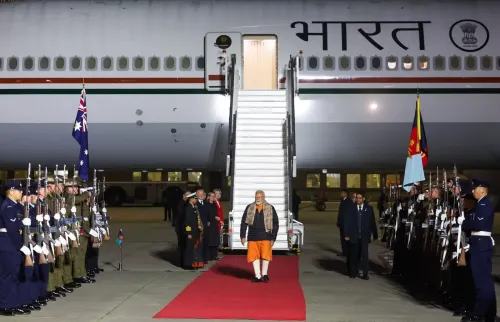
Prime Minister Narendra Modi addressed a joint press conference alongside Australian Prime Minister Anthony Albanese on Thursday, 9 July 2026, marking a significant moment in the bilateral engagement between India and Australia.
Context
The joint press meet between the two leaders underscores the deepening diplomatic ties that have characterised the India-Australia Comprehensive Strategic Partnership, upgraded in March 2023 when PM Albanese visited India. Such press conferences typically follow substantive bilateral discussions covering trade, defence, education, and regional security. The format signals a high degree of coordination and mutual priority accorded to the relationship by both governments.
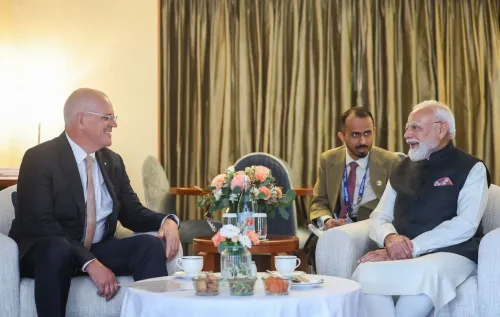
PM Modi and PM Albanese have met on multiple occasions since 2022, including at the Quad Leaders Summit in Sydney in May 2023, where the two nations advanced cooperation on defence technology and supply chain resilience. The July 2026 meeting continues that pattern of sustained, leader-level engagement.
Policy Backdrop
The bilateral relationship is anchored in several institutional frameworks. The India-Australia Economic Cooperation and Trade Agreement (ECTA), signed in 2022, set in motion a process of tariff reductions aimed at expanding bilateral commerce across goods and services. Progress on implementing ECTA commitments, including phased tariff cuts, has been a standing agenda item in bilateral interactions.
On the security side, the India-Australia 2+2 Ministerial Dialogue — bringing together foreign and defence ministers — has met annually since 2017, providing a structured channel for coordination on the Indo-Pacific strategic environment. Both nations are also members of the Quad, the quadrilateral grouping with the United States and Japan, which addresses regional security, critical and emerging technologies, and supply chain diversification.
Critical minerals have emerged as a central pillar of the partnership, with Australia's resource endowment and India's manufacturing ambitions creating natural complementarity. Clean energy cooperation and education links — with a large Indian student population in Australia — further broaden the partnership beyond traditional diplomacy.
Stakeholders and Impact
Defence manufacturers in both countries stand to benefit from deepened cooperation frameworks, as do Australian mining companies engaged in critical minerals supply agreements with Indian counterparts. The large Indian student community in Australia — one of the largest international student cohorts in the country — also has a direct stake in the education and mobility dimensions of the bilateral agenda.
For India, the partnership with Australia is integral to its broader Indo-Pacific strategy, providing a reliable partner for supply chain diversification away from single-source dependencies. For Australia, India represents one of the fastest-growing large economies and a critical node in its regional engagement architecture.
What's Next
Observers will watch closely for any new agreements or memoranda of understanding on critical minerals, defence cooperation, or clean energy that may emerge from this engagement. Progress on outstanding ECTA tariff schedules and announcements related to education mobility or defence technology transfer will be key indicators of the meeting's outcomes.
The trajectory of India-Australia ties — sustained across multiple summits and ministerial dialogues since 2014 — suggests the partnership will continue to deepen within the Quad framework, even as both nations maintain their independent foreign policy positions.
Point of View
Using leader-level visibility to reinforce strategic messaging. For the BJP government, Australia is not merely a trading partner but a pillar of its multi-alignment strategy that balances great-power competition without formal alliance commitments. The durability of this partnership across different domestic political cycles in both countries suggests it rests on structural interests, not just personal diplomacy.
NationPress
9 Jul 2026
Frequently Asked Questions
Why did PM Modi meet Australian PM Albanese in July 2026?
PM Modi and PM Albanese held a joint press conference on 9 July 2026 as part of ongoing high-level engagement under the India-Australia Comprehensive Strategic Partnership , covering defence, trade, critical minerals, and Indo-Pacific security.
What is the India-Australia Comprehensive Strategic Partnership?
The India-Australia Comprehensive Strategic Partnership was established in 2020 and upgraded during PM Albanese's visit to India in March 2023 , providing a framework for cooperation on defence, trade, education, clean energy, and regional security.
What is ECTA between India and Australia?
The India-Australia Economic Cooperation and Trade Agreement (ECTA) was signed in 2022 and aims to reduce tariffs and expand bilateral trade in goods and services, forming the commercial backbone of the partnership.
Is India part of the Quad with Australia?
Yes, India and Australia are both members of the Quad , a quadrilateral grouping that also includes the United States and Japan , focused on Indo-Pacific security, supply chains, and critical and emerging technologies.
What are the key areas of India-Australia cooperation in 2026?
The key pillars of India-Australia cooperation include critical minerals supply chains, clean energy, defence technology, education and student mobility, and broader Indo-Pacific security coordination through the Quad and the 2+2 Ministerial Dialogue .