'Not a Grihasthi, but Insightful': PM Modi Champions Women's Empowerment Initiatives
Synopsis
In a compelling address, PM Modi highlighted the significance of women's empowerment through government initiatives, emphasizing their growing economic independence and pivotal role in shaping India's future. As plans for women's reservations in Parliament unfold, he calls for unity across political lines to transform aspirations into reality.
Key Takeaways
Women’s Empowerment: Government schemes are pivotal for women's economic independence.
Nari Shakti Vandan Adhiniyam: Aimed at increasing women's representation in Parliament.
Panchayati Raj: A model showcasing women's leadership in local governance.
Upcoming Amendments: Focused on implementing women's reservations in Parliament.
Collaborative Efforts: A call for unity among political parties to support women's empowerment.
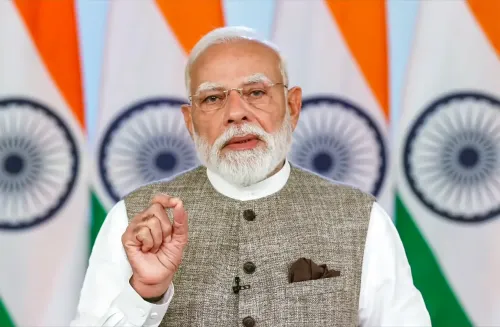
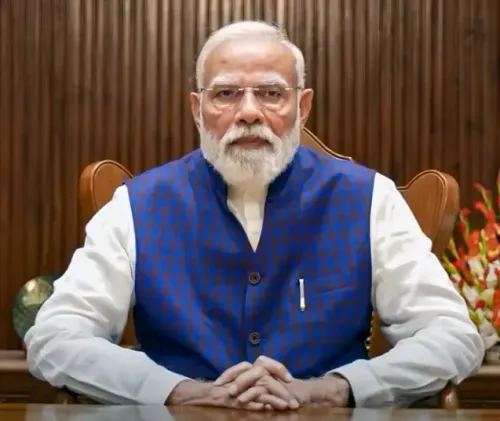
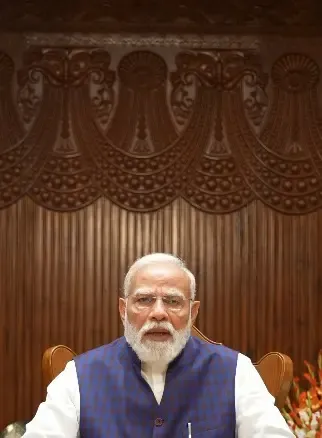
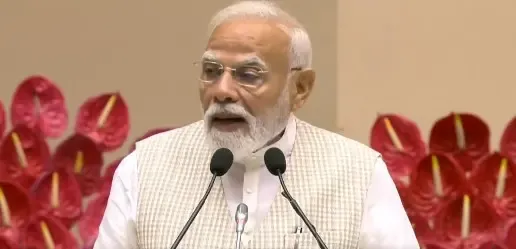
New Delhi, April 13 (NationPress) Prime Minister Narendra Modi stated on Monday that although he is not a Grihasthi (householder), he possesses a deep understanding of domestic life, asserting that through various governmental initiatives, women are gaining substantial economic empowerment.
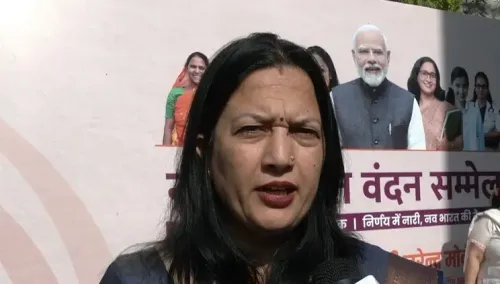
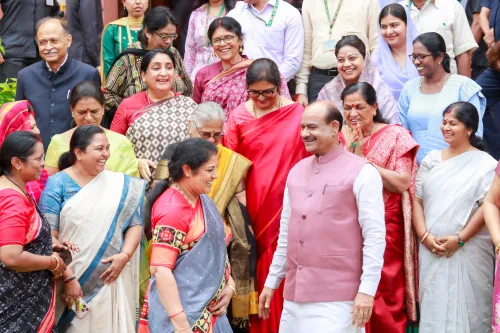
While speaking at the Nari Shakti Vandan Sammelan held at Vigyan Bhawan, the Prime Minister noted that the journey to Parliament is becoming less daunting for women, whose significance in society has only grown.
“Parliament is on the brink of marking a new historical chapter, one that aims to bring to fruition the visions of yesteryears and uphold the aspirations of the years to come,” he remarked.
He underscored that it is the government's commitment to ensure that the amendment bill to the Nari Shakti Vandan Adhiniyam is passed through active dialogue, collaboration, and participation from all sectors.
Upon the introduction of the Nari Shakti Vandan Adhiniyam in 2023, it was unanimously approved by all political factions in Parliament, he highlighted.
Prime Minister Modi praised Panchayati Raj institutions as exemplary models of women's leadership, emphasizing that India's Nari Shakti has made tremendous contributions to the nation’s development.
The triumph of the Jal Jeevan Mission exemplifies the pivotal role women have played at the Panchayat level. Research indicates that increased female participation in decision-making processes enhances sensitivity and responsiveness within governance frameworks, he added.
He enumerated several flagship programs benefiting women, including Beti Bachao Beti Padhao, the Maternity Benefit Scheme, the Sukanya Samriddhi Yojana for post-natal assistance, and Mission Indradhanush, aimed at ensuring timely vaccinations for children.
To tackle the absence of toilets in schools, the government initiated the Swachh Bharat Abhiyan. This initiative also offers free sanitary pads, provides annual financial aid of Rs one lakh for sports, and opens Sainik Schools for girls aspiring to enter the armed forces. In later life stages, the Ujjwala Yojana shields women from kitchen smoke hazards, the Har Ghar Nal scheme guarantees access to clean tap water at home, and the Ayushman Yojana offers free medical treatment up to Rs five lakh.
“Our sisters and daughters are reaping substantial benefits from these initiatives,” he asserted. Over 30 million women have achieved homeownership through government housing schemes.
“Traditionally, when fathers and sons engage in business discussions, if the mother walks in, they would often say, 'You may leave'. Now, with women gaining economic power, even sons invite their mothers to join the conversation,” he noted with a smile. He congratulated all Indian women on this transformative era.
“For decades, there has been a collective demand for women's reservations within our democratic structure. Nearly 40 years have elapsed since discussions surrounding the Women's Reservation Bill commenced. This journey reflects the efforts of all political entities over several generations. Each party has contributed uniquely to this concept. The Act was passed in 2023 with unanimous support from all political factions. There is a strong consensus to implement it by 2029. Women across the country should engage with their Members of Parliament, share their thoughts, and voice their expectations,” he continued.
“As the MPs prepare to attend parliamentary sessions, see them off with garlands of flowers. When they depart carrying the blessings of our mothers and sisters, they will be compelled to make the right choices,” Prime Minister Modi advised.
A special three-day parliamentary session is scheduled from April 16 to 18 to discuss amendments for implementing women's reservations. The original Nari Shakti Vandan Adhiniyam linked reservations to the new census and subsequent delimitation. However, due to delays in the census, the government now intends to proceed based on the data from the 2011 census.
Following the amendment, Lok Sabha seats could potentially rise from 543 to 816, with provisions to reserve one-third of the seats for women while preserving existing SC and ST reservations. At this stage, no separate OBC reservation within the women's quota has been established.
The government has proposed two major amendments, including a separate Delimitation Bill. Both are anticipated to be addressed as constitutional amendments during the upcoming session.
Prime Minister Modi has urged all political factions to back this historic move in the spirit of consensus that characterized the original passage of the Act in 2023, ensuring that Nari Shakti can play a more significant role in shaping the future of a developed India.
Point of View
Prime Minister Modi's remarks underscore a pivotal moment in Indian politics regarding women's empowerment. His focus on collaborative efforts across political parties reflects a growing recognition of the necessity of women's representation in governance, aiming for a more inclusive future.
NationPress
16 Sept 2026
Frequently Asked Questions
What is the Nari Shakti Vandan Adhiniyam?
The Nari Shakti Vandan Adhiniyam is a legislative initiative aimed at enhancing women's representation in Indian Parliament and ensuring their active participation in governance.
How does the government support women's empowerment?
The government supports women's empowerment through various schemes like Beti Bachao Beti Padhao, Maternity Benefit Scheme, and Ujjwala Yojana, among others.
What is the significance of the upcoming parliamentary session?
The upcoming parliamentary session aims to discuss amendments related to women's reservations, crucial for enhancing women's participation in politics.
How many Lok Sabha seats could potentially be increased?
The number of Lok Sabha seats could potentially increase from 543 to 816 after the proposed amendments.
What role do women play in the Panchayati Raj system?
Women in the Panchayati Raj system significantly contribute to decision-making and governance, enhancing community development and responsiveness.