PM Modi Invokes India's Civilisational Heritage in Sanskrit Post
Synopsis
Prime Minister Narendra Modi posted a Sanskrit Atharvaveda verse on 22 May 2026, describing India as a sacred land of devotion, courage and collective welfare, and wishing all citizens enduring happiness and prosperity — consistent with his long-standing public emphasis on civilisational identity.
Key Takeaways
Prime Minister Narendra Modi posted a Hindi and Sanskrit message on 22 May 2026 invoking India's civilisational heritage.
He described India as a punyabhoomi — a sacred land of spiritual practice, courage, strength and universal well-being.
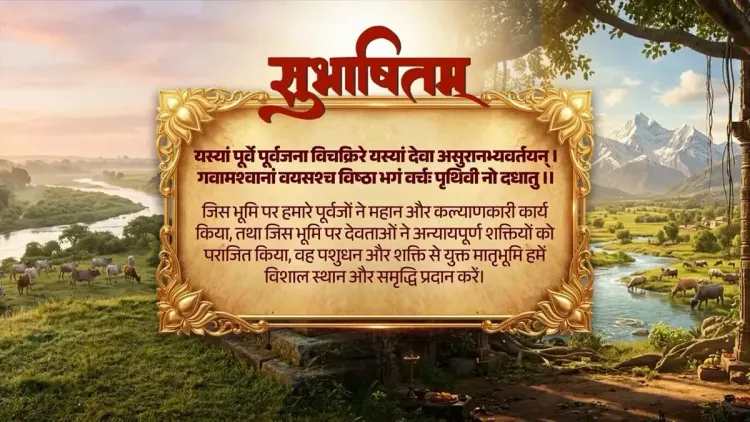
The post quoted a verse from the Atharvaveda referencing forefathers, the gods' victory over asuras, and the land's material abundance.
Modi expressed the wish that India's ancient land may always keep its people filled with happiness and prosperity.
The message continues a consistent pattern of the Prime Minister invoking Vedic and Sanskrit traditions in public communications.
Cultural policy watchers will monitor follow-up announcements on Sanskrit promotion and heritage preservation from relevant ministries.
Prime Minister Narendra Modi posted a message on Thursday, 22 May 2026 invoking India's ancient spiritual and cultural heritage, sharing a Sanskrit verse from the Vedas alongside a reflection on the nation as a land of courage, devotion and collective welfare.
Context
Writing in Hindi and Sanskrit, Prime Minister Modi described India as 'maatrubhoomi' (motherland) and 'punyabhoomi' (sacred land) — a place of 'sadhana aur upasana' (spiritual practice and devotion) as well as courage, strength and universal well-being. He expressed the wish that this sacred land, home to a great heritage and ancient civilisation, may always keep everyone filled with happiness and prosperity.
The post quoted a verse from the Atharvaveda: 'Yasyam purve purvajana vichakraire yasyam deva asuranabhyavartayan' — loosely translated as 'the land where our forefathers performed their deeds, where the gods overcame the asuras.' The verse continues with references to cattle, horses and material abundance, invoking the land's bounty.
Policy Backdrop
Prime Minister Modi has consistently woven references to India's Vedic and civilisational legacy into his public communications, from independence commemorations to international cultural forums. These invocations form part of a broader public emphasis on cultural continuity and national self-understanding that has characterised his tenure since 2014.
The government has pursued several initiatives aligned with this cultural emphasis, including the promotion of Sanskrit in educational curricula, the establishment of the Ministry of Culture's heritage preservation programmes, and the international promotion of Yoga and Ayurveda as expressions of India's living civilisational tradition.
Stakeholders and Impact
Such messaging resonates with a wide cross-section of Indian citizens who identify with the country's Vedic and Sanskrit literary traditions. For scholars and cultural institutions, the Prime Minister's public citation of Atharvaveda verses signals continued governmental interest in ancient textual heritage.
The post also carries significance for diaspora communities and international observers who follow India's cultural diplomacy, as the framing of India as a 'punyabhoomi' — a land of sacred purpose — is frequently deployed in outreach to Hindu communities worldwide.
What's Next
Observers will watch for follow-up announcements from the Ministry of Culture or the Ministry of Education regarding heritage preservation, Sanskrit promotion, or curriculum updates referencing ancient texts in upcoming parliamentary sessions. Posts of this nature from the Prime Minister's office have in the past preceded or accompanied formal policy announcements tied to cultural or national occasions.
As India continues to position its civilisational identity at the centre of its soft-power strategy, such statements from Prime Minister Modi are likely to recur with greater frequency ahead of significant cultural and national milestones.
Point of View
The Prime Minister signals not just personal reverence but a deliberate civilisational framing of India's self-image. This pattern has been consistent across his tenure and feeds into a broader arc of soft-power projection, from Yoga diplomacy to Sanskrit in education. The message carries no immediate policy directive, but its regularity suggests it is as much a governance signal as a cultural one — reminding domestic and international audiences of the ideological foundations underpinning his administration's cultural priorities.
NationPress
5 Oct 2026
Frequently Asked Questions
What did PM Modi post on 22 May 2026?
PM Modi posted a message in Hindi and Sanskrit describing India as a sacred land of devotion, courage and universal well-being, quoting a verse from the Atharvaveda and wishing all citizens happiness and prosperity.
Which Sanskrit verse did PM Modi quote?
He quoted a verse from the Atharvaveda: 'Yasyam purve purvajana vichakraire yasyam deva asuranabhyavartayan,' which refers to the land where forefathers performed their deeds and where the gods overcame the asuras.
What does 'punyabhoomi' mean?
'Punyabhoomi' is a Sanskrit term meaning 'sacred land' or 'land of merit.' PM Modi used it to describe India as a place of spiritual purpose, ancient heritage and collective welfare.
Why does PM Modi frequently quote Sanskrit texts?
PM Modi has consistently invoked India's Vedic and Sanskrit literary traditions as part of a broader public emphasis on civilisational identity and cultural continuity, a pattern visible across festivals, national commemorations and cultural forums throughout his tenure.
What policy actions follow such cultural statements by PM Modi?
Such statements have in the past been accompanied or followed by government initiatives on Sanskrit promotion in education, heritage preservation programmes under the Ministry of Culture, and the international promotion of Yoga and Ayurveda as expressions of India's living civilisational tradition.