PM Modi Shares Vedic Verse from Atharvaveda's Prithvi Sukta
Synopsis
Prime Minister Narendra Modi shared a Sanskrit verse from the Atharvaveda's Prithvi Sukta on August 6, 2026, invoking the Earth as mother of medicinal herbs and sustained by cosmic order — part of his recurring emphasis on India's ancient civilizational heritage.
Key Takeaways
Prime Minister Narendra Modi posted a Sanskrit shloka from the Prithvi Sukta of the Atharvaveda on August 6, 2026 .
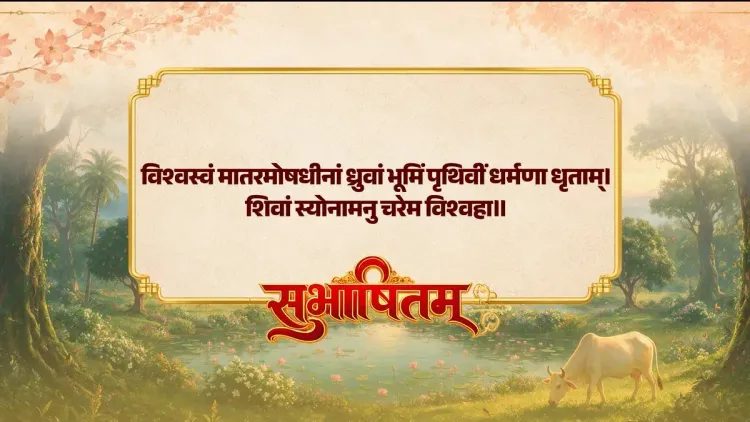
The verse invokes the Earth as the 'mother of all medicinal herbs,' sustained by dharma — cosmic and moral order.
The Prithvi Sukta is a 63-verse hymn and one of the earliest expressions of ecological reverence in world literature.
Modi has periodically shared Vedic and Sanskrit verses on social media as part of a broader cultural communication strategy.
No specific occasion or event has been officially linked to this post by the Prime Minister's Office.
An ancient invocation of the Earth — as mother, as healer, as the axis of cosmic order — landed on Prime Minister Narendra Modi's social media feed on Thursday, August 6, 2026, when he shared a Sanskrit shloka from the Atharvaveda's Prithvi Sukta.
The verse reads: 'Vishwasya maataramoshadheenam dhruvam bhumim prithivim dharmanaa dhrutaam. Shivam syonaamanucharem vishwahaa' — rendered in English as: 'May we forever walk upon this auspicious, benevolent Earth — the mother of all medicinal herbs, the firm and immovable ground, sustained by cosmic law.'
A Shloka from One of India's Oldest Texts
The Prithvi Sukta is a hymn of 63 verses embedded in the Atharvaveda, one of the four foundational Vedas of ancient Indian civilisation. It is among the earliest known expressions of ecological reverence in any world literature — addressing the Earth not as a resource but as a living, sovereign mother. The specific verse shared by Prime Minister Modi calls upon dharma — cosmic and moral order — as the sustaining force beneath the planet itself.Modi's Pattern of Sharing Sanskrit Verses
This is not a one-off gesture. Prime Minister Modi has periodically shared Sanskrit shlokas and Vedic passages on social media as part of a recurring emphasis on India's civilizational heritage. The practice fits a broader cultural communication strategy that positions India's ancient texts as living wisdom rather than museum artefacts — relevant to contemporary audiences on environment, governance, and ethics alike. The choice of the Prithvi Sukta carries particular resonance: its imagery of the Earth as the 'mother of medicinal herbs' and its call for humanity to 'walk upon her' with reverence has drawn comparisons to modern environmental philosophy, even as its roots stretch back thousands of years. The Prime Minister's Office has not issued additional context for the timing of this specific post. Whether it accompanies a cultural event, an environmental initiative, or stands as a standalone reflection remains to be clarified. A verse written millennia ago, posted on a twenty-first-century platform — the message, at its core, is unchanged: the Earth endures; the question is whether those who walk upon her remember why.Point of View
With its ecological undertones, is notable: it allows the post to resonate across cultural-nationalist and environmentally conscious audiences simultaneously. Over time, this pattern of Vedic social media posts constructs an image of leadership rooted in ancient wisdom, complementing policy communication with a deeper civilizational register. Whether these posts are coordinated with broader cultural or environmental initiatives remains a recurring question that the PMO rarely answers explicitly.
NationPress
20 Sept 2026
Frequently Asked Questions
What Sanskrit verse did PM Modi share on August 6 2026?
PM Modi shared a shloka from the Prithvi Sukta of the Atharvaveda, which translates as: 'May we forever walk upon this auspicious Earth — the mother of all medicinal herbs, sustained by cosmic law.'
What is the Prithvi Sukta in the Atharvaveda?
The Prithvi Sukta is a 63-verse hymn in the Atharvaveda, one of India's four foundational Vedas. It is among the oldest known texts addressing the Earth with reverence, treating it as a living mother rather than a resource.
Why does PM Modi share Sanskrit shlokas on social media?
PM Modi periodically shares Vedic and Sanskrit verses as part of a broader emphasis on India's ancient civilizational heritage, positioning classical texts as living wisdom relevant to contemporary life.
What does 'Dharmanaa dhrutaam' mean in the Prithvi Sukta verse?
'Dharmanaa dhrutaam' translates as 'sustained by dharma' — meaning the Earth is held in place and given order by cosmic and moral law, a central concept in Vedic philosophy.
Is the Prithvi Sukta related to environmentalism?
While the Prithvi Sukta predates modern environmentalism by millennia, its imagery of the Earth as mother and sustainer of life has drawn comparisons to contemporary ecological thought, and scholars often cite it in discussions of ancient Indian environmental philosophy.