PM Modi Highlights Rajasthan's Solar Energy Push
Synopsis
Prime Minister Narendra Modi on July 4, 2026, spotlighted Rajasthan's exceptional solar potential, announcing world-class solar parks and multiple solar energy initiatives as part of the government's broader push to diversify India's energy sources.
Key Takeaways
PM Modi posted on July 4, 2026 about his government's solar energy drive in Rajasthan .
He cited Rajasthan's high solar irradiance as the foundation for building world-class solar parks in the state.
Bhadla Solar Park in Jodhpur district is already among the largest solar installations in the world.
The push builds on the Jawaharlal Nehru National Solar Mission (2010) and the Rajasthan Solar Policy 2019 .
Expanded solar capacity benefits rural communities, farmers, private developers, and India's national grid.
New solar park tenders and grid integration updates in Rajasthan are expected to follow.
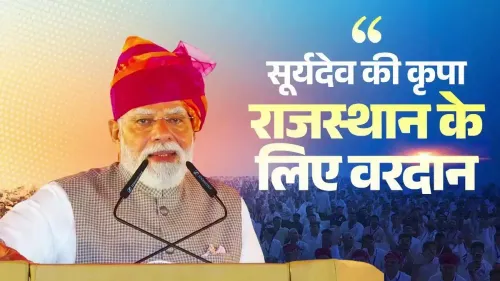
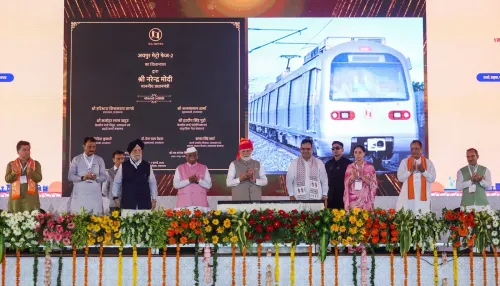
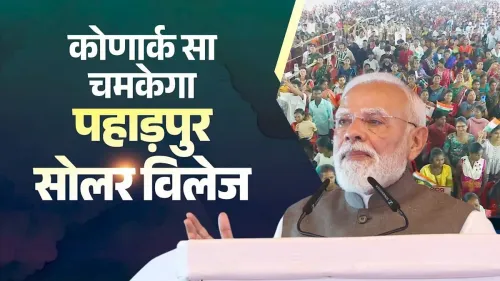
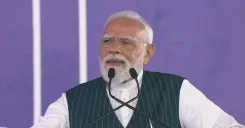
Prime Minister Narendra Modi on Saturday, July 4, 2026, highlighted his government's ongoing efforts to develop solar energy infrastructure in Rajasthan, pointing to the state's exceptional sunlight as a natural advantage for world-class solar parks and related renewable energy initiatives.
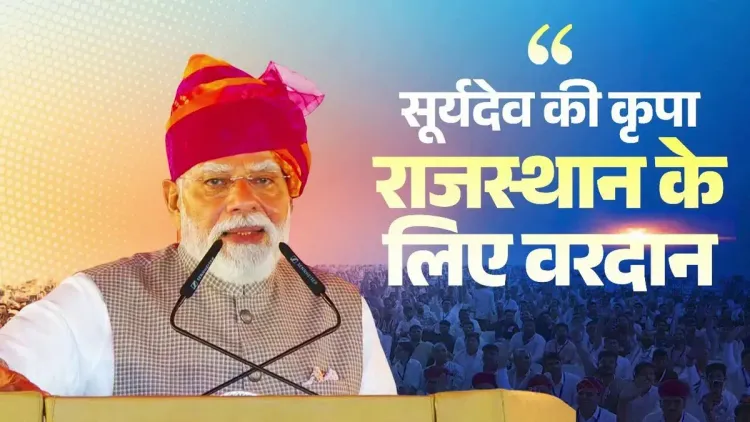
In a post on X, Modi stated: 'Rajasthan par Suryadev ki kripa ko dekhte hue yahan vishwastareey solar park banane ke saath-saath saur urja se jude kai prayas kiye ja rahe hain' — ('Considering the blessings of the Sun God on Rajasthan, world-class solar parks are being built here along with several other solar energy initiatives.')
Context
Rajasthan receives among the highest solar irradiance levels in India, making it a natural hub for large-scale photovoltaic installations. The state's vast stretches of arid and semi-arid land in the Thar Desert region have long been identified as prime real estate for utility-scale solar projects. Modi's post frames this geographical advantage as a kind of providential endowment, using the phrase 'blessings of the Sun God' to underscore Rajasthan's unique potential.
Policy Backdrop
India's solar energy journey has deep policy roots. The Jawaharlal Nehru National Solar Mission, launched in 2010, set the foundation for grid-connected solar power at scale. More recently, the International Solar Alliance — co-launched by India and France in 2015 — positioned India as a global leader in solar diplomacy and deployment.
At the state level, the Rajasthan Solar Policy 2019 updated the framework for attracting private investment, streamlining land allocation, and setting ambitious capacity targets. Bhadla Solar Park in Jodhpur district, developed in multiple phases, has emerged as one of the largest solar installations in the world, anchoring Rajasthan's reputation as India's solar capital. The current government's push builds directly on this lineage of state-central coordination.
Stakeholders and Impact
The primary beneficiaries of expanded solar infrastructure in Rajasthan include rural communities that have historically faced unreliable electricity supply, as well as private solar project developers and grid operators who stand to gain from new tenders and capacity additions. Farmers in the region have also been targeted through solar-powered irrigation schemes that reduce dependence on diesel pumps.
For the broader Indian economy, scaling up non-fossil energy in Rajasthan directly supports national targets for renewable capacity addition and helps moderate the country's import bill for fossil fuels. The state's solar output feeds into the national grid, with surplus power potentially transmitted to energy-deficit states.
What's Next
Observers will watch for the release of new solar park tenders, grid integration project announcements, and updates on transmission infrastructure linking Rajasthan's solar zones to consumption centres. Progress on the Green Energy Corridor projects, designed to evacuate renewable power from high-generation states, will be a key indicator of how quickly new capacity can be absorbed into the national grid.
With India's overall renewable energy ambitions continuing to set the pace for policy, Rajasthan's role as the country's solar frontier is likely to deepen — and Modi's public emphasis on the state signals continued political and financial commitment to that trajectory.
Point of View
Large-scale investment in the state. Coming ahead of any potential state-level political activity, the post reinforces the BJP's ownership of the renewable energy narrative in a key electoral state.
NationPress
4 Jul 2026
Frequently Asked Questions
What solar projects is the Modi government building in Rajasthan?
The government is developing world-class solar parks in Rajasthan alongside multiple other solar energy initiatives, leveraging the state's high solar irradiance. Bhadla Solar Park in Jodhpur district is already one of the largest solar installations globally.
Why is Rajasthan chosen for solar energy development in India?
Rajasthan receives some of the highest solar radiation levels in India, and its vast arid land — particularly in the Thar Desert region — makes it ideal for large-scale photovoltaic installations at relatively low land-acquisition cost.
What is Bhadla Solar Park?
Bhadla Solar Park is a major solar installation located in Jodhpur district, Rajasthan , developed in multiple phases. It is considered one of the largest solar parks in the world and is a flagship example of India's utility-scale solar ambitions.
What is India's policy framework for solar energy?
India's solar policy framework includes the Jawaharlal Nehru National Solar Mission (2010) , the International Solar Alliance (2015) co-founded with France, and the Rajasthan Solar Policy 2019 , which together guide grid-connected solar deployment and private investment.
How does Rajasthan solar power benefit ordinary people?
Expanded solar capacity in Rajasthan improves electricity reliability for rural communities, powers solar irrigation schemes that reduce farmers' diesel costs, and feeds surplus clean energy into the national grid — potentially lowering power costs across India.