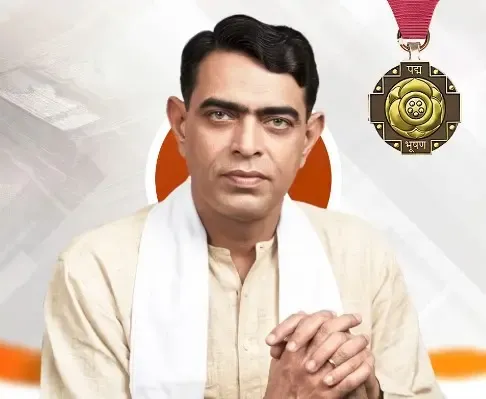
PM Modi pays tribute to Rashtrakavi Ramdhari Singh Dinkar on birth anniversary
Synopsis
Prime Minister Narendra Modi paid tribute to Rashtrakavi Ramdhari Singh Dinkar on his birth anniversary, honouring the legendary Hindi poet's nationalist verse — including Rashmirathi and Hunkar — for continuing to inspire courage, self-pride, and dedication to the motherland among Indians.
Key Takeaways
Prime Minister Narendra Modi offered a 'shata-shata naman' (hundredfold salute) to Rashtrakavi Ramdhari Singh Dinkar on his birth anniversary.
Modi praised Dinkar's poetry for instilling valour, brilliance, and self-pride in the hearts of Indians even today.
Ramdhari Singh Dinkar , born in 1908 , earned the title Rashtrakavi for nationalist works rooted in veer ras (the heroic literary sentiment).
His landmark works include Rashmirathi and Hunkar , which emphasise patriotism and national self-respect.
The tribute continues PM Modi's consistent pattern of marking birth anniversaries of cultural figures who highlight India's literary and civilisational heritage.
A poet who wrote fire into India's freedom struggle — Prime Minister Narendra Modi marked the birth anniversary of Rashtrakavi Ramdhari Singh Dinkar on Wednesday, September 23, offering what he called a 'shata-shata naman' — a hundredfold salute — to one of Hindi literature's most towering nationalist voices.
In his post, Prime Minister Modi wrote: 'राष्ट्रकवि रामधारी सिंह दिनकर जी की जयंती पर उन्हें मेरा शत-शत नमन।' — 'On the birth anniversary of Rashtrakavi Ramdhari Singh Dinkar, my hundredfold salutations to him.' He added that Dinkar's powerful poetry, filled with the spirit of public awakening and national self-respect, 'continues to this day to infuse valour, brilliance, and self-pride in the hearts of the people of this country,' and that his works enrich literature while deepening dedication to the motherland.
The poet who gave India its 'veer ras'
Ramdhari Singh Dinkar, born in 1908 in the Begusarai district of present-day Bihar, earned the title 'Rashtrakavi' — National Poet — for verse that crackled with nationalist energy at a time when India was still fighting for independence. His landmark works, including Rashmirathi and Hunkar, are anchored in veer ras — the literary sentiment of heroism — and remain staples of Hindi curriculum and public recitation across the country.
Dinkar's poetry was never quiet. It thundered against subjugation, celebrated martial courage, and called ordinary Indians toward a consciousness of their own dignity. Decades after his passing, lines from his works are still quoted in Parliament, at school assemblies, and at moments of national reckoning.
Modi's pattern of connecting governance to literary heritage
This tribute is part of a consistent practice by Prime Minister Modi of using social media to mark the birth anniversaries of writers, poets, and thinkers whose work emphasises national pride, self-reliance, and India's civilisational identity. From freedom-era philosophers to regional literary giants, these posts serve as a thread linking contemporary political messaging to India's cultural memory. Dinkar — with his themes of swabhiman (self-respect) and rashtriya chetna (national consciousness) — fits squarely within that frame.
For literature enthusiasts and students of Hindi poetry, the Prime Minister's acknowledgement keeps Dinkar's legacy visible in mainstream public discourse, well beyond the academic world.
Dinkar's words were written for a nation finding its spine. That they still resonate — in classrooms, in speeches, in a Prime Minister's post — is perhaps the surest proof that he found it.
Point of View
The BJP leadership reinforces a civilisational narrative that runs parallel to its policy agenda. Dinkar, whose verse was as political as it was poetic, is a particularly potent symbol in this context. The tribute keeps that symbolism alive in the digital public square, reaching audiences far beyond traditional literary circles.
NationPress
23 Sept 2026
Frequently Asked Questions
Who is Rashtrakavi Ramdhari Singh Dinkar?
Ramdhari Singh Dinkar was a celebrated Hindi poet born in 1908 in Bihar, awarded the title 'Rashtrakavi' (National Poet) for his powerful nationalist works including Rashmirathi and Hunkar, which are rooted in themes of heroism, self-respect, and patriotism.
Why did PM Modi pay tribute to Dinkar?
Prime Minister Narendra Modi posted a tribute on X to mark Ramdhari Singh Dinkar's birth anniversary, praising his poetry for continuing to inspire valour and national self-pride among Indians.
What is 'veer ras' in Dinkar's poetry?
'Veer ras' is one of the nine classical literary sentiments in Sanskrit and Hindi poetics, representing heroism and martial courage. Dinkar's poetry is especially celebrated for its use of veer ras to ignite nationalist feeling.
What are Ramdhari Singh Dinkar's most famous works?
Dinkar's most acclaimed works include Rashmirathi, a retelling of the Mahabharata centred on Karna, and Hunkar, a collection of fiercely nationalist poems. Both remain widely read and recited in India.
Does PM Modi regularly tribute literary figures on their birth anniversaries?
Yes. Prime Minister Modi consistently uses social media to mark the birth anniversaries of writers, poets, and cultural icons — particularly those whose work emphasises national pride, self-reliance, and India's civilisational heritage.