PM Modi shares Sanskrit verse on wisdom and friendship
Synopsis
Prime Minister Narendra Modi shared a Sanskrit shloka on 25 August 2026 counselling association with the virtuous, learned discourse, and friendship with the ungreedy — continuing his documented practice of invoking classical Indian ethical thought in public communication.
Key Takeaways
PM Modi posted a Sanskrit verse on 25 August 2026 on X, with an attached video.
The shloka advises keeping company with the virtuous, engaging in noble discourse with the learned, and befriending those free from greed.
The verse belongs to the Sanskrit subhashita tradition — compact ethical aphorisms designed for memorability and moral instruction.
The post carries no attached policy announcement or event; it stands as a standalone cultural message.
Modi has a documented pattern of sharing Sanskrit verses and classical references as part of his public communication on cultural heritage.
A verse thousands of years old, and yet its counsel lands with striking freshness. Prime Minister Narendra Modi posted a Sanskrit shloka on X on Tuesday, 25 August 2026, drawing on classical Indian ethical thought to underscore the enduring value of good company, learned conversation, and generous friendship.
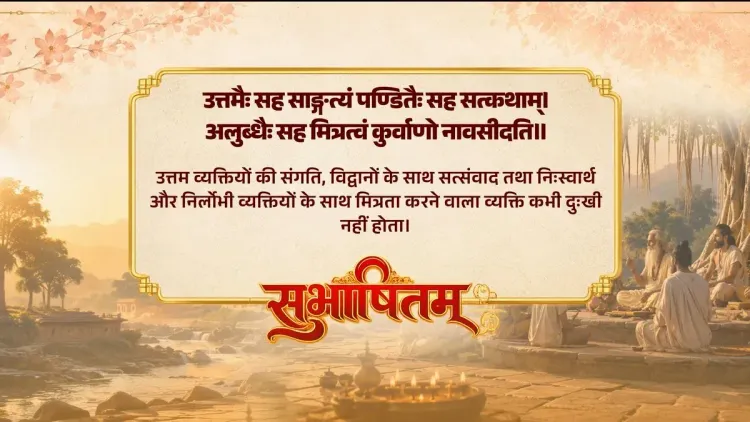
The verse, rendered in Sanskrit, reads: 'Uttamaih saha sangatyam panditaih saha satkatham. Alubdhaih saha mitratam kurvanno navasidati' — meaning, roughly, 'One who keeps the company of the virtuous, engages in noble discourse with the learned, and forges friendship with the ungreedy never comes to grief.' The message is unambiguous: the quality of one's associations shapes the quality of one's life.
A classical teaching on the architecture of character
The shloka belongs to a tradition of Sanskrit subhashitas — 'well-spoken' aphoristic verses — that distil ethical philosophy into compact, memorable form. The verse identifies three pillars: satsang (company of the virtuous), satkatha (noble discourse), and friendship with those free from greed (alubdha). Together, they form a guardrail against moral and material ruin — a framework as practical today as it was when first composed.
Modi's recurring turn to Sanskrit in public communication
This post fits a documented pattern in Prime Minister Modi's public communication style. He has periodically shared Sanskrit verses, classical proverbs, and references to ancient Indian texts on social media, framing them as living wisdom rather than museum pieces. The practice reflects a broader emphasis on cultural heritage that has been a consistent thread in his public persona across more than a decade in national politics. The choice of Sanskrit — a language that carries both sacred and scholarly weight in India — amplifies the register of the message beyond the everyday.
No specific policy event or occasion was attached to the post. The verse stands on its own — a quiet, deliberate reminder, in the Prime Minister's own words through an ancient poet's, that who we walk with determines where we end up.
Point of View
Virtue, and freedom from greed, he projects values without entering the daily political fray. It is soft power deployed inward: aimed at shaping the cultural mood of his follower base rather than making a policy argument. The consistency of this practice over years suggests it is a considered communication strategy, not an occasional flourish.
NationPress
25 Aug 2026
Frequently Asked Questions
What Sanskrit verse did PM Modi post on 25 August 2026?
PM Modi posted the shloka 'Uttamaih saha sangatyam panditaih saha satkatham, Alubdhaih saha mitratam kurvanno navasidati', which advises keeping the company of the virtuous, engaging in learned discourse, and befriending the ungreedy as the surest path to a life free of ruin.
What does the Sanskrit shloka posted by Modi mean in English?
The verse means: one who associates with the virtuous, holds noble conversations with the learned, and makes friends with those free from greed will never come to grief — a classical Indian ethical teaching on the power of good associations.
Why does PM Modi post Sanskrit verses on social media?
Modi has a documented pattern of sharing Sanskrit shlokas and classical Indian proverbs on X as part of his emphasis on India's cultural and civilisational heritage. The practice is a consistent feature of his public communication style.
What is a Sanskrit subhashita?
A subhashita — literally 'well-spoken' in Sanskrit — is a short, aphoristic verse from the classical Indian tradition that distils ethical, philosophical, or practical wisdom into a memorable couplet or stanza.
Was the Modi Sanskrit post linked to any policy or event?
No. The post on 25 August 2026 carried no reference to a specific policy announcement, government scheme, or public event. It was shared as a standalone cultural and ethical message.