PM Modi Thanks South Korea's Lee Jae-myung for Kind Wishes
Synopsis
Prime Minister Narendra Modi on 10 July 2026 publicly thanked South Korean leader Lee Jae-myung for a message of goodwill, underscoring the personal diplomatic warmth underpinning the India-South Korea Special Strategic Partnership and the broader Act East Policy.
Key Takeaways
PM Narendra Modi responded to Lee Jae-myung on X on 10 July 2026 , calling his wishes 'thoughtful' and 'cherished'.
India and South Korea have maintained formal diplomatic relations since 1973 .
The bilateral relationship was elevated to a Special Strategic Partnership in 2015 .
The two countries signed the Comprehensive Economic Partnership Agreement (CEPA) in 2010 .
The exchange is consistent with India's Act East Policy , which prioritises deeper ties with South Korea , Japan and ASEAN .
Analysts will watch for the next India-South Korea summit or CEPA review as a venue for advancing defence and semiconductor cooperation.
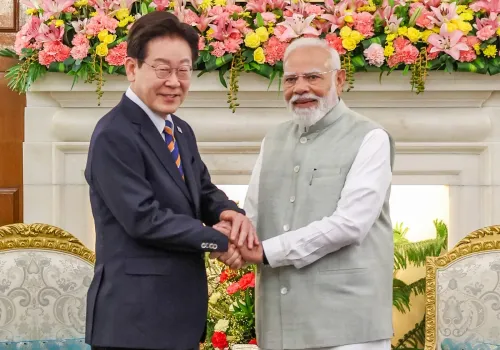
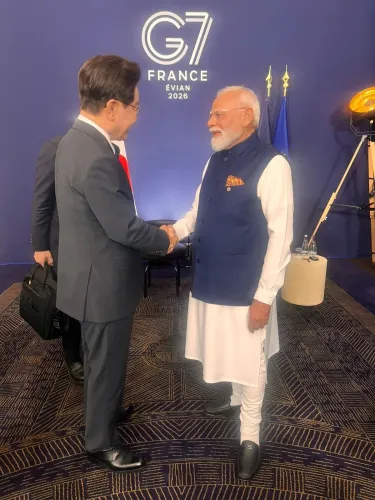
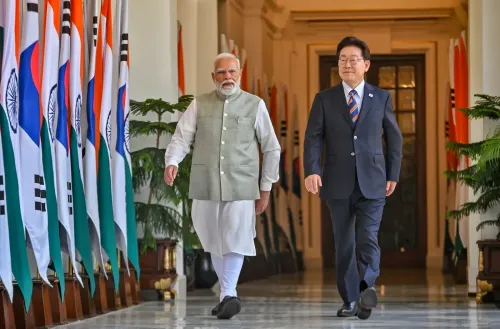
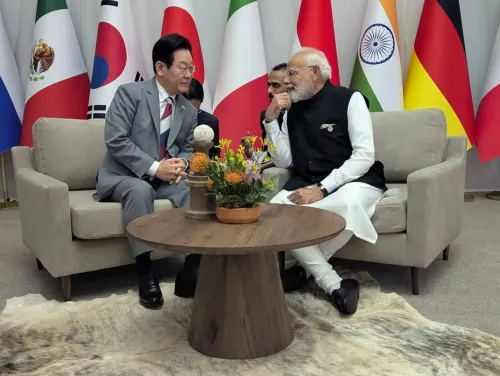
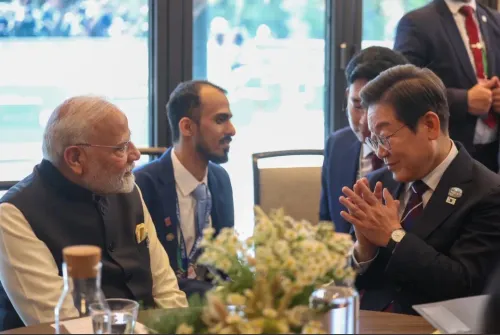
Prime Minister Narendra Modi on Friday, 10 July 2026, responded warmly to a message of goodwill from South Korean leader Lee Jae-myung, acknowledging the gesture on social media platform X and describing such exchanges as deeply valued between friends.
Posting on X, Prime Minister Modi wrote: 'Thank you President Lee Jae-myung for your kind wishes. Such thoughtful messages from friends are always cherished.' The message, directed at @Jaemyung_Lee, reflects the personal diplomatic rapport that both leaders have cultivated alongside the formal institutional ties binding the two nations.
Context
India and South Korea share a relationship that dates to the establishment of formal diplomatic ties in 1973. Over the decades, that relationship has matured from modest trade links into a Special Strategic Partnership, a designation formalised during a bilateral summit in 2015. High-level personal exchanges of this kind are a consistent feature of that partnership, reinforcing the human dimension of a relationship that is also driven by commerce and security.
Lee Jae-myung is a prominent South Korean political figure and former leader of the Democratic Party of Korea, who has engaged with Indian leadership in bilateral discussions. The specific occasion prompting his message of goodwill has not been independently confirmed.
Policy Backdrop
The diplomatic courtesy sits within the broader framework of India's Act East Policy, which seeks deeper economic, technological and security linkages with South Korea, Japan and ASEAN nations. A landmark in that architecture was the Comprehensive Economic Partnership Agreement (CEPA) signed by both countries in 2010, which expanded bilateral trade and investment flows significantly.
Routine high-level courtesies — exchanged around national days, personal milestones or diplomatic summits — are a recognised instrument for sustaining political warmth between governments. They complement formal mechanisms such as the India-Republic of Korea Joint Commission, which coordinates cooperation across trade, culture and security.
Stakeholders and Impact
Diplomatic services on both sides, as well as trade and industry bodies with interests in the India-South Korea corridor, watch such signals closely. The bilateral relationship encompasses cooperation in defence technology, semiconductors, shipbuilding and people-to-people ties, making the political temperature between the two capitals commercially significant.
South Korean investment in India spans sectors from consumer electronics to heavy industry, and Indian technology professionals and students have a growing presence in Seoul and other South Korean cities. Goodwill at the leadership level helps sustain the enabling environment for these exchanges.
What's Next
Observers will watch for the next formal India-South Korea summit or a review meeting under the CEPA framework, where the two sides are expected to explore advances in defence-industrial collaboration and semiconductor supply-chain partnerships. Personal rapport between leaders, of the kind visible in this exchange, typically eases the path for substantive outcomes at such meetings.
As India deepens its strategic footprint in East Asia, consistent diplomatic engagement with Seoul — at both the institutional and personal level — will remain a pillar of the Act East Policy for the foreseeable future.
Point of View
Signalling that New Delhi values the relationship across political lines in Seoul. It fits a consistent pattern in which the Modi government uses social media to keep bilateral warmth visible between formal summits. For South Korea, the exchange carries significance at a moment when both nations are exploring deeper defence-industrial and semiconductor ties that require sustained political will. The gesture reinforces that India's Act East Policy is as much about cultivating personal relationships with key leaders as it is about institutional frameworks.
NationPress
10 Jul 2026
Frequently Asked Questions
Why did PM Modi thank Lee Jae-myung on X?
Prime Minister Narendra Modi thanked Lee Jae-myung on X on 10 July 2026 in response to a message of goodwill that Lee had sent him, describing it as a thoughtful gesture from a friend.
What is the current status of India-South Korea relations?
India and South Korea share a Special Strategic Partnership, a status formalised in 2015, covering trade, defence technology, and people-to-people ties, underpinned by the Comprehensive Economic Partnership Agreement signed in 2010.
Who is Lee Jae-myung?
Lee Jae-myung is a prominent South Korean political figure and former leader of the Democratic Party of Korea who has engaged in bilateral discussions with Indian leadership.
What is India's Act East Policy?
India's Act East Policy is a strategic framework that seeks deeper economic, security and people-to-people linkages with South Korea, Japan and ASEAN nations, with South Korea being a key partner in trade and defence technology.
What could follow this diplomatic exchange between India and South Korea?
Observers are watching for the next India-South Korea bilateral summit or a review of the CEPA trade agreement, where both sides are expected to discuss advances in defence-industrial collaboration and semiconductor supply-chain cooperation.