PM Modi urges space startups to serve farms, schools
Synopsis
Prime Minister Narendra Modi urged Indian space startups to direct their technology toward agriculture, livestock, dairy, and environment, and to engage with Atal Tinkering Labs to build curiosity among schoolchildren — extending a decade-long policy arc linking space reform with grassroots development.
Key Takeaways
PM Modi called on space startups to apply their technology to agriculture, livestock management, dairy, and environmental monitoring.
He urged startups to actively engage with Atal Tinkering Labs to inspire curiosity among school students.
Atal Tinkering Labs were launched under the Atal Innovation Mission of NITI Aayog in 2016 to promote school-level innovation.
The IN-SPACe framework, established in 2020 , opened India's space sector to private startups for civilian applications.
ISRO satellites have long provided agricultural and environmental data; the push now is for startups to build last-mile products on that infrastructure.
Space technology, Prime Minister Narendra Modi argued on Friday, August 21, 2026, should not stay confined to orbit — it should land in the paddy field, the dairy shed, and the school lab.
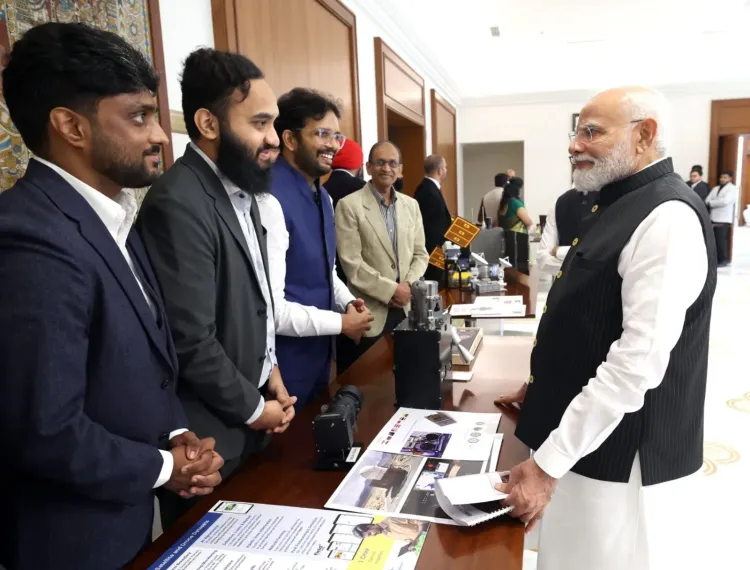
In a post on X, the Prime Minister urged Indian space startups to think beyond conventional applications and channel their capabilities toward agriculture, livestock management, dairy, and environmental monitoring — sectors that shape the daily lives of hundreds of millions. He also called on startups to actively engage with Atal Tinkering Labs, the school-level innovation hubs designed to spark curiosity among young students.
From orbit to the farm: why space tech fits agriculture
The ask is not abstract. ISRO satellites have for decades provided crop-health imagery, flood mapping, and soil-moisture data to state governments. What Modi appeared to be pushing for is the next step: private startups building affordable, last-mile products on top of that infrastructure — precision-irrigation alerts for smallholder farmers, real-time disease-detection tools for livestock herders, or emission-tracking dashboards for forest departments. The civilian space economy, unlocked by the IN-SPACe framework established in 2020, now gives private players the regulatory room to do exactly that.Atal Tinkering Labs: the pipeline Modi wants startups to feed
The second thread of the Prime Minister's message is generational. Atal Tinkering Labs, rolled out under the Atal Innovation Mission of NITI Aayog since 2016, place fabrication tools and problem-solving challenges inside school classrooms. By urging startups to engage with these labs, Modi is effectively asking today's space entrepreneurs to become mentors for tomorrow's — closing a loop between cutting-edge industry and early-stage curiosity. A child in a rural school who sees a satellite image of her own village's crop stress is a child who might one day build the sensor that generated it.A policy arc that has been building for a decade
The Prime Minister's remarks fit a consistent pattern. Since 2016, successive policy moves — the Atal Innovation Mission, the 2020 space-sector reforms, and the broader push to commercialise ISRO's capabilities — have tried to connect India's space ambitions with ground-level development challenges. What has been slower to materialise is the startup ecosystem actually delivering those applications at scale. Modi's public nudge signals that the government wants that gap closed, and wants startups to see agriculture and dairy not as peripheral markets but as core opportunities. If India's space startups take that seriously, the next breakthrough may not come from a launch pad — it may come from a sensor pinging a farmer's phone at 6 a.m.Point of View
And the attempt to build an innovation pipeline from school labs upward through the Atal Innovation Mission. By explicitly naming agriculture, dairy, and livestock — not defence or telecom — he is signalling that the government's priority use-case for private space applications is rural development, not prestige technology. The Atal Tinkering Labs link is strategically shrewd: it asks startups to invest in the next generation of talent while simultaneously generating grassroots visibility for space technology. Whether this nudge translates into formal funding calls or ministry partnerships will determine if it moves policy or stays aspiration.
NationPress
21 Aug 2026
Frequently Asked Questions
What did PM Modi say about space startups and agriculture?
PM Modi urged Indian space startups to think about how space technology can contribute to agriculture, livestock management, dairy, and environmental monitoring — sectors that directly touch everyday lives.
What are Atal Tinkering Labs?
Atal Tinkering Labs are school-level innovation hubs set up under the Atal Innovation Mission of NITI Aayog since 2016, designed to foster problem-solving and curiosity among students using hands-on tools and challenges.
What is IN-SPACe and how does it help space startups?
IN-SPACe, established in 2020, is the Indian National Space Promotion and Authorisation Centre that provides a regulatory framework allowing private startups to participate in India's space sector, including building civilian applications.
How can space technology help Indian farmers?
Space technology can support farmers through satellite-based crop-health monitoring, soil-moisture data, flood mapping, and precision-irrigation alerts — services ISRO has provided to state governments and which private startups can now extend to individual farmers.
Why is Modi asking space startups to engage with school students?
By connecting startups with Atal Tinkering Labs, Modi wants today's space entrepreneurs to mentor the next generation, building awareness of space applications among schoolchildren who could become future innovators in the sector.