Pralhad Joshi Hails India's QS Sustainability Rankings Leap

Synopsis
Union Minister Pralhad Joshi highlights QS Sustainability Rankings 2027 data showing 13 Indian universities in the global top 500 — up from five in 2023 — and 38 institutions improving their standings, linking the gains to NEP 2020 and Prime Minister Modi's sustainability agenda.
Key Takeaways
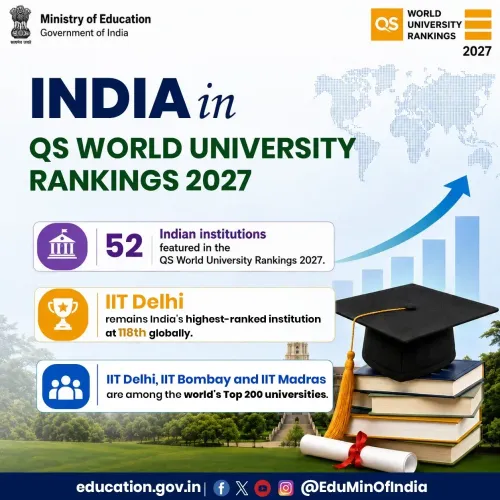
13 Indian universities now rank in the QS World University Rankings Sustainability global top 500, up from just five in 2023 .
38 Indian institutions improved their positions in the QS Sustainability 2027 edition.
Union Minister Pralhad Joshi attributed the gains to growing institutional commitment to sustainability, social responsibility and environmental stewardship.
India's National Education Policy 2020 embedded sustainability and environmental awareness as explicit goals in higher education.
The progress aligns with India's stated commitments under the UN Sustainable Development Goals .
Joshi linked the ranking improvements to Prime Minister Narendra Modi's vision for an innovation-led and responsible education ecosystem.
Thirteen Indian universities now sit inside the global top 500 for sustainability — up from just five in 2023 — and Union Consumer Affairs and New and Renewable Energy Minister Pralhad Joshi wants the country to notice. On Monday, 16 November 2026, the minister took to X to highlight India's performance in the QS World University Rankings: Sustainability 2027, calling the improvement a reflection of a deepening institutional commitment to environmental stewardship and social responsibility.
The headline figure is striking: 38 Indian institutions improved their positions in the latest sustainability edition of the QS table, while the number of universities cracking the top 500 globally has more than doubled in roughly four years. Joshi framed the progress as evidence that Indian higher education is moving in step with global sustainability benchmarks — not just keeping pace, but accelerating.From Five to Thirteen: What the Top-500 Jump Signals
The jump from five institutions in the global top 500 (2023) to thirteen is not a statistical footnote — it marks a structural shift in how Indian universities are measured and how they are choosing to present themselves internationally. QS, the UK-based higher education analytics firm, scores universities across environmental impact, social indicators and governance, making the sustainability edition a distinct and increasingly competitive table in its own right.
India's broader trajectory in QS rankings has been upward since roughly 2019, coinciding with expanded internationalisation drives and regulatory reform in the higher education sector. The sustainability edition adds a new dimension: universities are now being rewarded not just for research output or reputation, but for how responsibly they operate and what they teach about the planet's future.
NEP 2020's Sustainability Mandate and What Comes Next
The ranking gains do not exist in a policy vacuum. India's National Education Policy 2020 explicitly embedded environmental awareness and sustainable development goals into the multidisciplinary higher education framework — laying curricular groundwork that universities appear to be translating into measurable outcomes. Joshi's post directly linked the progress to Prime Minister Narendra Modi's broader vision for an education ecosystem built on 'innovation, responsibility and sustainable development.'
The alignment with India's commitments under the UN Sustainable Development Goals gives these ranking gains a diplomatic resonance beyond campus boundaries. As global climate conversations intensify, a country's university sector increasingly functions as soft-power infrastructure — and India's sustainability scorecard is improving at the right moment.
The watch item now is whether the Ministry of Education follows the momentum with concrete funding or curriculum measures tied to sustainability performance, turning a ranking headline into lasting institutional change.
Point of View
These ranking gains serve a dual purpose: they validate the education reform narrative at home while reinforcing India's soft-power credentials in global climate and development diplomacy. Joshi's decision to amplify the data publicly signals that sustainability in education is being consciously positioned as a governance achievement, not merely an academic metric. Whether the momentum translates into targeted public funding for sustainability infrastructure at universities will determine if this trajectory holds beyond the current cycle.
NationPress
16 Nov 2026
Frequently Asked Questions
How many Indian universities are in the QS Sustainability Rankings top 500 in 2027?
According to the QS World University Rankings: Sustainability 2027, 13 Indian universities are now ranked in the global top 500, up from just five in 2023.
What are the QS World University Rankings Sustainability?
The QS World University Rankings: Sustainability is an annual ranking published by UK-based higher education analytics firm QS that evaluates universities on environmental impact, social responsibility and governance performance, separate from the main QS overall rankings.
What is India's National Education Policy 2020 and how does it relate to sustainability?
The National Education Policy 2020 introduced explicit goals for multidisciplinary education, environmental awareness and sustainable development in Indian higher education institutions, providing a policy framework that universities are now translating into internationally recognised sustainability outcomes.
What did Pralhad Joshi say about Indian universities in QS rankings?
On 16 November 2026 , Union Minister Pralhad Joshi posted on X highlighting that 38 Indian institutions improved their QS Sustainability 2027 rankings and 13 entered the global top 500, attributing the progress to institutional commitment to sustainability and PM Modi's education vision.
How has India's performance in QS rankings changed since 2019?
Indian higher education institutions have recorded steady gains in multiple QS ranking tables since 2019 , coinciding with expanded internationalisation efforts and regulatory changes, with the sustainability edition showing particularly sharp improvement between 2023 and 2027.