Pralhad Joshi Highlights 11 Years of Digital India Progress
Synopsis
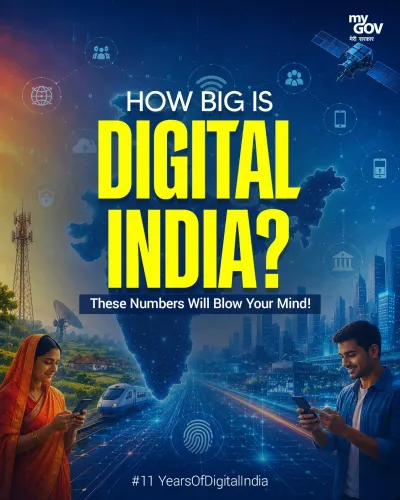
On the 11th anniversary of Digital India, Union Minister Pralhad Joshi highlighted India's growth from 25 crore to 103 crore internet connections, nearly 50% of global real-time payments, and 70-plus crore DigiLocker users, attributing the transformation to PM Modi's leadership and the Viksit Bharat vision.
Key Takeaways
Union Minister Pralhad Joshi marked the 11th anniversary of Digital India on 1 July 2026 with a post citing major connectivity and payments milestones.
India's internet connections grew from roughly 25 crore before 2014 to over 103 crore in 2026 , according to Joshi's post.
India now accounts for nearly 50 per cent of the world's real-time digital payments , underpinned by the Unified Payments Interface (UPI) launched in 2016.
DigiLocker , the government's cloud document platform, has crossed 70 crore users , and 5G coverage now extends across almost every district.
The Digital India programme was launched on 1 July 2015 as a flagship initiative to bridge the digital divide and expand e-governance.
The anniversary messaging links Digital India's gains to the government's Viksit Bharat 2047 long-term development roadmap.
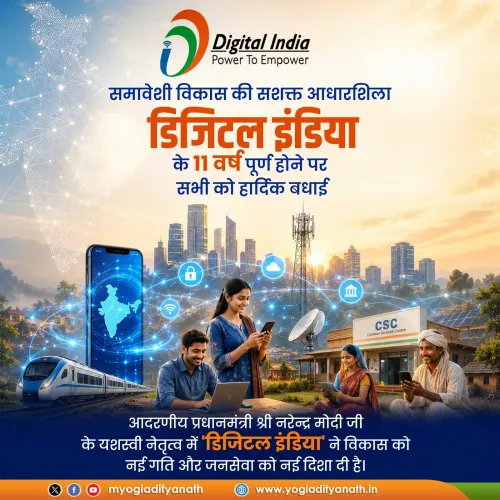
Union Consumer Affairs Minister Pralhad Joshi on Wednesday, 1 July 2026 marked the 11th anniversary of the Digital India initiative by highlighting a sweeping set of digital metrics, contrasting the country's connectivity and payments landscape today with conditions before 2014, and crediting the programme's gains to the leadership of Prime Minister Narendra Modi.
Context
Joshi's post draws a direct before-and-after comparison: India had roughly 25 crore internet connections before 2014, when digital governance was, in his words, 'still in its nascent stages.' As of 2026, he states, the country has surpassed 103 crore internet connections, with 5G coverage across almost every district. The figures, cited by the minister, frame the anniversary as a milestone in infrastructural scale rather than a policy announcement.
Joshi also cited India's share of global real-time digital payments at nearly 50 per cent and claimed more than 70 crore DigiLocker users. These numbers, attributed to the minister's post, reflect the government's stated position on the programme's reach; independent verification of the specific 2026 figures remains pending.
Policy Backdrop
The Digital India programme was formally launched on 1 July 2015 with the stated aim of bridging the digital divide, expanding broadband connectivity, and shifting government services online. It has since become the umbrella under which several large-scale platforms — including DigiLocker, the cloud-based document storage and verification service, and the Unified Payments Interface (UPI), rolled out in 2016 — were developed and scaled.
Together, these platforms form what is often described as India Stack: a layered set of open-application programming interfaces built on Aadhaar, UPI, and DigiLocker that enables government and private services to reach citizens at population scale. The National Digital Communications Policy of 2018 further accelerated broadband and 5G deployment, setting the regulatory groundwork for the connectivity numbers the minister cited.
The Digital India anniversary falls within the government's broader Viksit Bharat 2047 roadmap, which links digital transformation to long-term economic development targets ahead of the centenary of Indian independence.
Stakeholders and Impact
The most direct beneficiaries of the Digital India ecosystem are ordinary citizens who now access government documents, subsidies, and financial services through smartphones rather than physical offices. UPI in particular has reshaped everyday commerce, enabling instant bank-to-bank transfers for street vendors, small businesses, and rural households alike.
India's digital public infrastructure model has also drawn interest from other developing nations looking to replicate its scale and cost efficiency. The government has actively positioned the India Stack as an exportable governance template, adding a diplomatic dimension to what began as a domestic connectivity drive.
What's Next
Attention will now turn to the next formal Digital India progress report and whether the 2026-27 Union Budget carries supplementary allocations for digital infrastructure expansion, particularly in underserved districts where last-mile connectivity remains a challenge. The anniversary statement from a senior cabinet minister signals that Digital India will remain a centrepiece of the ruling party's governance narrative as India moves deeper into the second half of this decade.
Point of View
The party frames digital transformation as tangible, everyday progress rather than abstract infrastructure spending. The reference to Viksit Bharat 2047 also signals that Digital India is being repositioned from a standalone scheme into a long-arc national project, making it harder for any future government to dismantle without appearing to reverse measurable gains. The choice of a senior cabinet minister — rather than the IT ministry — to lead the anniversary messaging suggests a deliberate effort to broaden ownership of the programme across the government.
NationPress
1 Jul 2026
Frequently Asked Questions
When was Digital India launched and what is it?
Digital India was launched on 1 July 2015 by the Modi government to expand internet connectivity, promote e-governance, and deliver citizen services digitally. It serves as the umbrella programme for platforms like UPI and DigiLocker.
How many internet connections does India have in 2026?
According to Union Minister Pralhad Joshi's post marking the 11th anniversary of Digital India, India has over 103 crore internet connections as of 2026, up from around 25 crore before 2014.
What is India's share of global real-time digital payments?
Minister Joshi stated that India accounts for nearly 50 per cent of the world's real-time digital payments, driven largely by the Unified Payments Interface (UPI) launched in 2016.
What is DigiLocker and how many people use it?
DigiLocker is a government-run cloud platform that lets citizens store and share official documents digitally, eliminating the need for physical paperwork. Joshi cited over 70 crore users as of 2026.
What is Viksit Bharat and how does Digital India relate to it?
Viksit Bharat 2047 is the government's long-term development roadmap targeting a fully developed India by the centenary of independence. Digital India's infrastructure gains are positioned as a foundational pillar of that broader economic vision.