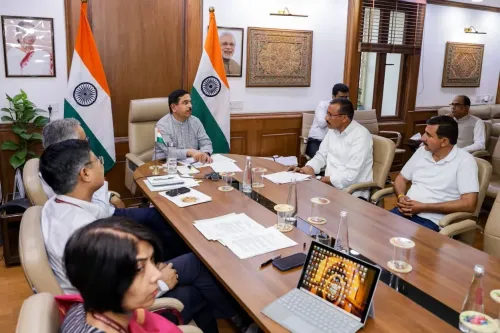
Pralhad Joshi Reviews Warehousing Act 2007 Amendment

Synopsis
Union Consumer Affairs Minister Pralhad Joshi held a review meeting on 14 July 2026 with senior Food Department officials to examine proposed amendments to the Warehousing (Development and Regulation) Act, 2007, aiming to modernise storage regulation, boost farmer incomes, and attract investment into India's warehousing sector.
Key Takeaways
Pralhad Joshi chaired a review meeting on 14 July 2026 with senior officials of the Department of Food and Public Distribution on amendments to the Warehousing (Development and Regulation) Act, 2007 .
The proposed amendment aims to build a modern, well-regulated warehousing ecosystem to complement India's expanding infrastructure.
Key objectives include enhancing farmers' incomes , attracting private investment, and positioning warehousing as a driver of economic growth and food security.
The original 2007 Act introduced negotiable warehouse receipts to help farmers access formal credit by pledging stored produce as collateral.
The specific text and scope of the proposed amendments have not yet been made public.
The next milestone is introduction of an amendment bill in Parliament and subsequent rules by the Warehousing Development and Regulatory Authority .
Union Consumer Affairs Minister Pralhad Joshi chaired a review meeting with senior officials of the Department of Food and Public Distribution on Tuesday, 14 July 2026, to examine proposed amendments to the Warehousing (Development and Regulation) Act, 2007. The minister underlined that a modern, well-regulated warehousing ecosystem is essential to complement India's expanding infrastructure, boost farmers' incomes, attract investment, and position the sector as a driver of economic growth and food security.
Context
Posting on X, Minister Joshi stated that the proposed amendment 'emphasises that a modern and well-regulated warehousing ecosystem is essential to complement India's rapidly expanding infrastructure, enhance farmers' incomes, attract investment and position the warehousing sector as a key driver of economic growth and food security.' The meeting involved senior officials of @fooddeptgoi, the nodal department overseeing foodgrain procurement, storage, and public distribution policy.
The original Warehousing (Development and Regulation) Act was enacted in 2007 to create a regulated warehousing framework, introduce negotiable warehouse receipts, and improve formal credit access for farmers and traders. Nearly two decades on, the government is now signalling a legislative refresh to align the law with contemporary infrastructure and market realities.
Policy Backdrop
The 2007 Act established the Warehousing Development and Regulatory Authority (WDRA), which registers warehouses and certifies negotiable warehouse receipts — instruments that allow farmers to pledge stored produce as collateral for loans rather than selling immediately at distress prices. The system was designed to reduce post-harvest losses and integrate smallholder farmers into formal credit markets.
Successive governments have sought to strengthen agricultural storage and marketing infrastructure as part of broader supply-chain reforms. Modernising warehousing regulation fits within the wider policy arc of reducing food wastage, attracting private logistics investment, and reinforcing national food-security objectives — themes that have gained urgency as India's cold-chain and bulk-storage capacity has expanded significantly in recent years.
Stakeholders and Impact
The proposed amendments are expected to have direct bearing on farmers, who stand to benefit from improved storage options and stronger warehouse-receipt mechanisms that can ease access to institutional credit. Private warehousing investors and logistics operators are also key stakeholders, as a more predictable regulatory environment could unlock fresh capital into the sector.
Grain traders, food-processing companies, and state-level procurement agencies that interact with the public distribution system would similarly be affected by any changes to licensing, compliance, or receipt-negotiability provisions. The ministry has not yet disclosed the specific text or scope of the proposed amendments.
What's Next
The immediate next step is the introduction of an amendment bill in Parliament, with any subsequent rules to be notified by the Warehousing Development and Regulatory Authority. The review meeting signals that the ministry is in active pre-legislative consultation, though no timeline for tabling the bill has been publicly announced.
If enacted, the amendments could reshape how India's multi-billion-rupee warehousing sector is governed, with potential knock-on effects on agricultural commodity markets, rural credit flows, and the country's overall food-security architecture.
Point of View
Reflecting the Centre's broader push to align agricultural infrastructure regulation with India's current logistics and investment landscape. The emphasis on farmer incomes alongside investor attraction is a deliberate political framing — it positions warehousing reform as both a rural welfare measure and a pro-growth economic move. Coming at a time when cold-chain and bulk-storage capacity has expanded rapidly, the proposed amendment could be the regulatory capstone that unlocks institutional capital into the sector. The outcome will depend heavily on how the bill balances compliance burdens for smaller warehouse operators against the transparency demands of large private investors.
NationPress
14 Jul 2026
Frequently Asked Questions
What is the Warehousing (Development and Regulation) Act, 2007?
The Warehousing (Development and Regulation) Act, 2007 is a central legislation that created a regulated framework for India's warehousing sector, established the Warehousing Development and Regulatory Authority (WDRA), and introduced negotiable warehouse receipts to help farmers and traders access formal credit by pledging stored commodities as collateral.
Why is the government amending the Warehousing Act?
The government is proposing amendments to modernise the nearly two-decade-old law so it can better complement India's rapidly expanding infrastructure, enhance farmers' incomes, attract private investment into the warehousing sector, and strengthen national food security.
What did Pralhad Joshi say about the warehousing amendment?
Minister Pralhad Joshi stated that the proposed amendment 'emphasises that a modern and well-regulated warehousing ecosystem is essential to complement India's rapidly expanding infrastructure, enhance farmers' incomes, attract investment and position the warehousing sector as a key driver of economic growth and food security.'
Who will be affected by changes to the Warehousing Act?
Farmers, private warehousing investors, logistics operators, grain traders, food-processing companies, and state-level procurement agencies that interact with the public distribution system are all key stakeholders who could be affected by the proposed amendments.
When will the Warehousing Act amendment bill be introduced in Parliament?
No official timeline has been announced yet. The 14 July 2026 review meeting indicates the ministry is in active pre-legislative consultation; the next step is introduction of the amendment bill in Parliament followed by rules notified by the Warehousing Development and Regulatory Authority.