Prez Murmu: Socially Responsible Doctors Can Transform Society
Synopsis
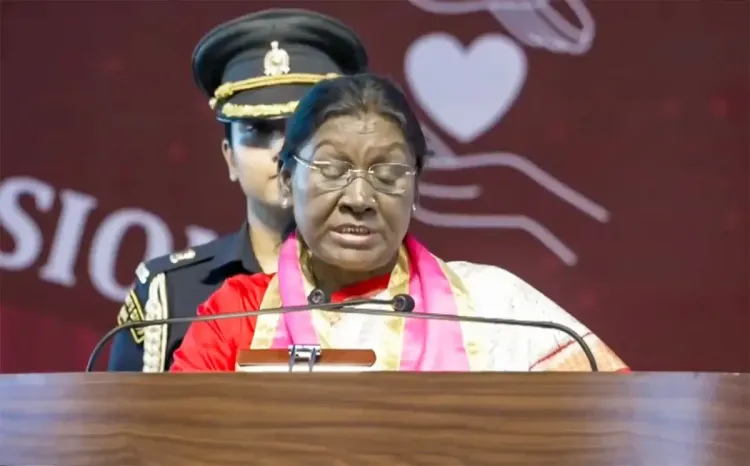
President Droupadi Murmu highlighted the crucial role of skilled and socially aware doctors during her address at the AIIMS Rajkot convocation, emphasizing their potential to create meaningful societal change through innovative healthcare practices.
Key Takeaways
Socially conscious doctors can create significant societal change.
AIIMS institutions are vital for affordable healthcare .
Good governance is crucial for institutional growth.
Empathy in medicine is irreplaceable.
Healthcare is linked to national development goals.
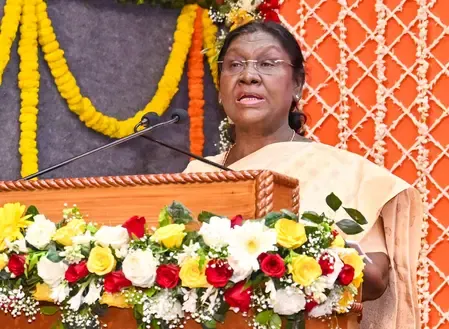
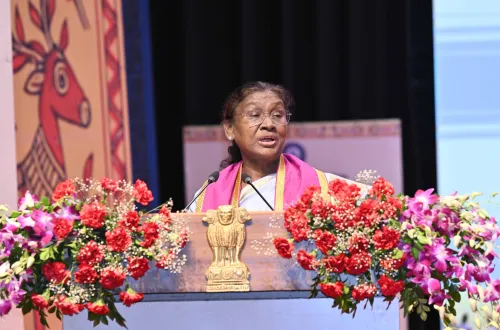
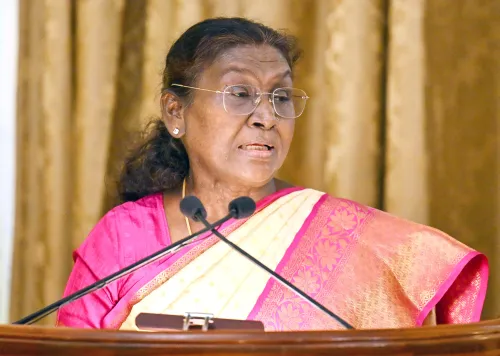
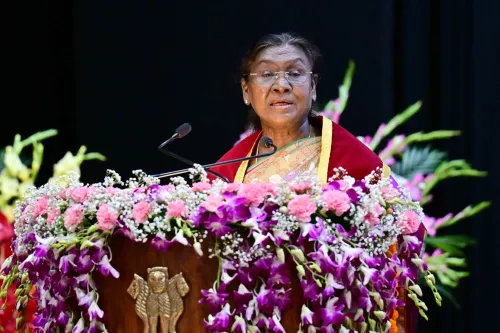
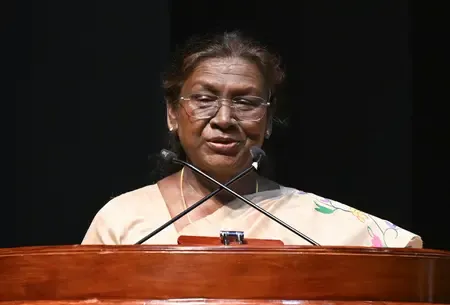
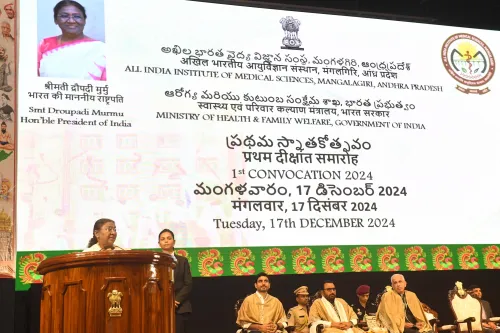
Rajkot, April 13 (NationPress) President Droupadi Murmu emphasized on Monday that skilled and socially aware doctors are capable of instigating a "profound transformation in society" during her address at the inaugural convocation ceremony of the All India Institute of Medical Sciences (AIIMS) in Rajkot, Gujarat.
While speaking to the graduating cohort, the President highlighted the establishment of multiple AIIMS facilities across India, designed to deliver world-class tertiary healthcare at reasonable prices.
She acknowledged their significant contributions to medical education, research, innovation, as well as public health initiatives and policy development.
"The dedication of AIIMS towards enhancing healthcare through innovative research and patient care is commendable," she stated.
Murmu observed that AIIMS Rajkot, being a nascent institution, has an extensive journey ahead in the realms of medical education, research, and community service.
She urged the policymakers of the institution to ensure that, in addition to fulfilling the primary objectives of AIIMS, they also focus on tackling the unique health challenges faced by the region.
She emphasized that good governance and transparency from the outset will have a lasting impact on the institution’s development.
"Good governance is crucial for the healthy evolution of any organization. Initial steps to ensure transparency and good governance will significantly influence the future of this institution," she noted.
Characterizing the medical field as a commitment to humanity, the President remarked that it requires more than just scientific expertise.
It necessitates sensitivity, patience, and humility from its practitioners.
"The medical profession is not just a job; it is a commitment to serving humanity. This field demands not only scientific knowledge but also a great deal of sensitivity, patience, and humility," she asserted.
Discussing the significance of the white coat, she remarked that it embodies the trust society bestows upon doctors in times of illness and uncertainty.
"The white coat symbolizes the faith that society places in doctors during periods of illness and uncertainty. The responsibility of preserving this trust lies firmly on the doctors' shoulders," she stated.
Murmu also spoke about the rapid technological advancements in healthcare, noting that innovations like artificial intelligence, robotics, precision medicine, and digital health services are revolutionizing the medical landscape.
"Technological progress in healthcare is accelerating at an extraordinary rate. Innovations such as artificial intelligence, robotics, precision medicine, and digital health services are swiftly changing the medical field's landscape and potential," she explained.
The President encouraged the graduates to welcome these advancements while retaining a human touch in their practice.
"By embracing the latest technologies, they will not only enhance their skills and knowledge but also treat ailments more effectively. Nonetheless, the importance of human empathy in medicine remains irreplaceable," she remarked.
"A doctor’s kind words, a reassuring smile, and the ability to truly listen can often provide healing beyond what medicine can achieve," she added.
Moreover, she stated that while becoming a competent doctor is commendable, embodying strong human values as a physician is even more significant.
"Being a good doctor is a notable achievement. However, being a doctor who embodies principles such as integrity, compassion, and a spirit of kindness is an even greater accomplishment," she expressed.
She added, "Skilled and socially conscious doctors possess the potential to enact substantial change in society. They should actively contribute to nation-building by utilizing their positions constructively."
Linking healthcare with national development objectives, Murmu asserted that public health is essential for realizing the vision of Viksit Bharat by 2047.
Murmu highlighted that the government has initiated various measures to enhance access to healthcare services, and that collaborative efforts from all stakeholders will bolster these initiatives.
"The well-being of citizens is a decisive factor in achieving the vision of Viksit Bharat by 2047. The central government has implemented numerous steps to ensure that quality healthcare services are accessible to all citizens. These initiatives are already yielding positive outcomes," she stated.
She concluded by asserting that institutions like AIIMS bear a vital responsibility in steering the country’s healthcare framework.
"Institutions of national significance, such as AIIMS, hold paramount importance. They are charged with steering the nation’s healthcare sector by setting new standards in medical research and innovation," she mentioned.
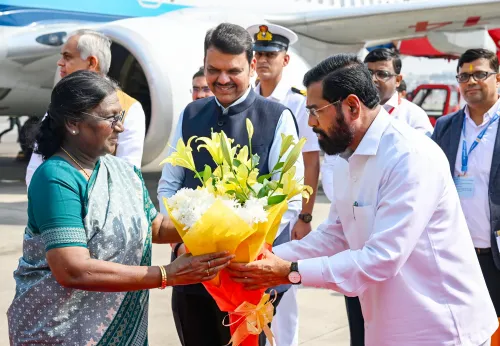
The President is on a four-day visit to Gujarat and Maharashtra from April 13 to 16.
As per the official itinerary, on April 14, she will participate in the ‘Samajik Samrasta Mahotsava’ at Lok Bhavan in Gandhinagar, commemorating the birth anniversary of Dr. B. R. Ambedkar, and will also attend the fifth convocation ceremony of Rashtriya Raksha University in the city.
Point of View
President Droupadi Murmu articulately underscored the transformative potential of doctors who are both skilled and socially aware. By linking healthcare initiatives with national development goals, she emphasized the need for a compassionate approach in medicine, setting a forward-looking vision for India's health sector.
NationPress
19 Sept 2026
Frequently Asked Questions
What did President Murmu say about the role of doctors?
President Murmu stated that skilled and socially conscious doctors have the ability to bring about profound change in society.
What is the significance of AIIMS according to President Murmu?
She highlighted AIIMS's pivotal role in medical education, research, innovation, and the provision of affordable healthcare.
How did she link healthcare to national development?
Murmu emphasized that public health is essential for achieving the vision of Viksit Bharat by 2047.
What qualities did she say are important for doctors?
She mentioned that doctors need to possess sensitivity, patience, humility, and a commitment to humanity.
What technological advancements did she mention?
President Murmu spoke about the rapid transformation in healthcare due to advancements like artificial intelligence, robotics, and digital health services.