Punjab CM Mann Deploys Mobile Labs to Fight Milk Adulteration
Synopsis
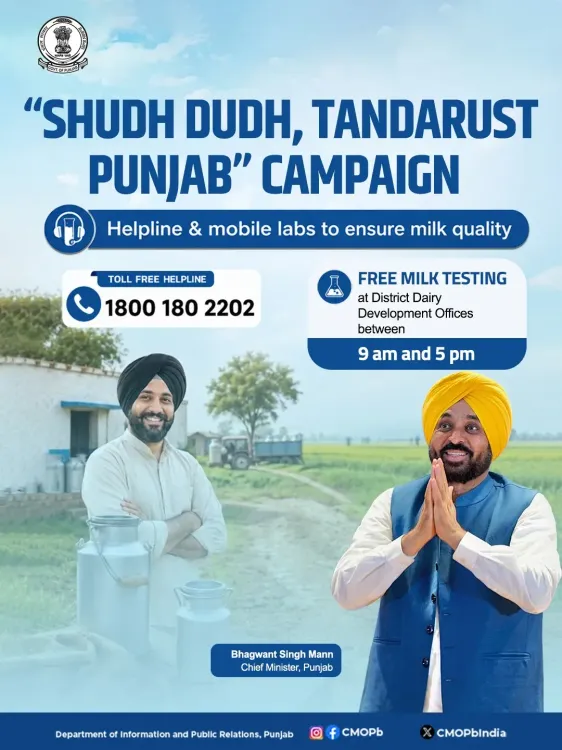
The Chief Minister's Office of Punjab announced on 8 July 2026 that CM Bhagwant Mann's government has deployed mobile testing labs, distributed instant milk-testing kits, and launched toll-free helpline 1800 180 2202 to fight adulteration — protecting consumer health and the livelihoods of honest dairy farmers across the state.
Key Takeaways
The Bhagwant Mann -led Punjab government announced a multi-pronged anti-milk-adulteration drive on 8 July 2026 .
Mobile testing laboratories have been deployed across the state to check milk quality at source and in the supply chain.
Instant testing kits have been distributed to enable rapid, on-the-spot checks outside laboratory settings.
A toll-free helpline — 1800 180 2202 — has been activated for consumers to report adulteration concerns directly.
The initiative targets both consumer health and the economic interests of honest dairy farmers undercut by adulterated supply.
The campaign operates under the hashtag #ShudhDudhTandarustPunjab ('Pure Milk, Healthy Punjab'), indicating a sustained public awareness push.
The Chief Minister's Office of Punjab announced on Wednesday, 8 July 2026 that the Bhagwant Mann-led state government has launched a multi-pronged drive to combat milk adulteration, deploying mobile testing laboratories, distributing instant testing kits, and activating a toll-free consumer helpline across the state.
Context
The official post states that adulterated milk 'compromises consumer health and hits the income of honest dairy farmers,' framing the initiative as simultaneously a public health measure and an economic safeguard for compliant producers. The government has made the toll-free number 1800 180 2202 available for direct public feedback, positioning citizens as active participants in quality enforcement.
The campaign is tagged under the hashtag #ShudhDudhTandarustPunjab — roughly translating to 'Pure Milk, Healthy Punjab' — signalling a deliberate branding effort to build public awareness around dairy safety.
Policy Backdrop
Punjab is one of India's major dairy-producing states, with a large network of smallholder farmers and cooperative structures supplying urban markets across the north. Milk adulteration — involving substances such as water, detergent, or synthetic compounds — has been a documented concern in periodic national food safety surveys, affecting both consumer health and the earnings of farmers who follow quality norms.
The legal foundation for such state-level action rests on the Food Safety and Standards Act, 2006, which established the Food Safety and Standards Authority of India (FSSAI) as the national regulatory body. States retain enforcement responsibility and may supplement central standards with their own rapid-response mechanisms, which is precisely the approach Punjab appears to be taking with mobile labs and instant kits.
Indian states have periodically deployed mobile laboratories and consumer-reporting helplines to address adulteration. Punjab's current drive fits this broader pattern of technology-enabled, state-driven food safety enforcement that works alongside — rather than replacing — central regulations.
Stakeholders and Impact
Dairy farmers stand to benefit directly: when adulterated milk undercuts market prices, honest producers lose income and competitive standing. By making adulteration harder to conceal, the initiative aims to level the playing field in the dairy supply chain.
Consumers, particularly in urban and peri-urban areas where processed and loose milk is widely purchased, gain an accessible channel to report quality concerns through the 1800 180 2202 helpline without needing to approach regulatory offices. The distribution of instant testing kits could also empower local retailers, schools, and community groups to conduct preliminary checks at the point of purchase.
Chief Minister Bhagwant Mann, who has led Punjab since March 2022 under the Aam Aadmi Party, has positioned this initiative within a wider agenda of welfare-oriented governance and regulatory reform in the state.
What's Next
The effectiveness of the initiative will ultimately be measured by data on testing volumes, detection rates, and enforcement actions taken against adulterators — none of which have been released at this stage. Analysts and farmer groups are likely to watch for follow-up disclosures on how many samples have been tested and what proportion failed quality checks.
If the mobile lab and helpline model proves effective in the dairy sector, it could provide a template for similar rapid-response mechanisms in other food categories, extending the state's food safety infrastructure beyond milk. For now, the Punjab government's public communication signals a commitment to keeping the issue in the public eye under the #ShudhDudhTandarustPunjab campaign.
Point of View
Citizen-facing tools — helplines, mobile units, branded campaigns — to demonstrate regulatory intent on everyday consumer issues. By twinning the health argument with the economic grievance of honest farmers, the government broadens the political coalition behind the initiative beyond urban consumers to rural dairy households. The toll-free number is a particularly telling choice: it creates a direct feedback loop that bypasses bureaucratic layers and generates a visible metric of public engagement. Whether the initiative translates into measurable reductions in adulteration will depend on enforcement follow-through, which remains the traditional weak link in India's food safety architecture.
NationPress
7 Oct 2026
Frequently Asked Questions
What is the Punjab government doing to stop milk adulteration?
The Punjab government under CM Bhagwant Mann has deployed mobile testing laboratories, distributed instant testing kits, and launched a toll-free helpline at 1800 180 2202 where consumers can report adulteration concerns directly.
What is the toll-free number for reporting adulterated milk in Punjab?
The toll-free number is 1800 180 2202 , set up by the Punjab government to allow consumers to report milk quality issues and provide direct feedback to authorities.
What is the #ShudhDudhTandarustPunjab campaign?
#ShudhDudhTandarustPunjab — meaning 'Pure Milk, Healthy Punjab' — is the official hashtag campaign launched by the Chief Minister's Office of Punjab to raise public awareness about milk adulteration and the government's enforcement measures.
How does milk adulteration affect dairy farmers in Punjab?
When adulterated milk enters the market at lower prices, honest dairy farmers who follow quality standards lose income and competitive standing. The Punjab government's initiative aims to protect their livelihoods by making adulteration harder to conceal.
What law governs milk adulteration enforcement in India?
The Food Safety and Standards Act, 2006 provides the national legal framework, with the FSSAI setting standards. State governments like Punjab are responsible for on-ground enforcement and may deploy additional mechanisms such as mobile labs and consumer helplines.