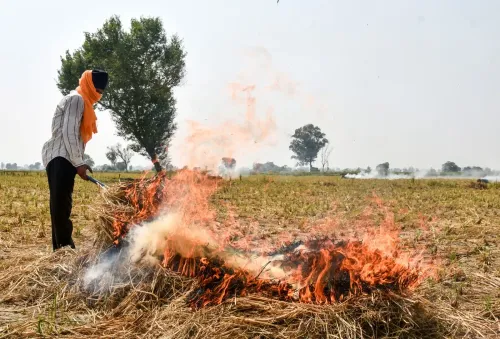
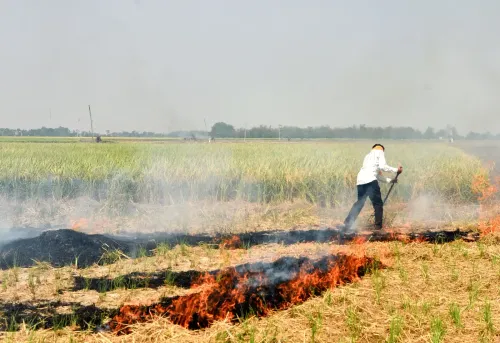
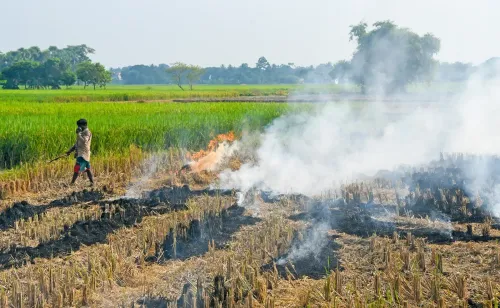
Punjab stubble burning: 5,517 incidents recorded, Ferozepur tops with 728 cases
Synopsis
Punjab has logged 5,517 stubble-burning incidents with the paddy season nearly over — and 96.65% of fields already harvested. Ferozepur leads all districts with 728 cases, while Patiala has issued the most warnings statewide. With ₹85.90 lakh in fines imposed but less than half recovered, the gap between enforcement action and actual deterrence remains Punjab's stubble-burning dilemma.
Key Takeaways
Punjab has recorded 5,517 stubble-burning incidents as of 11 November 2026 , per the Punjab Pollution Control Board (PPCB) .
Ferozepur leads all districts with 728 cases, followed by Tarn Taran (687) , Sangrur (628) , Bathinda (499) , and Patiala (374) .
Authorities have imposed ₹85.90 lakh in Environmental Compensation fines; only ₹37.55 lakh has been recovered so far.
1,259 FIRs have been registered and 1,637 red entries made in revenue records across the state.
96.65% of Punjab's 32.87 lakh hectares of paddy area has been harvested, with the season nearing its close.
Patiala has issued 390 warnings and show-cause notices — the highest among all Punjab districts.
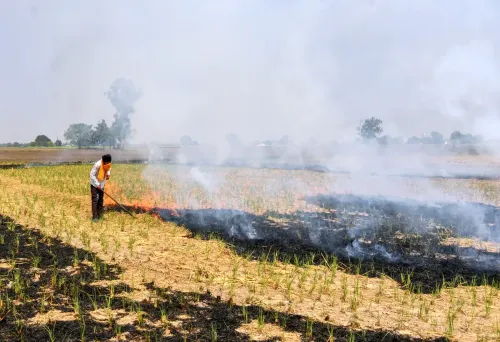
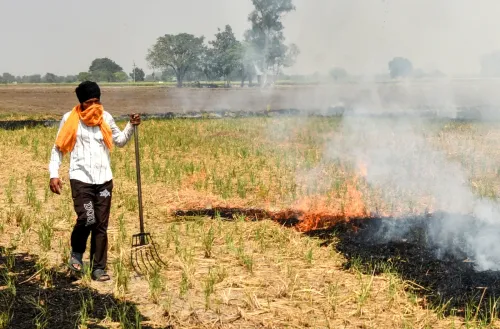
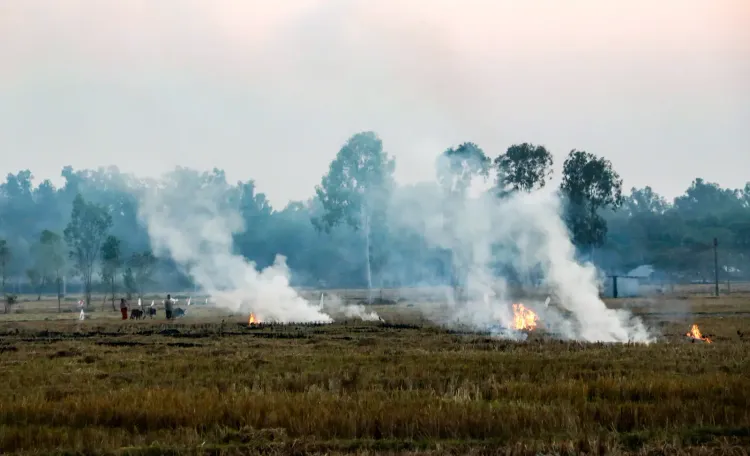
Punjab has recorded 5,517 stubble-burning incidents so far this paddy harvesting season, according to the latest data from the Punjab Pollution Control Board (PPCB), with Ferozepur district leading the state with 728 confirmed cases. The figures, current as of Wednesday, 11 November 2026, come as North India continues to battle dangerously elevated air pollution levels.
District-wise Breakdown
Among the districts reporting the highest number of incidents, Ferozepur tops the list with 728 cases. Tarn Taran follows closely with 687 incidents, while Sangrur has recorded 628 cases. Bathinda stands fourth with 499 incidents, and Patiala rounds out the top five with 374 cases. This clustering across central and southwestern Punjab reflects the region's dense concentration of paddy cultivation.
Harvesting Season Progress
According to the PPCB report, 96.65 per cent of Punjab's total paddy area of 32.87 lakh hectares has been harvested to date. In Patiala alone, approximately 98 per cent of its paddy area — measuring 2.314 lakh hectares — has already been harvested, yet the district has still reported 374 burning incidents, underscoring the persistence of the practice even as the season nears its end.
Enforcement Action Taken
Authorities have inspected 4,620 fields across Punjab, with physical verification of reported incidents completed at 2,003 locations. Fines totalling ₹85.90 lakh have been imposed as 'Environmental Compensation' (EC), of which ₹37.55 lakh has been recovered so far. First Information Reports (FIRs) have been registered in 1,259 cases, and 'red entries' have been recorded in revenue records in 1,637 cases. Authorities have additionally issued 1,435 warnings and show-cause notices to those allegedly involved.
Patiala's Enforcement Profile
In Patiala, officials have inspected 282 fields and completed physical verification at 184 locations. Environmental Compensation fines worth ₹6.70 lakh have been imposed, with ₹2.60 lakh recovered. The district has registered 153 FIRs and recorded 120 red entries. Notably, Patiala has issued 390 warnings and show-cause notices — the highest figure among all districts in the state. Three fields in Patiala have been confirmed as stubble-burning sites by non-Agriculture Field Level (non-AFL) officials; across Punjab, 147 such fields have been identified in total.
Wider Context and What Comes Next
Stubble burning in Punjab and neighbouring Haryana has long been identified as a primary seasonal contributor to hazardous air quality in the Delhi-NCR region and across the Indo-Gangetic Plain. Despite years of financial incentives for in-situ residue management and legal penalties, enforcement gaps have meant that the practice persists at scale annually. This is the third consecutive year in which Punjab has attempted a stricter, fine-and-FIR-led enforcement regime. With harvesting now nearly complete, the PPCB is expected to publish a final season-end tally within days. Continued monitoring and faster recovery of pending Environmental Compensation dues will be a key indicator of whether this year's enforcement push translates into lasting deterrence.
Point of View
517-case tally with barely half the fines recovered tells a familiar story: enforcement in Punjab's stubble-burning crackdown remains more visible on paper than on the ground. Red entries and FIRs are blunt instruments — they punish after the fact but do not change the economics that make burning cheaper than hiring residue-management equipment for small and marginal farmers. What the PPCB data does not capture is how much of the remaining unharvested 3.35% will also go up in flames in the final days of the season. With Delhi's air quality index already in the severe zone, every additional field fire carries a public health cost that falls disproportionately on urban populations far from where the decision to burn is made.
NationPress
12 Nov 2026
Frequently Asked Questions
How many stubble-burning incidents have been recorded in Punjab this season?
Punjab has recorded 5,517 stubble-burning incidents as of 11 November 2026 , according to the Punjab Pollution Control Board (PPCB). The figures cover the ongoing paddy harvesting season, during which over 96% of the state's paddy area has already been harvested.
Which district in Punjab has the most stubble-burning cases?
Ferozepur leads all districts in Punjab with 728 stubble-burning cases. It is followed by Tarn Taran (687), Sangrur (628), Bathinda (499), and Patiala (374).
What enforcement action has Punjab taken against stubble burning?
Authorities have inspected 4,620 fields , registered 1,259 FIRs , and imposed fines of ₹85.90 lakh as Environmental Compensation, of which ₹37.55 lakh has been recovered. Additionally, 1,637 red entries have been recorded in revenue records and 1,435 warnings and show-cause notices have been issued.
Why does stubble burning in Punjab matter for air quality?
Stubble burning in Punjab and neighbouring Haryana is a major seasonal contributor to hazardous air pollution across North India, particularly in the Delhi-NCR region. The smoke from burning crop residue significantly worsens air quality indices during October and November each year.
What is the status of paddy harvesting in Punjab?
96.65 per cent of Punjab's total paddy area of 32.87 lakh hectares has been harvested as of 11 November 2026 . In Patiala alone, approximately 98 per cent of its 2.314 lakh hectares of paddy area has been harvested.