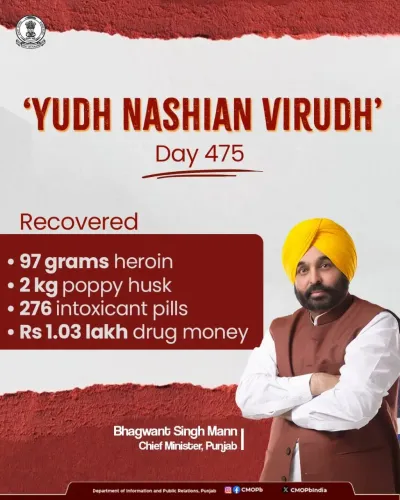
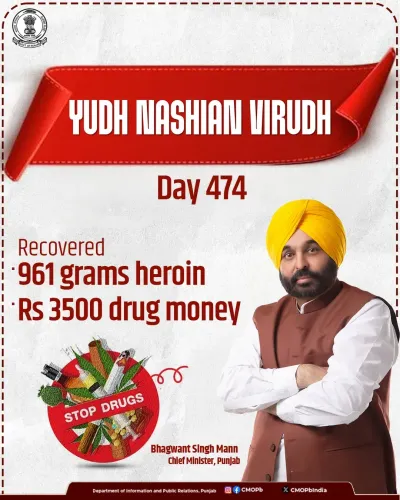
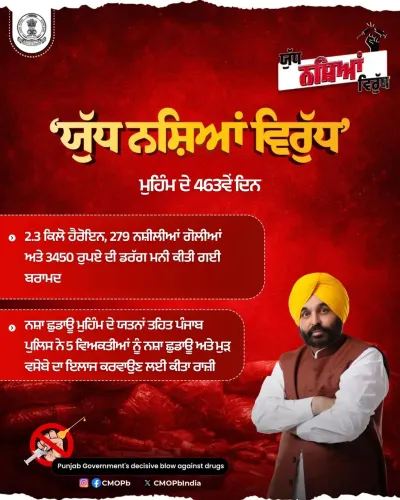
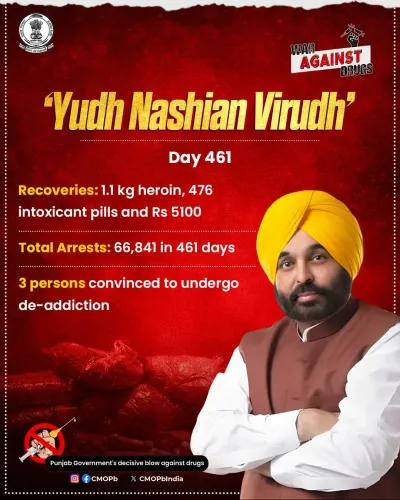
Punjab Police Arrests 69,201 Drug Smugglers in 476-Day Drive
Synopsis
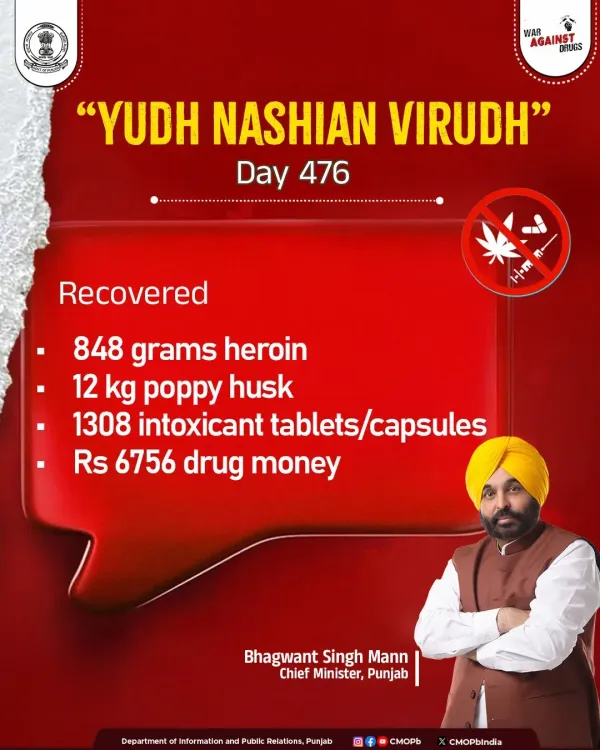
Punjab Police's 'Yudh Nashian Virudh' anti-drug campaign completed its 476th day on June 21, 2026, with cumulative arrests reaching 69,201 drug smugglers. Day 476 saw seizures of 848 g heroin, 12 kg poppy husk, 1,308 intoxicant tablets and Rs 6,756 in drug money, the Chief Minister's Office of Punjab announced.
Key Takeaways
The Yudh Nashian Virudh campaign completed its 476th consecutive day on June 21, 2026 .
Cumulative arrests of drug smugglers under the campaign have reached 69,201 .
Day 476 seizures included 848 grams of heroin , 12 kg of poppy husk , and 1,308 intoxicant tablets/capsules .
Rs 6,756 in drug money was also recovered from arrested smugglers on the day.
The campaign was launched by the AAP government under Chief Minister Bhagwant Mann after he took office in March 2022 .
Punjab's drug supply problem is linked to the Golden Crescent corridor and has persisted across multiple state governments.
The Chief Minister's Office of Punjab announced on Sunday, June 21, 2026, that the state police's sustained anti-drug campaign Yudh Nashian Virudh ('War Against Drugs') has entered its 476th consecutive day, with cumulative arrests of drug smugglers reaching 69,201. Day 476's operations alone yielded seizures of 848 grams of heroin, 12 kg of poppy husk, 1,308 intoxicant tablets and capsules, and Rs 6,756 in drug money.
Context
The Yudh Nashian Virudh campaign is a daily, rolling police operation launched by the Aam Aadmi Party (AAP) government in Punjab after Chief Minister Bhagwant Mann took office in March 2022. The drive made anti-narcotics enforcement one of its earliest and most visible governance priorities, with the CMO publishing daily updates on arrests and seizures. Sunday's update quoted the official post: 'Police teams have continued its drive against drugs Yudh Nashian Virudh for 476th day… the number of total drug smugglers arrested has reached to 69,201 in 476 days.'
Punjab borders Pakistan and sits along supply corridors linked to the Golden Crescent — the Afghanistan-Iran-Pakistan narcotics production belt — making it one of India's most drug-affected states. Heroin and poppy-husk abuse have been documented across border districts for decades, spanning multiple state governments.
Policy Backdrop
The AAP administration's enforcement-heavy approach continues a pattern seen in earlier Punjab governments, which also ran periodic anti-narcotics sweeps and published aggregate policing statistics. Between 2015 and 2017, the previous Shiromani Akali Dal–BJP government conducted similar operations following a state-wide survey that highlighted high addiction rates among youth. What distinguishes the current campaign is its unbroken daily cadence and the practice of maintaining a running cumulative count of arrests.
The state has paired enforcement with de-addiction centres and awareness programmes, though the CMO's public communications have focused primarily on policing outputs — arrest tallies, seizure weights, and drug money recovered — as the primary metric of progress.
Stakeholders and Impact
The most direct stakeholders are Punjab's border villages, where drug availability has historically been highest, and the state's youth population, which anti-drug advocates have long identified as the demographic most vulnerable to addiction. Seizures of synthetic drugs — reflected in Sunday's figure of 1,308 intoxicant tablets and capsules — signal that the supply threat is not limited to traditional opiates such as heroin and poppy husk.
For Punjab Police, the campaign represents a significant operational commitment: maintaining daily raids, processing arrests, and managing an evidence and case load that has now crossed 69,000 accused persons. Legal observers and civil-society groups have noted that the downstream challenge lies in the courts, where case disposal rates and eventual conviction outcomes will determine whether the enforcement effort translates into durable deterrence.
What's Next
Analysts watching the campaign will focus on conviction rates and case disposal data from courts handling the 69,000-plus arrests, which will provide a clearer picture of the drive's long-term effectiveness beyond arrest numbers. Potential coordination between Punjab Police and central agencies on border security and precursor chemical control remains a key policy question. As the campaign moves deeper into its second year, pressure is likely to grow on the government to supplement policing statistics with outcome data — including addiction prevalence trends and rehabilitation throughput — to demonstrate that enforcement is producing measurable public-health results.
Point of View
Converting policing activity into a visible governance scorecard. Crossing the 69,000-arrest milestone in under 16 months is a significant enforcement output, but the campaign's political durability will hinge on whether courts can process this volume of cases and deliver convictions at scale. Punjab's drug crisis has outlasted multiple enforcement drives across governments, suggesting that policing alone — without measurable reductions in addiction prevalence — risks becoming a metric of activity rather than impact. The shift from daily arrest tallies to outcome-based reporting, including de-addiction throughput and recidivism data, will be the real test of whether this campaign breaks the historical pattern.
NationPress
21 Jun 2026
Frequently Asked Questions
What is Yudh Nashian Virudh?
'Yudh Nashian Virudh' is a sustained anti-drug campaign run by Punjab Police under the AAP government of Chief Minister Bhagwant Mann, launched after he took office in March 2022. The drive conducts daily raids targeting drug smugglers and publishes cumulative arrest and seizure statistics.
How many drug smugglers have been arrested in Punjab's anti-drug drive?
As of day 476 of the Yudh Nashian Virudh campaign on June 21, 2026, the total number of drug smugglers arrested has reached 69,201, according to the Chief Minister's Office of Punjab.
What drugs were seized on day 476 of the Punjab anti-drug campaign?
On the 476th day of the campaign, Punjab Police recovered 848 grams of heroin, 12 kg of poppy husk, 1,308 intoxicant tablets and capsules, and Rs 6,756 in drug money from arrested smugglers.
Why is Punjab particularly affected by drug trafficking?
Punjab shares a border with Pakistan and lies along supply routes connected to the Golden Crescent — the Afghanistan-Iran-Pakistan narcotics production zone — making it one of India's most drug-affected states. Heroin and poppy-husk abuse have been documented across border districts for decades.
What happens to drug smugglers arrested under Yudh Nashian Virudh?
Arrested accused are processed through the criminal justice system and their cases are heard in courts. Legal observers note that conviction rates and case disposal speed are key indicators of the campaign's long-term effectiveness, given the large volume of over 69,000 arrests.