Punjab Police Raids 446 Locations on Day 132 of Anti-Gang Drive

Synopsis
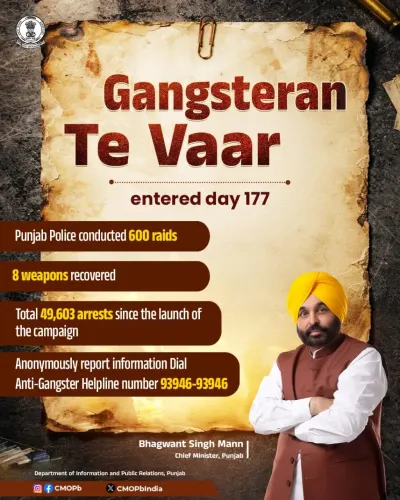
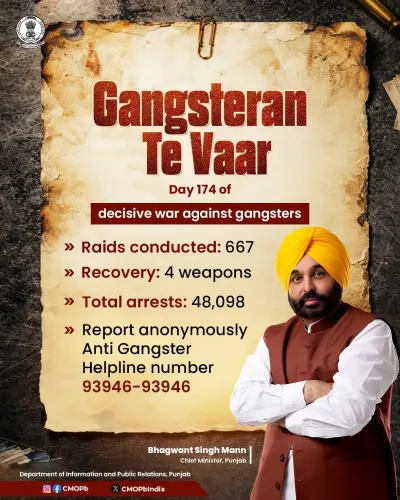
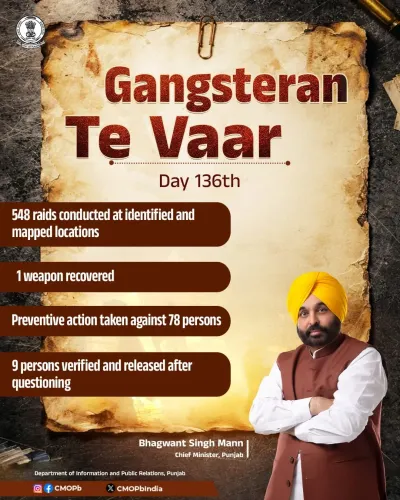
On the 132nd day of Punjab's 'Gangsteran Te Vaar' campaign, police raided 446 mapped locations linked to gangster associates statewide, recovering one weapon and pushing cumulative arrests to 33,119. The CMO Punjab announced the update on June 2, 2026.
Key Takeaways
446 raids were conducted simultaneously across identified and mapped locations linked to gangster associates in Punjab on June 2, 2026 .
The operation marked the 132nd day of the ongoing 'Gangsteran Te Vaar' (War on Gangsters) campaign.
Cumulative arrests since the campaign's launch have reached 33,119 , with at least one weapon recovered in the latest round.
The campaign uses pre-mapped, intelligence-driven targeting of gangster associates — not just active criminals — across the state.
At current pace, the campaign is averaging over 250 arrests per day , placing substantial demand on Punjab's detention and judicial systems.
The Chief Minister's Office of Punjab is maintaining a daily public disclosure cadence, framing enforcement metrics as a governance accountability tool.
The Chief Minister's Office of Punjab announced on Tuesday, June 2, 2026, that Punjab Police conducted simultaneous raids on 446 identified and mapped locations linked to gangster associates across the state, marking the 132nd day of the ongoing 'Gangsteran Te Vaar' (War on Gangsters) campaign.
Police teams arrested individuals during the operation, with one weapon recovered, pushing the campaign's cumulative arrest tally to 33,119 since its launch. The CMO's post, shared in both Punjabi and English, described the campaign as 'faislakunn muhim' (decisive campaign), underscoring the state government's framing of the drive as a sustained, data-led offensive.
Context
Punjab has historically contended with organised criminal networks tied to drug trafficking, extortion, and cross-border syndicates. The 'Gangsteran Te Vaar' campaign was launched by the state government as a structured, intelligence-driven initiative to dismantle these networks by targeting not just active gangsters but their wider support ecosystem — associates, logistics providers, and shelter networks. The use of 'identified and mapped' locations signals a departure from reactive policing toward a pre-planned, data-intensive enforcement model. Each day's raids are coordinated across multiple police districts simultaneously, a logistical undertaking that reflects significant central coordination from the Punjab Police headquarters.Policy Backdrop
Post-2022 state elections, the Aam Aadmi Party government in Punjab made law-and-order — particularly anti-gangster and anti-drug enforcement — a centrepiece of its governance agenda. Successive administrations in the state have launched periodic crackdowns, but the current campaign is notable for its daily public reporting cadence, which serves both an operational and a communicative function. The practice of publishing daily arrest and raid tallies through official government channels is part of a broader pattern seen across Indian states using transparency in enforcement metrics as a governance signal. At 33,119 arrests over 132 days, the campaign is averaging over 250 arrests per day — a scale that places significant pressure on the state's detention, prosecution, and judicial infrastructure.Stakeholders and Impact
For Punjab residents — particularly in districts with documented gang activity such as Amritsar, Ludhiana, and Bathinda — the campaign represents a visible state presence in areas previously marked by intimidation and criminal impunity. Community members, traders, and transport operators who have faced extortion demands stand to benefit most directly from sustained enforcement. Gangster associates and their networks face compounding pressure as the campaign's mapping approach systematically narrows the operational space available to them. However, civil liberties observers and legal aid organisations have previously flagged concerns in similar campaigns about the risk of wrongful detention when enforcement operates at high volume and speed. For Punjab Police itself, the campaign is a reputational exercise as much as an operational one — the force has faced scrutiny over alleged links between some officers and criminal networks in prior years, and the public accountability of daily disclosures serves as an internal discipline mechanism.What's Next
The state government and police leadership are expected to continue daily updates as the campaign progresses beyond its 132nd day. Analysts and opposition parties will likely scrutinise conviction rates and trial progress for those arrested, since a high arrest count without corresponding judicial outcomes would blunt the campaign's long-term deterrent effect. Legislative and judicial infrastructure — including fast-track courts and enhanced prosecution capacity — will determine whether the campaign translates into durable disruption of organised crime in Punjab, or remains primarily a policing statistic.Point of View
119 arrests in 132 days, the campaign's scale is striking, but the real test will be conviction rates: high-volume arrests without judicial follow-through historically produce diminishing deterrence in organised crime contexts. The 'mapped locations' framing signals an intelligence-led shift from reactive policing, which, if genuine, represents a structural upgrade in how Punjab handles gang networks. Sustaining that institutional capacity beyond the campaign's political lifecycle will be the harder challenge for the state.
NationPress
24 Sept 2026
Frequently Asked Questions
What is the 'Gangsteran Te Vaar' campaign in Punjab?
'Gangsteran Te Vaar' (War on Gangsters) is an ongoing Punjab Police campaign that conducts coordinated raids on locations linked to gangsters and their associates across the state, with daily updates published by the Chief Minister's Office.
How many arrests have been made in Punjab's anti-gangster campaign?
As of June 2, 2026 — the campaign's 132nd day — total arrests have reached 33,119 since the drive's launch.
How many raids did Punjab Police conduct on June 2, 2026?
Punjab Police conducted 446 raids at pre-identified and mapped locations linked to gangster associates across the state on that day.
Which government launched the Gangsteran Te Vaar campaign in Punjab?
The campaign is being run under the current Punjab state government, with the Chief Minister's Office serving as the primary public communication channel for daily operational updates.
What does 'mapped locations' mean in Punjab Police raids?
'Mapped locations' refers to addresses and premises pre-identified through intelligence gathering as linked to gangster networks, allowing police to conduct coordinated, simultaneous raids rather than reactive, case-by-case operations.